Maiwald Stephanie, Sivapalaratnam Suthesh, Motazacker Mahdi M, van Capelleveen Julian C, Bot Ilze, de Jager Saskia C, van Eck Miranda, Jolley Jennifer, Kuiper Johan, Stephens Jonathon, Albers Cornelius A, Vosmeer C Ruben, Kruize Heleen, Geerke Daan P, van der Wal Allard C, van der Loos Chris M, Kastelein John J P, Trip Mieke D, Ouwehand Willem H, Dallinga-Thie Geesje M, Hovingh G Kees
Department of Vascular Medicine, Academic Medical Centre, Amsterdam, the Netherlands; Department of Experimental Vascular Medicine, Academic Medical Centre, Amsterdam, the Netherlands.
Department of Vascular Medicine, Academic Medical Centre, Amsterdam, the Netherlands.
PLoS One. 2014 May 30;9(5):e98289. doi: 10.1371/journal.pone.0098289. eCollection 2014.
Genetic factors explain a proportion of the inter-individual variation in the risk for atherosclerotic events, but the genetic basis of atherosclerosis and atherothrombosis in families with Mendelian forms of premature atherosclerosis is incompletely understood. We set out to unravel the molecular pathology in a large kindred with an autosomal dominant inherited form of premature atherosclerosis.
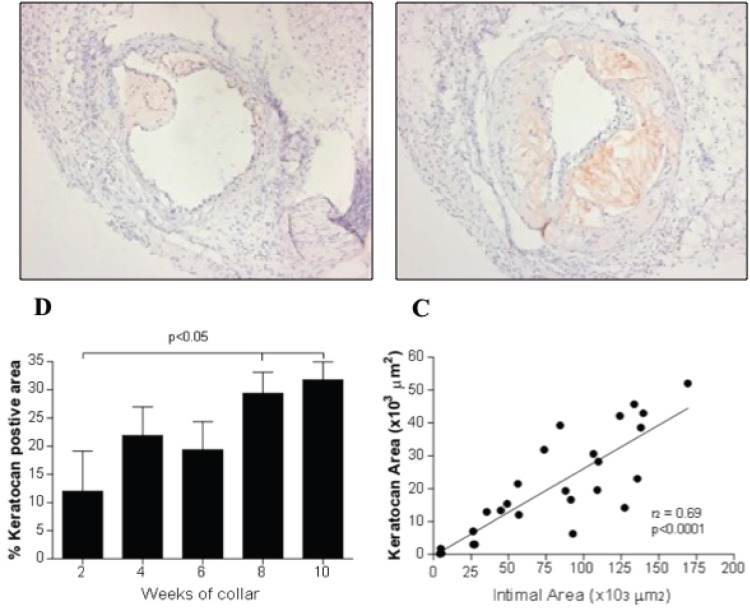
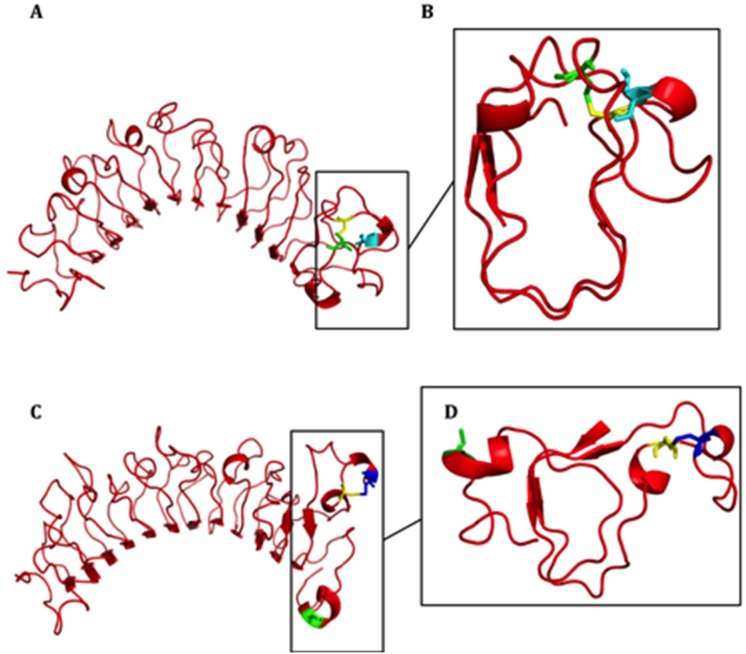
Parametric linkage analysis was performed in a pedigree comprising 4 generations, of which a total of 11 members suffered from premature vascular events. A parametric LOD-score of 3.31 was observed for a 4.4 Mb interval on chromosome 12. Upon sequencing, a non-synonymous variant in KERA (c.920C>G; p.Ser307Cys) was identified. The variant was absent from nearly 28,000 individuals, including 2,571 patients with premature atherosclerosis. KERA, a proteoglycan protein, was expressed in lipid-rich areas of human atherosclerotic lesions, but not in healthy arterial specimens. Moreover, KERA expression in plaques was significantly associated with plaque size in a carotid-collar Apoe-/- mice (r2 = 0.69; p<0.0001).
A rare variant in KERA was identified in a large kindred with premature atherosclerosis. The identification of KERA in atherosclerotic plaque specimen in humans and mice lends support to its potential role in atherosclerosis.
遗传因素可解释动脉粥样硬化事件风险个体间差异的一部分,但孟德尔式早发动脉粥样硬化家族中动脉粥样硬化和动脉粥样硬化血栓形成的遗传基础尚未完全明确。我们着手在一个具有常染色体显性遗传早发动脉粥样硬化形式的大家族中阐明分子病理学。
在一个包含4代人的家系中进行参数连锁分析,其中共有11名成员患有早发血管事件。在12号染色体上一个4.4 Mb的区间观察到参数对数优势分数为3.31。测序后,在KERA基因中鉴定出一个非同义变体(c.920C>G;p.Ser307Cys)。在近28,000名个体中未发现该变体,包括2,571例早发动脉粥样硬化患者。KERA是一种蛋白聚糖蛋白,在人类动脉粥样硬化病变的富含脂质区域表达,但在健康动脉标本中不表达。此外,在颈动脉环Apoe-/-小鼠中,斑块中的KERA表达与斑块大小显著相关(r2 = 0.69;p<0.0001)。
在一个早发动脉粥样硬化的大家族中鉴定出KERA基因的一个罕见变体。在人和小鼠的动脉粥样硬化斑块标本中鉴定出KERA,支持了其在动脉粥样硬化中的潜在作用。