Department of Biological Chemistry, Faculty of Agriculture and the Department of Applied Molecular Bioscience, Graduate School of Medicine, Yamaguchi University , Yamaguchi , Japan.
Departments of Bacteriology and Medical Microbiology/Immunology, University of Wisconsin-Madison , Madison, WI , USA.
PeerJ. 2014 May 20;2:e395. doi: 10.7717/peerj.395. eCollection 2014.
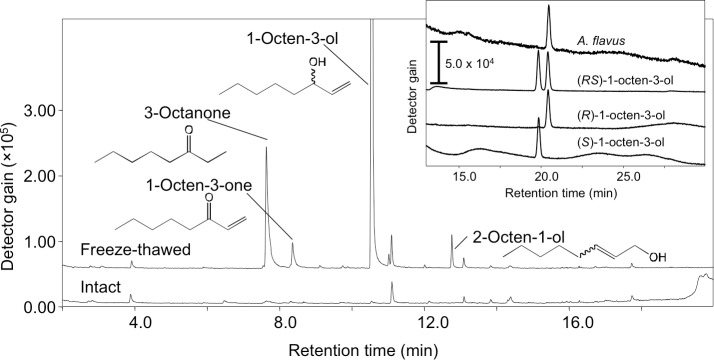
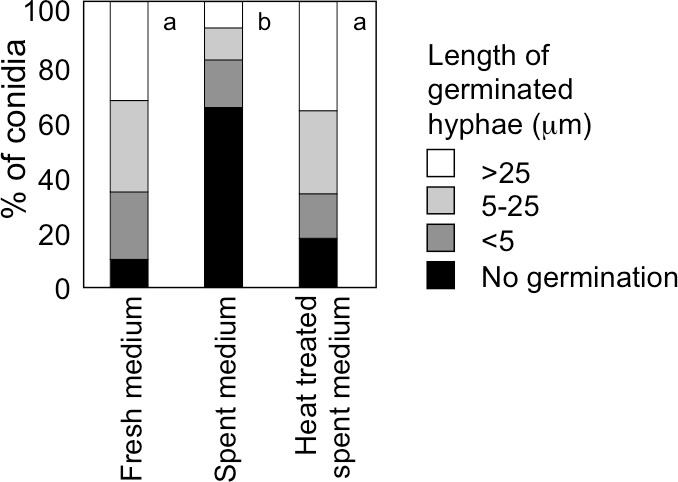
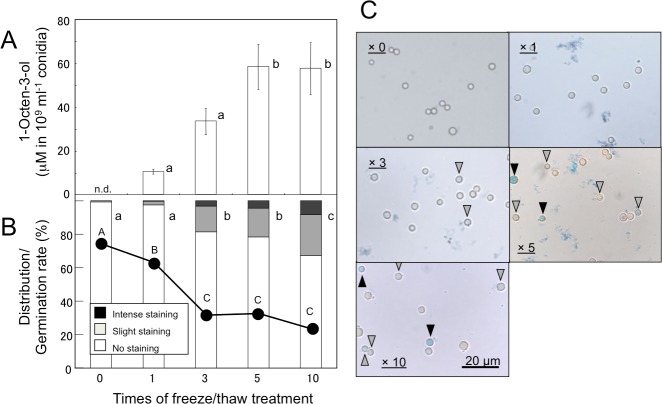
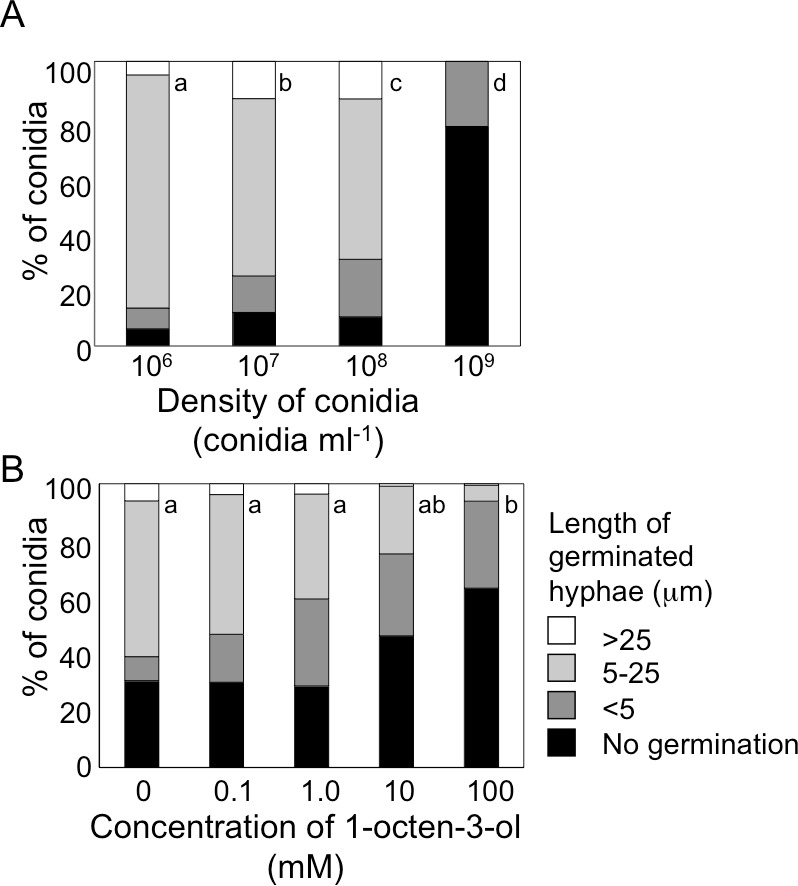
Eight-carbon (C8) volatiles, such as 1-octen-3-ol, are ubiquitous among fungi. They are the volatiles critical for aroma and flavor of fungi, and assumed to be signals controlling germination of several fungi. In this study, we found that intact Aspergillus flavus conidia scarcely synthesized C8 volatiles but repeated freeze-thaw treatment that made the cell membrane permeable promoted (R)-1-octen-3-ol formation. Loss or down regulation of any one of five fatty acid oxygenases (PpoA, PpoB, PpoC, PpoD or lipoxygenase) hypothesized contribute to 1-octen-3-ol formation had little impact on production of this volatile. This suggested that none of the oxygenases were directly involved in the formation of 1-octen-3-ol or that compensatory pathways exist in the fungus. Germination of the conidia was markedly inhibited at high density (1.0 × 10(9)spores mL(-1)). It has been postulated that 1-octen-3-ol is an autoinhibitor suppressing conidia germination at high density. 1-Octen-3-ol at concentration of no less than 10 mM was needed to suppress the germination while the concentration of 1-octen-3-ol in the suspension at 1.0 × 10(9) mL(-1) was under the detection limit (<1 µM). Thus, 1-octen-3-ol was not the principal component responsible for inhibition of germination. Instead, it was evident that the other heat-labile factor(s) suppressed conidial germination.
八碳(C8)挥发物,如 1-辛烯-3-醇,在真菌中普遍存在。它们是真菌香气和风味的关键挥发性物质,被认为是控制几种真菌萌发的信号。在这项研究中,我们发现完整的黄曲霉分生孢子几乎不合成 C8 挥发物,但反复的冻融处理使细胞膜通透性增强,促进了(R)-1-辛烯-3-醇的形成。假设任何一种脂肪酸加氧酶(PpoA、PpoB、PpoC、PpoD 或脂氧合酶)的缺失或下调都有助于 1-辛烯-3-醇的形成,但对这种挥发性物质的产生几乎没有影响。这表明这些加氧酶都没有直接参与 1-辛烯-3-醇的形成,或者真菌中存在补偿途径。在高密度(1.0×10(9)个孢子 mL(-1))下,分生孢子的萌发明显受到抑制。有人假设 1-辛烯-3-醇是一种自动抑制剂,抑制高密度下的分生孢子萌发。需要至少 10mM 的 1-辛烯-3-醇才能抑制萌发,而在 1.0×10(9)mL(-1)的悬浮液中 1-辛烯-3-醇的浓度低于检测限(<1µM)。因此,1-辛烯-3-醇不是抑制萌发的主要成分。相反,很明显是其他不耐热的因子抑制了分生孢子的萌发。