Ju Wei, Zhang Meili, Petrus Michael, Maeda Michiyuki, Pise-Masison Cynthia A, Waldmann Thomas A
Lymphoid Malignancies Branch, Center for Cancer Research, National Cancer Institute, NIH, 10 Center Drive, Building 10, Room 4 N115, Bethesda, MD 20892-1374, USA.
Retrovirology. 2014 Jun 2;11:43. doi: 10.1186/1742-4690-11-43.
Adult T-cell leukemia/lymphoma (ATL) is an aggressive malignancy of CD4+CD25+ lymphocytes caused by human T-cell lymphotropic virus type 1. While much progress has been made in understanding the mechanisms of cellular dysregulation, the prognosis for aggressive ATL still remains poor. Therefore, new therapeutic approaches need to be developed.
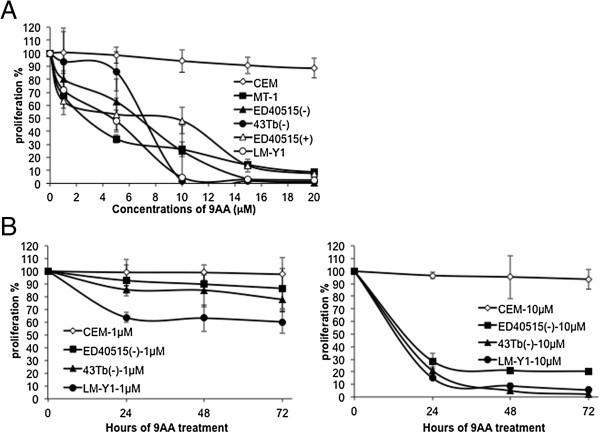
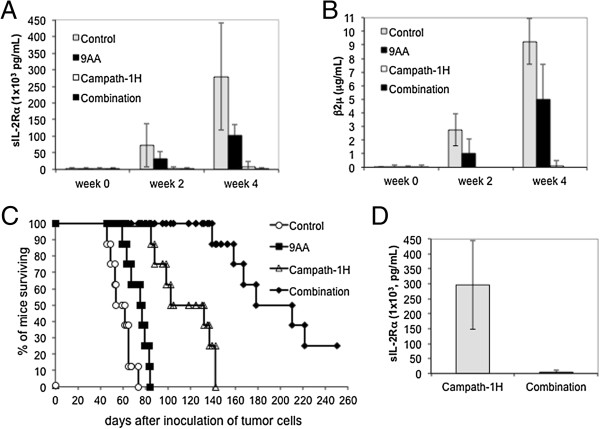
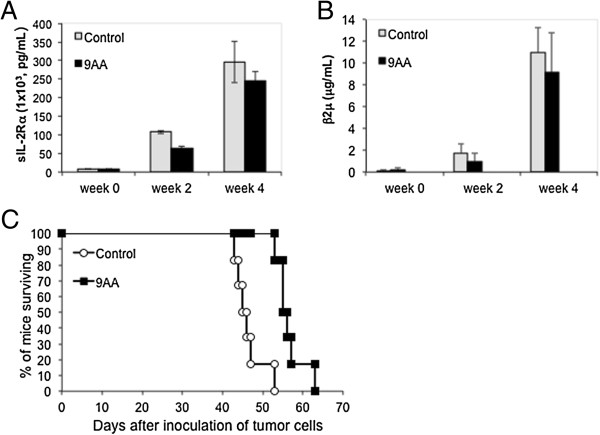
Previously, we demonstrated that the viral protein Tax inactivates p53 in HTLV-1-infected T-cells. Here we show that 9-aminoacridine (9AA) through p53 reactivation and NF-κB inhibition has selective toxicity for infected leukemic cells independent of their p53 status. We further demonstrate that 9AA activates caspase-3/7 resulting in PARP cleavage. Next we investigated the efficacy of 9AA in the MET-1 ATL model. Alone, 9AA did not cause significant drops in surrogate tumor markers, soluble IL-2Rα or β2-micorglobulin (β2μ) levels with only a slight increase in survival of MET-1-bearing mice. However, in combination with Campath-1H, 9AA treatment resulted in low soluble IL-2Rα and β2μ levels at 2 and 4 weeks. Consistent with reduced tumor cell burden, combination treatment significantly increased survival of MET-1-bearing mice compared to mice treated with either drug alone. Splenic cells isolated from 9AA or combination treated mice showed increased p53 protein levels and transcriptional activity. Consistent with increased tumor suppressor activity, we found increased PARP-1 cleavage in 9AA and combination treated cells.
Our results indicate that targeting reactivation of p53 and inhibition of NF-κB with acridine-derivatives in combination with other chemotherapeutics could result in increased efficacy and selective killing of tumor cells.
成人T细胞白血病/淋巴瘤(ATL)是由1型人类嗜T细胞病毒引起的CD4+CD25+淋巴细胞的侵袭性恶性肿瘤。虽然在理解细胞失调机制方面已取得很大进展,但侵袭性ATL的预后仍然很差。因此,需要开发新的治疗方法。
此前,我们证明病毒蛋白Tax可使HTLV-1感染的T细胞中的p53失活。在此我们表明,9-氨基吖啶(9AA)通过p53再激活和NF-κB抑制对受感染的白血病细胞具有选择性毒性,而与它们的p53状态无关。我们进一步证明9AA激活caspase-3/7,导致PARP裂解。接下来,我们研究了9AA在MET-1 ATL模型中的疗效。单独使用时,9AA不会导致替代肿瘤标志物、可溶性IL-2Rα或β2-微球蛋白(β2μ)水平显著下降,携带MET-1的小鼠的存活率仅略有增加。然而,与Campath-1H联合使用时,9AA治疗在2周和4周时导致可溶性IL-2Rα和β2μ水平降低。与肿瘤细胞负担减轻一致,联合治疗与单独使用任何一种药物治疗的小鼠相比,显著提高了携带MET-1的小鼠的存活率。从9AA或联合治疗的小鼠中分离的脾细胞显示p53蛋白水平和转录活性增加。与肿瘤抑制活性增加一致,我们发现9AA和联合治疗的细胞中PARP-1裂解增加。
我们的结果表明,用吖啶衍生物靶向p53再激活和NF-κB抑制并与其他化疗药物联合使用,可能会提高疗效并选择性杀死肿瘤细胞。