Vegter Stefan, Tolley Keith
University of Groningen, Department of Pharmacy, Groningen, the Netherlands; Vegter Health Economic Research, Groningen, the Netherlands.
Tolley Health Economics Consultancy Ltd, Buxton, United Kingdom.
PLoS One. 2014 Jun 3;9(6):e96829. doi: 10.1371/journal.pone.0096829. eCollection 2014.
Several treatments are available for actinic keratosis (AK) on the face and scalp. Most treatment modalities were compared to placebo and therefore little is known on their relative efficacy.
To compare the different treatments for mild to moderate AK on the face and scalp available in clinical practice in Europe.
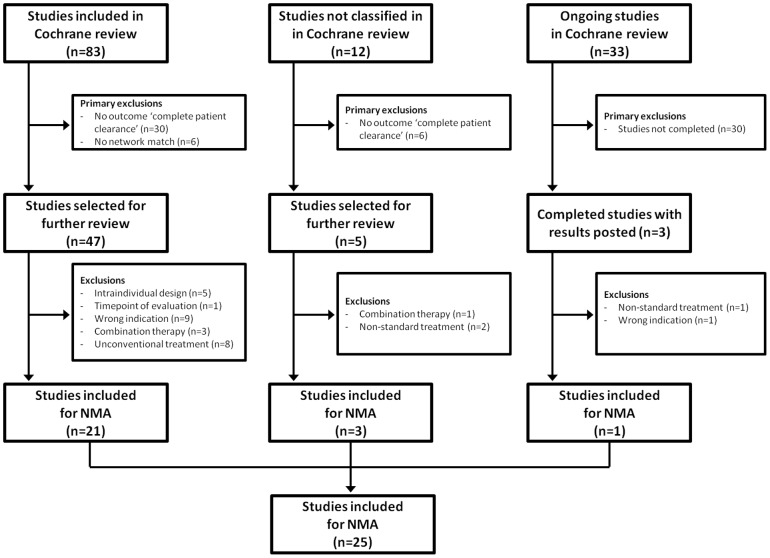
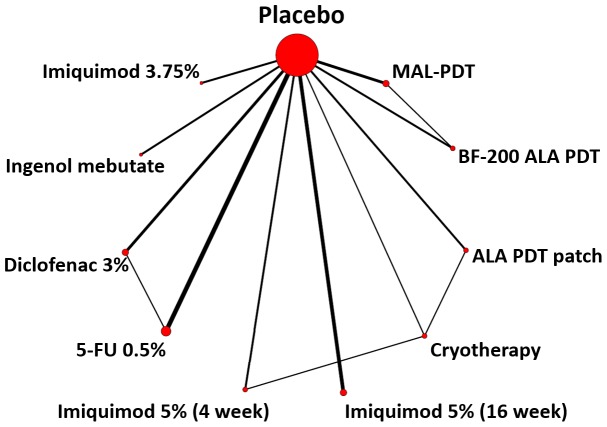
A network meta-analysis (NMA) was performed on the outcome "complete patient clearance". Ten treatment modalities were included: two 5-aminolaevulinic acid photodynamic therapies (ALA-PDT), applied as gel (BF-200 ALA) or patch; methyl-aminolevulinate photodynamic therapy (MAL-PDT); three modalities with imiquimod (IMI), applied as a 4-week or 16-week course with 5% imiquimod, or a 2-3 week course with 3.75% imiquimod; cryotherapy; diclofenac 3% in 2.5% hyaluronic acid; 0.5% 5-fluorouracil (5-FU); and ingenol mebutate (IMB). The only data available for 5% 5-FU was from one small study and was determined to be too limited to be reliably included in the analysis. For BF-200 ALA and MAL-PDT, data from illumination with narrow-band lights were selected as these are typically used in clinical practice. The NMA was performed with a random-effects Bayesian model.
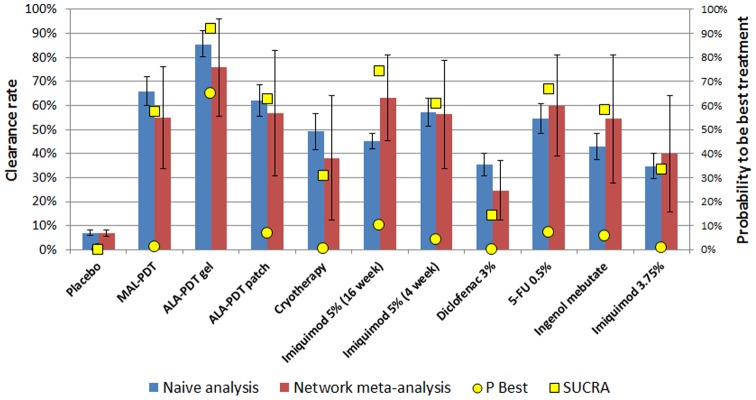
25 trials on 5,562 patients were included in the NMA. All active treatments were significantly better than placebo. BF-200 ALA showed the highest efficacy compared to placebo to achieve total patient clearance. BF-200 ALA had the highest probability to be the best treatment and the highest SUCRA score (64.8% and 92.1%), followed by IMI 5% 4 weeks (10.1% and 74.2%) and 5-FU 0.5% (7.2% and 66.8%).
This NMA showed that BF-200 ALA, using narrow-band lights, was the most efficacious treatment for mild to moderate AK on the face and scalp. This analysis is relevant for clinical decision making and health technology assessment, assisting the improved management of AK.
面部和头皮的光化性角化病(AK)有多种治疗方法。大多数治疗方式都与安慰剂进行了比较,因此对它们的相对疗效了解甚少。
比较欧洲临床实践中可用于治疗面部和头皮轻度至中度AK的不同治疗方法。
对“患者完全清除”这一结果进行网络荟萃分析(NMA)。纳入了十种治疗方式:两种5-氨基酮戊酸光动力疗法(ALA-PDT),分别以凝胶(BF-200 ALA)或贴片形式应用;甲基氨基酮戊酸光动力疗法(MAL-PDT);三种咪喹莫特(IMI)治疗方式,分别为使用5%咪喹莫特进行为期4周或16周的疗程,或使用3.75%咪喹莫特进行为期2 - 3周的疗程;冷冻疗法;2.5%透明质酸中含3%双氯芬酸;0.5% 5-氟尿嘧啶(5-FU);以及鬼臼毒素酯(IMB)。5% 5-FU的唯一可用数据来自一项小型研究,被判定过于有限,无法可靠地纳入分析。对于BF-200 ALA和MAL-PDT,选择了窄带光照射的数据,因为这些在临床实践中通常会使用。NMA采用随机效应贝叶斯模型进行。
NMA纳入了25项针对5562例患者的试验。所有积极治疗均显著优于安慰剂。与安慰剂相比,BF-200 ALA在实现患者完全清除方面显示出最高疗效。BF-200 ALA成为最佳治疗方法的概率最高,SUCRA评分也最高(分别为64.8%和92.1%),其次是5%咪喹莫特4周疗程(10.1%和74.2%)以及0.5% 5-FU(7.2%和66.8%)。
该NMA表明,使用窄带光的BF-200 ALA是治疗面部和头皮轻度至中度AK最有效的方法。该分析对于临床决策和卫生技术评估具有参考价值,有助于改善AK的管理。