Department of Ophthalmology and Visual Science, Eye, Ear, Nose, and Throat Hospital, School of Shanghai Medicine, Fudan University, 83 Fenyang Road, Shanghai 200031, China.
Diagn Pathol. 2014 Jun 3;9:105. doi: 10.1186/1746-1596-9-105.
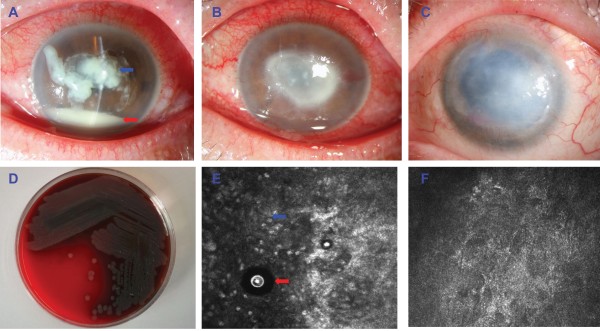
A 56-year-old woman with a history of disposable soft contact lens wear was referred to our university eye center for a corneal ulcer. Based on the microbial culture, the initial diagnosis was bacterial keratitis, which was unresponsive to topical fortified antibiotics. The patient was then examined using in vivo confocal microscopy, which revealed Acanthamoeba infection. This case emphasizes the need to suspect Acanthamoeba infection in soft contact lens wearers who present with progressive ulcerative keratitis or progressively worsening corneal ulcers that are not responsive to the usual antimicrobial therapy. It is also important to consider the possibility of a coinfection with bacterial and Acanthamoeba species.
The virtual slide(s) for this article can be found here: http://www.diagnosticpathology.diagnomx.eu/vs/5168343391150859.
一名 56 岁女性,有佩戴一次性软性隐形眼镜的历史,因角膜溃疡被转至我们大学眼科中心。根据微生物培养结果,最初诊断为细菌性角膜炎,局部使用强化抗生素治疗后无反应。随后对患者进行了活体共聚焦显微镜检查,结果显示为棘阿米巴感染。本病例强调,对于软性隐形眼镜佩戴者,出现进行性溃疡性角膜炎或对常规抗菌治疗反应不佳的进行性恶化性角膜溃疡时,应怀疑棘阿米巴感染。还需要考虑细菌和棘阿米巴属同时感染的可能性。
本文的虚拟幻灯片可在此处找到:http://www.diagnosticpathology.diagnomx.eu/vs/5168343391150859。