Kawamura Kunio, Takahashi Tetsuya, Kanazawa Masato, Igarashi Hironaka, Nakada Tsutomu, Nishizawa Masatoyo, Shimohata Takayoshi
Department of Neurology, Brain Research Institute, Niigata University, Niigata, Japan.
Department of Center for Integrated Human Brain Science, Brain Research Institute, Niigata University, Niigata, Japan.
PLoS One. 2014 Jun 4;9(6):e98639. doi: 10.1371/journal.pone.0098639. eCollection 2014.
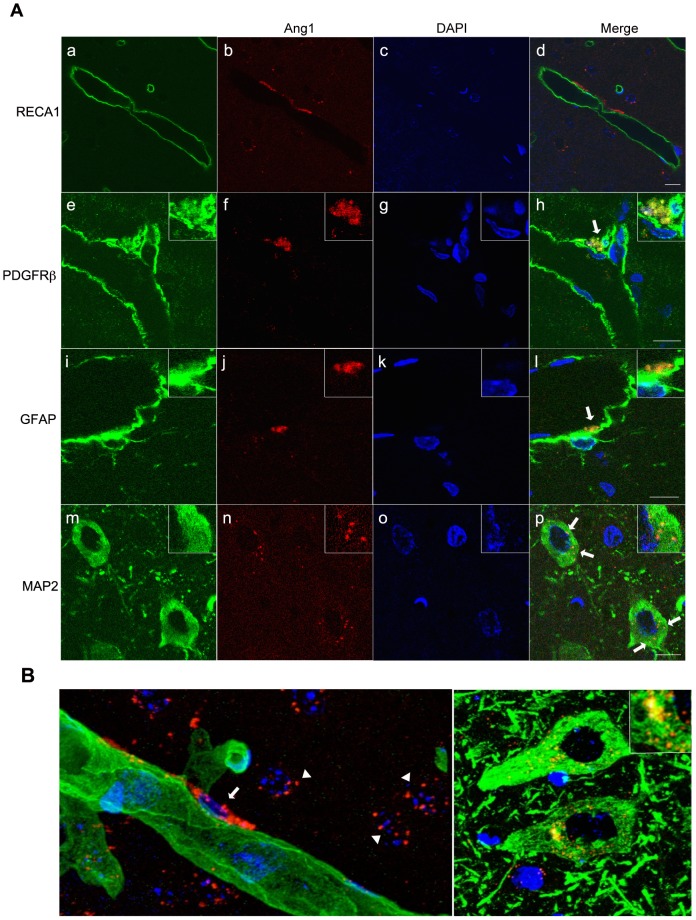
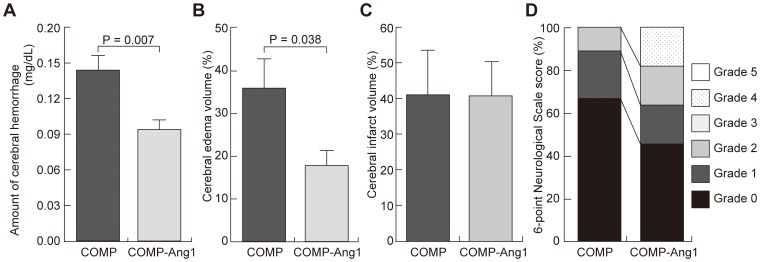
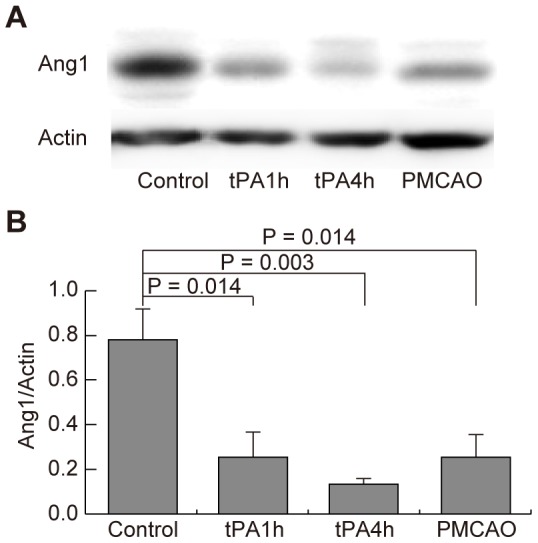
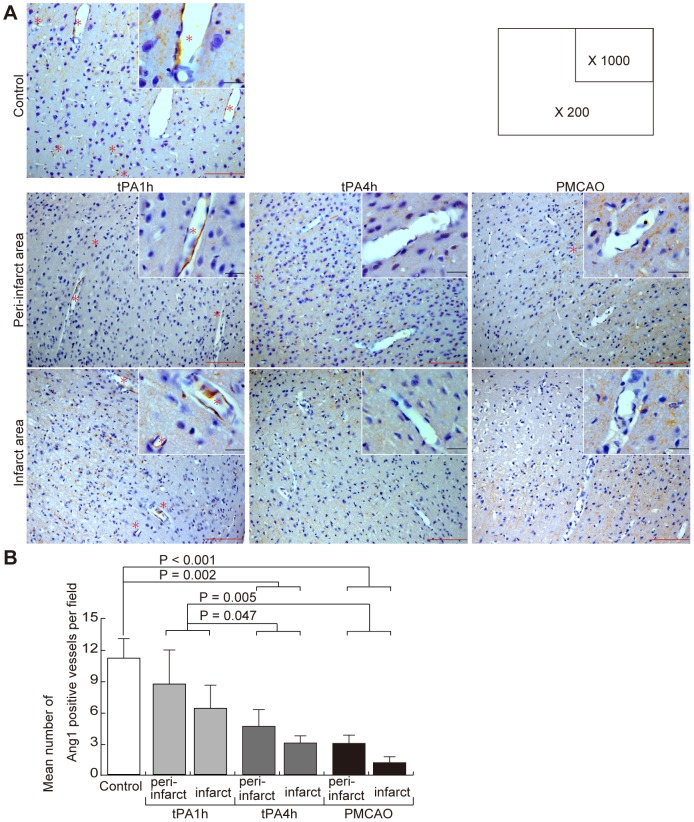
An angiogenesis factor, angiopoietin-1 (Ang1), is associated with the blood-brain barrier (BBB) disruption after focal cerebral ischemia. However, whether hemorrhagic transformation and cerebral edema after tissue plasminogen activator (tPA) treatment are related to the decrease in Ang1 expression in the BBB remains unknown. We hypothesized that administering Ang1 might attenuate hemorrhagic transformation and cerebral edema after tPA treatment by stabilizing blood vessels and inhibiting hyperpermeability. Sprague-Dawley rats subjected to thromboembolic focal cerebral ischemia were assigned to a permanent ischemia group (permanent middle cerebral artery occlusion; PMCAO) and groups treated with tPA at 1 h or 4 h after ischemia. Endogenous Ang1 expression was observed in pericytes, astrocytes, and neuronal cells. Western blot analyses revealed that Ang1 expression levels on the ischemic side of the cerebral cortex were decreased in the tPA-1h, tPA-4h, and PMCAO groups as compared to those in the control group (P = 0.014, 0.003, and 0.014, respectively). Ang1-positive vessel densities in the tPA-4h and PMCAO groups were less than that in the control group (p = 0.002 and <0.001, respectively) as well as that in the tPA-1h group (p = 0.047 and 0.005, respectively). These results suggest that Ang1-positive vessel density was maintained when tPA was administered within the therapeutic time window (1 h), while it was decreased when tPA treatment was given after the therapeutic time window (4 h). Administering Ang1 fused with cartilage oligomeric protein (COMP) to supplement this decrease has the potential to suppress hemorrhagic transformation as measured by hemoglobin content in a whole cerebral homogenate (p = 0.007) and cerebral edema due to BBB damage (p = 0.038), as compared to administering COMP protein alone. In conclusion, Ang1 might be a promising target molecule for developing vasoprotective therapies for controlling hemorrhagic transformation and cerebral edema after tPA treatment.
一种血管生成因子,血管生成素-1(Ang1),与局灶性脑缺血后的血脑屏障(BBB)破坏有关。然而,组织型纤溶酶原激活剂(tPA)治疗后的出血转化和脑水肿是否与BBB中Ang1表达的降低有关仍不清楚。我们假设给予Ang1可能通过稳定血管和抑制高通透性来减轻tPA治疗后的出血转化和脑水肿。将经历血栓栓塞性局灶性脑缺血的Sprague-Dawley大鼠分为永久性缺血组(永久性大脑中动脉闭塞;PMCAO)以及缺血后1小时或4小时接受tPA治疗的组。在内皮细胞、星形胶质细胞和神经元细胞中观察到内源性Ang1表达。蛋白质免疫印迹分析显示,与对照组相比,tPA-1小时组、tPA-4小时组和PMCAO组大脑皮质缺血侧的Ang1表达水平降低(分别为P = 0.014、0.003和0.014)。tPA-4小时组和PMCAO组中Ang1阳性血管密度低于对照组(分别为p = 0.002和<0.001)以及tPA-1小时组(分别为p = 0.047和0.005)。这些结果表明,在治疗时间窗(1小时)内给予tPA时,Ang1阳性血管密度得以维持,而在治疗时间窗(4小时)后给予tPA治疗时,其密度降低。与单独给予软骨寡聚蛋白(COMP)相比,给予与COMP融合的Ang1以补充这种降低有可能抑制全脑匀浆中血红蛋白含量所测量的出血转化(p = 0.007)以及由于BBB损伤引起的脑水肿(p = 0.038)。总之,Ang1可能是开发血管保护疗法以控制tPA治疗后出血转化和脑水肿的一个有前景的靶分子。