Xiang Yue, Liu Wei, Chen Yue, Zhang Chuntao, Su Weiheng, Zhang Yan, Sun Jiaxi, Gao Feng, Jiang Chunlai
National Engineering Laboratory For AIDS Vaccine, College of Life Science, Jilin University, Changchun, Jilin, China.
Duke Human Vaccine Institute, Duke University Medical Center, Durham, North Carolina, United States of America.
PLoS One. 2014 Jun 4;9(6):e98058. doi: 10.1371/journal.pone.0098058. eCollection 2014.
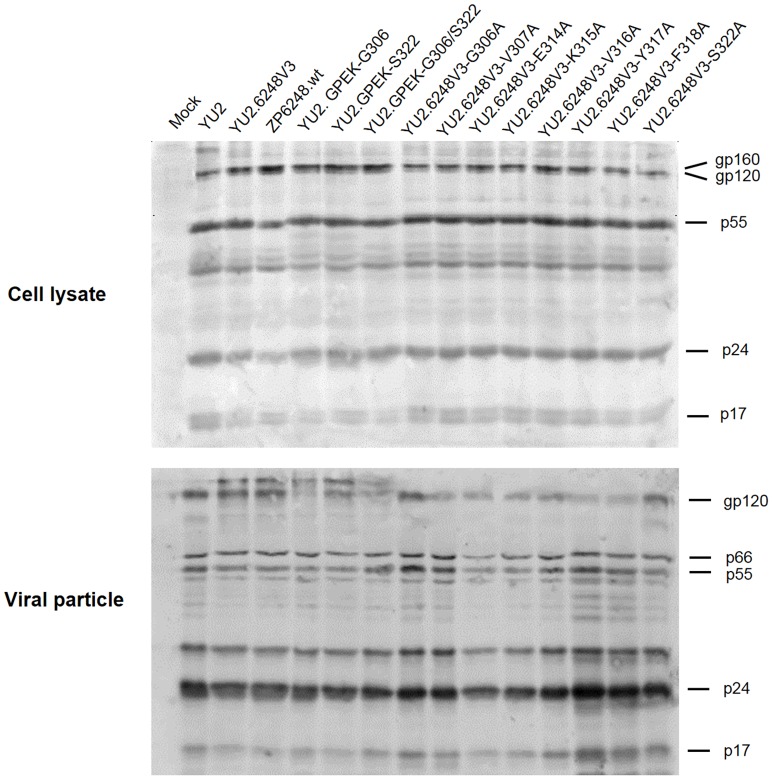
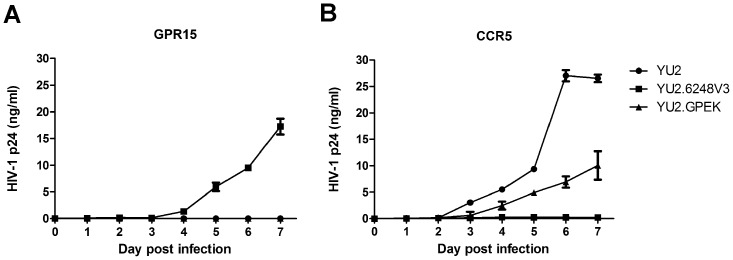
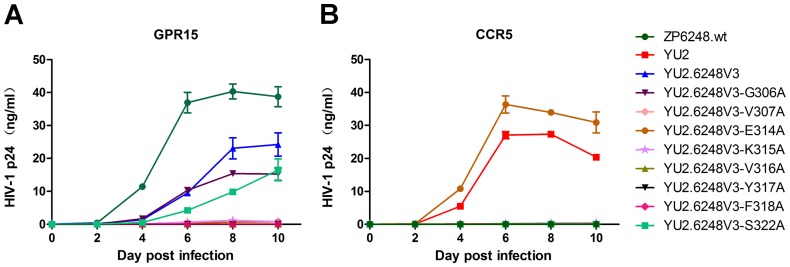
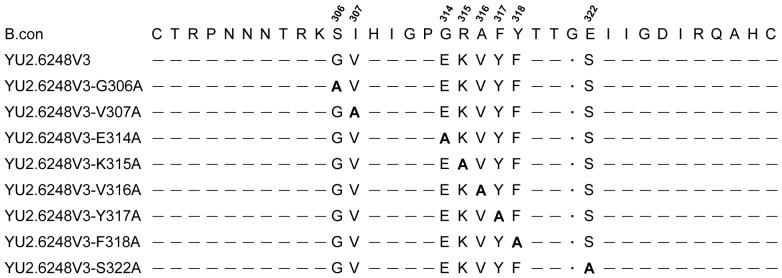
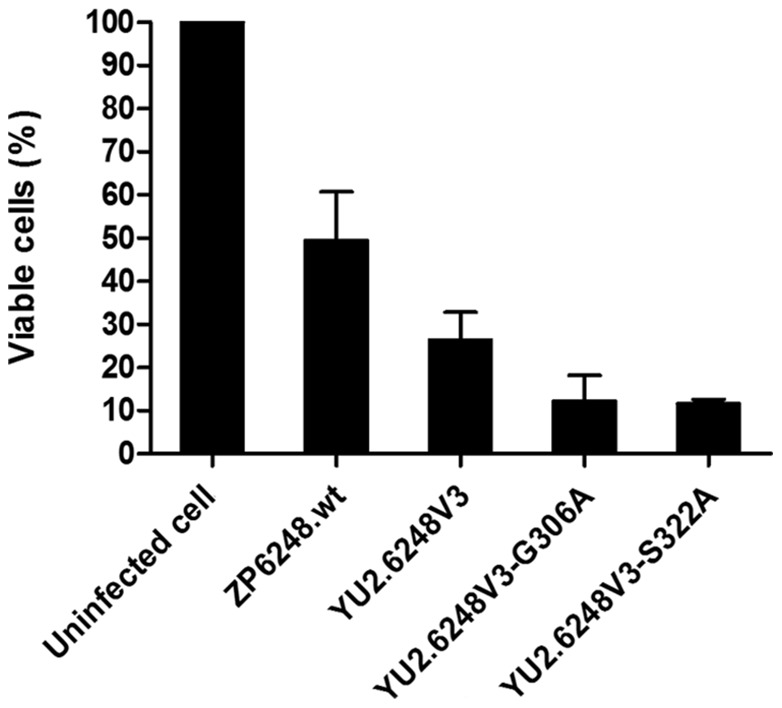
The majority of HIV-1 strains enter CD4+ T cells using the CCR5 and/or CXCR4 co-receptor. However, we recently identified a transmitted/founder (T/F) virus (ZP6248) that efficiently used an alternative coreceptor GPR15, rather than commonly used CXCR4 and CCR5, to establish clinical infection. To understand which regions in the env gene were critical for the atypical coreceptor usage, we generated a set of V3 mutants and determined their infectivity in GHOST cells that expressed different coreceptors. When the variable loop 3 (V3) in YU2 was replaced with the ZP6248 V3 (YU2.6248V3), the chimera YU2.6248V3 infected GPR15+ cells but not CCR5+ cells. To determine which amino acids in V3 was responsible for this phenotype change, each of the eight amino acids that differed from the subtype B consensus V3 was substituted with alanine. The G306A and S322A mutations significantly reduced the replication capacity of YU2.6248V3 in GPR15+ cells, while all other alanine substitutions at positions 307, 314, 315, 316, 317 and 318 completely abrogated the infectivity of YU2.6248V3 in GPR15+ cells. The E314A mutation, as the E314G mutation reported before, also rendered the YU2.6248V3 infectious in CCR5+ cells, while none of other alanine mutants could infect CCR5+ cells. These results demonstrated that amino acids in ZP6248 V3 might form a unique conformation that was critical for the interaction with GPR15 while the amino acids at position 314 in the V3 crown of ZP6248 played a key role in interaction with both CCR5 and GPR15. The unique phenotypes of ZP6248 can serve as a model to understand how HIV-1 explores the diverse coreceptor reservoir through novel genetic variants to establish clinical infection.
大多数HIV-1毒株利用CCR5和/或CXCR4共受体进入CD4+ T细胞。然而,我们最近鉴定出一种传播/奠基(T/F)病毒(ZP6248),它有效地利用了一种替代共受体GPR15,而非常用的CXCR4和CCR5,来建立临床感染。为了解env基因中的哪些区域对于这种非典型共受体的使用至关重要,我们构建了一组V3突变体,并确定了它们在表达不同共受体的GHOST细胞中的感染性。当将YU2中的可变环3(V3)替换为ZP6248的V3(YU2.6248V3)时,嵌合体YU2.6248V3能够感染GPR15+细胞,但不能感染CCR5+细胞。为了确定V3中的哪些氨基酸导致了这种表型变化,将与B亚型V3共识不同的八个氨基酸中的每一个都替换为丙氨酸。G306A和S322A突变显著降低了YU2.6248V3在GPR15+细胞中的复制能力,而在位置307、314、315、316、317和318处的所有其他丙氨酸替换则完全消除了YU2.6248V3在GPR15+细胞中的感染性。E314A突变,如同之前报道的E314G突变一样,也使YU2.6248V3能够感染CCR5+细胞,而其他丙氨酸突变体均不能感染CCR5+细胞。这些结果表明,ZP6248 V3中的氨基酸可能形成一种独特的构象,这对于与GPR15的相互作用至关重要,而ZP6248的V3冠中位置314处的氨基酸在与CCR5和GPR15的相互作用中都起着关键作用。ZP6248的独特表型可以作为一个模型,来理解HIV-1如何通过新的基因变体探索不同的共受体库以建立临床感染。