Illarionova Nina B, Brismar Hjalmar, Aperia Anita, Gunnarson Eli
Department of Women's and Children's Health, Karolinska Institutet, Stockholm, Sweden.
Department of Women's and Children's Health, Karolinska Institutet, Stockholm, Sweden; Science for Life Laboratory, Department of Cell Physics, Royal Institute of Technology, Stockholm, Sweden.
PLoS One. 2014 Jun 5;9(6):e98469. doi: 10.1371/journal.pone.0098469. eCollection 2014.
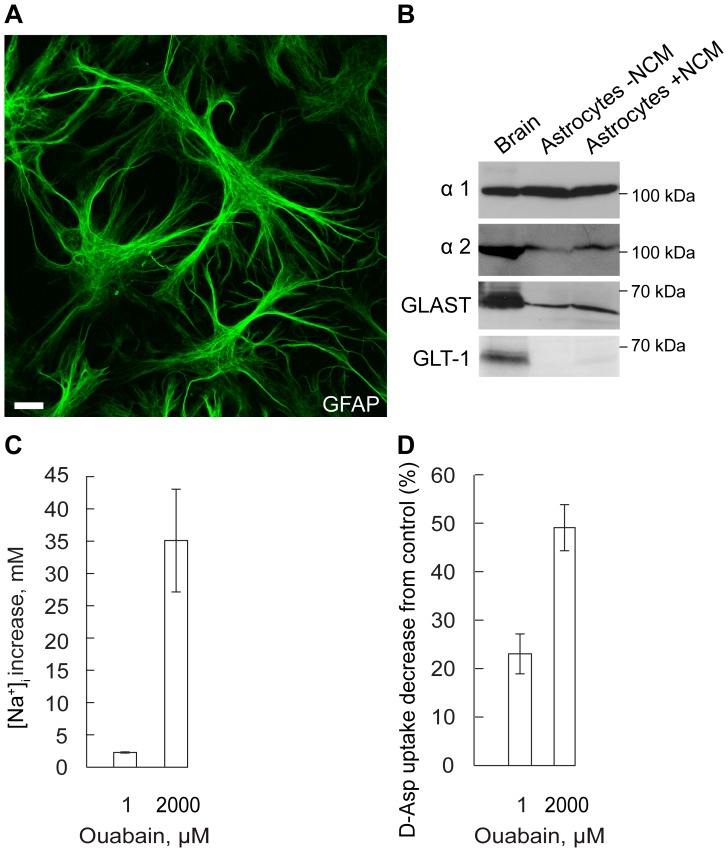
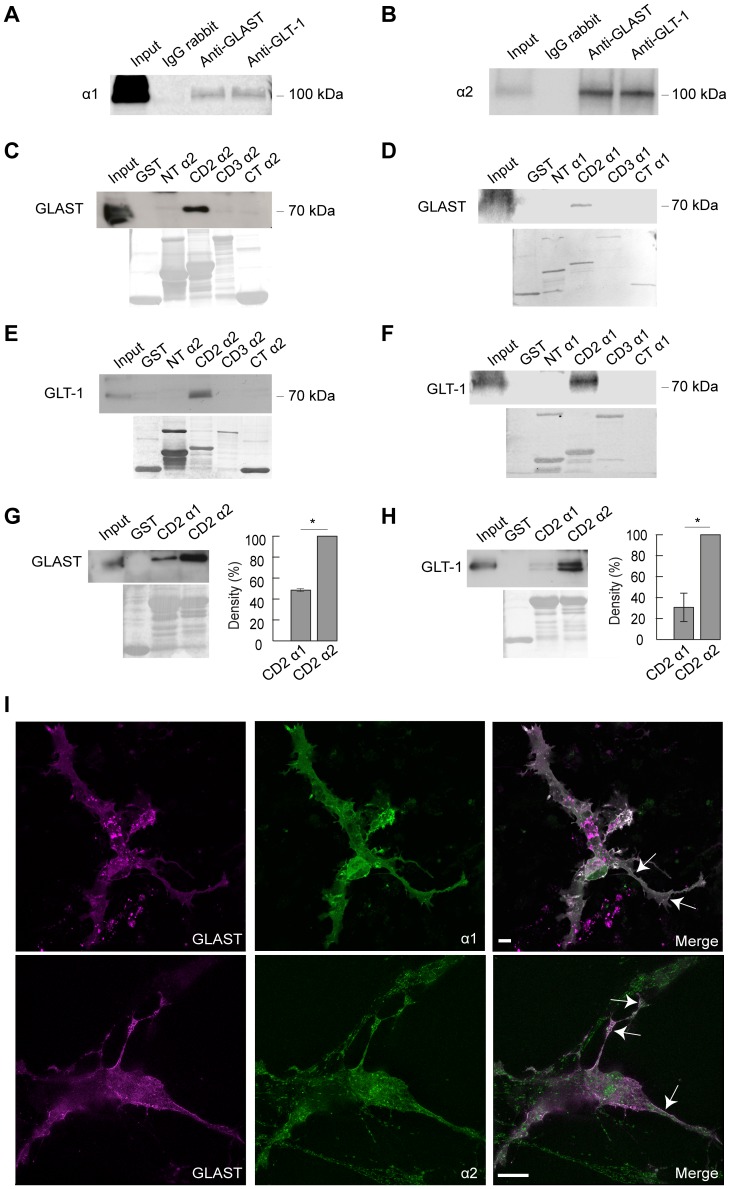
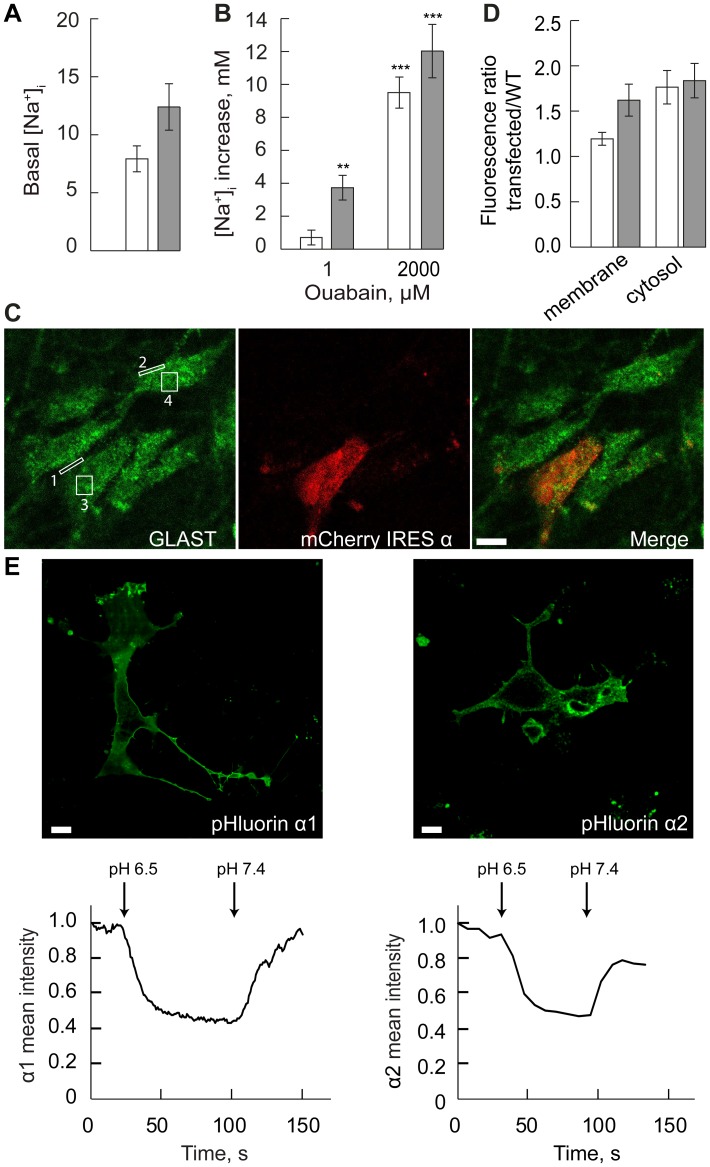
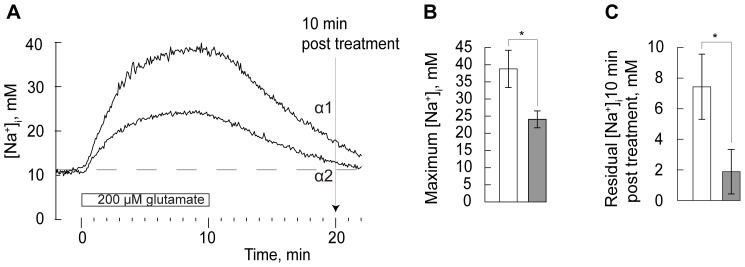
Glutamate released during neuronal activity is cleared from the synaptic space via the astrocytic glutamate/Na(+) co-transporters. This transport is driven by the transmembrane Na(+) gradient mediated by Na,K-ATPase. Astrocytes express two isoforms of the catalytic Na,K-ATPase α subunits; the ubiquitously expressed α1 subunit and the α2 subunit that has a more specific expression profile. In the brain α2 is predominantly expressed in astrocytes. The isoforms differ with regard to Na+ affinity, which is lower for α2. The relative roles of the α1 and α2 isoforms in astrocytes are not well understood. Here we present evidence that the presence of the α2 isoform may contribute to a more efficient restoration of glutamate triggered increases in intracellular sodium concentration [Na(+)]i. Studies were performed on primary astrocytes derived from E17 rat striatum expressing Na,K-ATPase α1 and α2 and the glutamate/Na(+) co-transporter GLAST. Selective inhibition of α2 resulted in a modest increase of [Na(+)]i accompanied by a disproportionately large decrease in uptake of aspartate, an indicator of glutamate uptake. To compare the capacity of α1 and α2 to handle increases in [Na(+)]i triggered by glutamate, primary astrocytes overexpressing either α1 or α2 were used. Exposure to glutamate 200 µM caused a significantly larger increase in [Na(+)]i in α1 than in α2 overexpressing cells, and as a consequence restoration of [Na(+)]i, after glutamate exposure was discontinued, took longer time in α1 than in α2 overexpressing cells. Both α1 and α2 interacted with astrocyte glutamate/Na(+) co-transporters via the 1st intracellular loop.
神经元活动期间释放的谷氨酸通过星形胶质细胞谷氨酸/Na(+)共转运体从突触间隙清除。这种转运由Na,K-ATP酶介导的跨膜Na(+)梯度驱动。星形胶质细胞表达催化性Na,K-ATP酶α亚基的两种同工型;普遍表达的α1亚基和具有更特异表达谱的α2亚基。在脑中,α2主要在星形胶质细胞中表达。这两种同工型在Na+亲和力方面存在差异,α2的Na+亲和力较低。α1和α2同工型在星形胶质细胞中的相对作用尚未完全了解。在此我们提供证据表明,α2同工型的存在可能有助于更有效地恢复谷氨酸引发的细胞内钠浓度[Na(+)]i的升高。研究是在源自E17大鼠纹状体、表达Na,K-ATP酶α1和α2以及谷氨酸/Na(+)共转运体GLAST的原代星形胶质细胞上进行的。对α2的选择性抑制导致[Na(+)]i适度增加,同时伴随着作为谷氨酸摄取指标的天冬氨酸摄取不成比例地大幅下降。为了比较α1和α2处理谷氨酸引发的[Na(+)]i升高的能力,使用了过表达α1或α2的原代星形胶质细胞。暴露于200 μM谷氨酸后,α1过表达细胞中[Na(+)]i的升高明显大于α2过表达细胞,因此,在停止谷氨酸暴露后,α1过表达细胞中[Na(+)]i的恢复比α2过表达细胞花费更长时间。α1和α2都通过第1个细胞内环与星形胶质细胞谷氨酸/Na(+)共转运体相互作用。