Instituto de Investigaciones en Ingeniería Genética y Biología Molecular (INGEBI) - Consejo Nacional de Investigaciones Científicas y Tecnológicas (CONICET), Buenos Aires, Argentina; Facultad de Farmacia y Bioquímica, Universidad de Buenos Aires, Buenos Aires, Argentina.
Hospital General de Agudos J.M. Ramos Mejía, Buenos Aires, Argentina.
PLoS Negl Trop Dis. 2014 Jun 5;8(6):e2906. doi: 10.1371/journal.pntd.0002906. eCollection 2014 Jun.
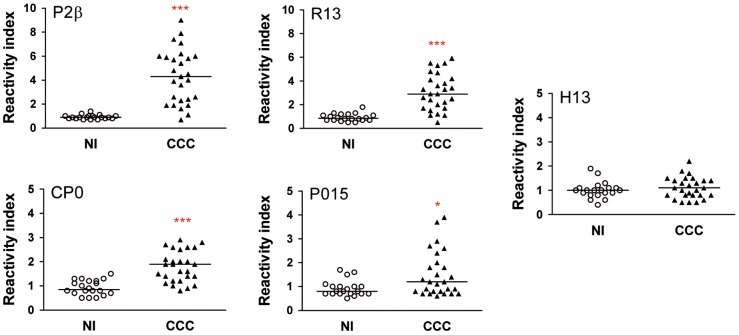
Trypanosoma cruzi ribosomal P proteins, P2β and P0, induce high levels of antibodies in patients with chronic Chagas' disease Cardiomyopathy (CCC). It is well known that these antibodies alter the beating rate of cardiomyocytes and provoke apoptosis by their interaction with β1-adrenergic and M2-muscarinic cardiac receptors. Based on these findings, we decided to study the cellular immune response to these proteins in CCC patients compared to non-infected individuals.
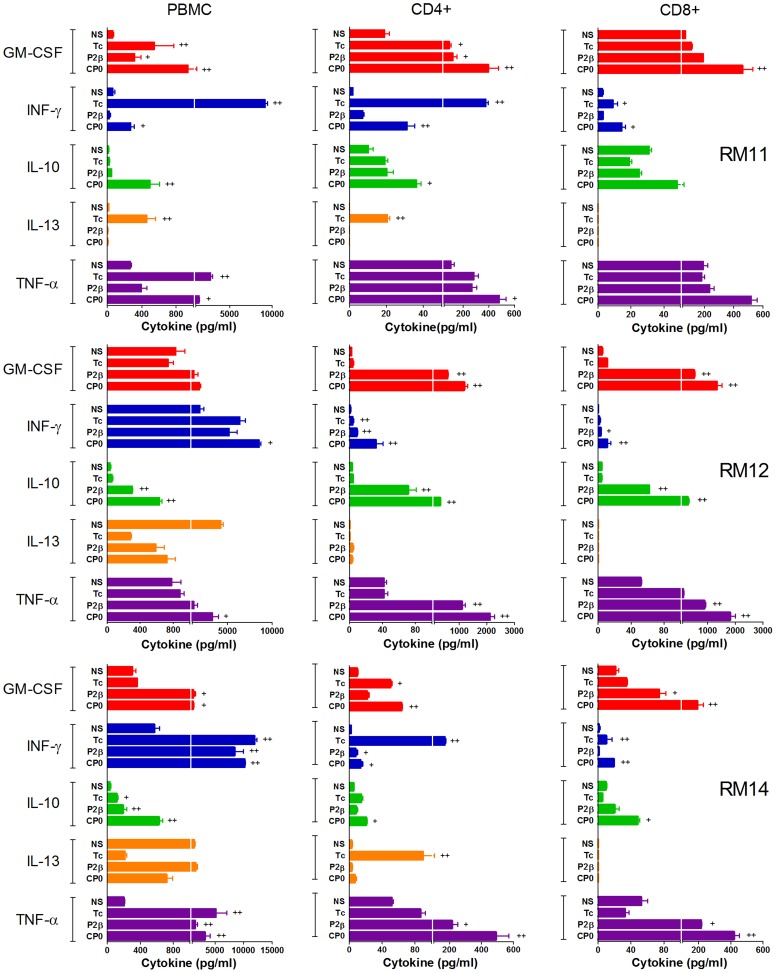
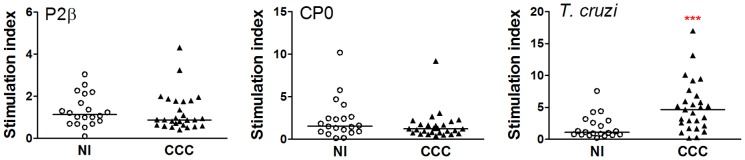
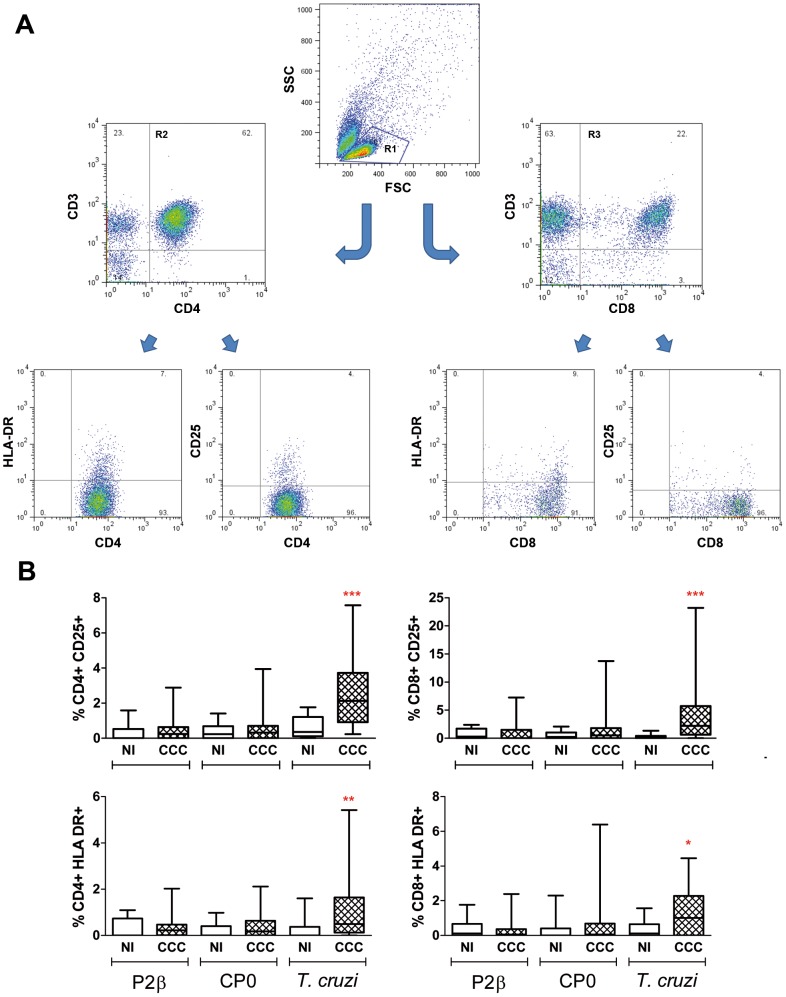
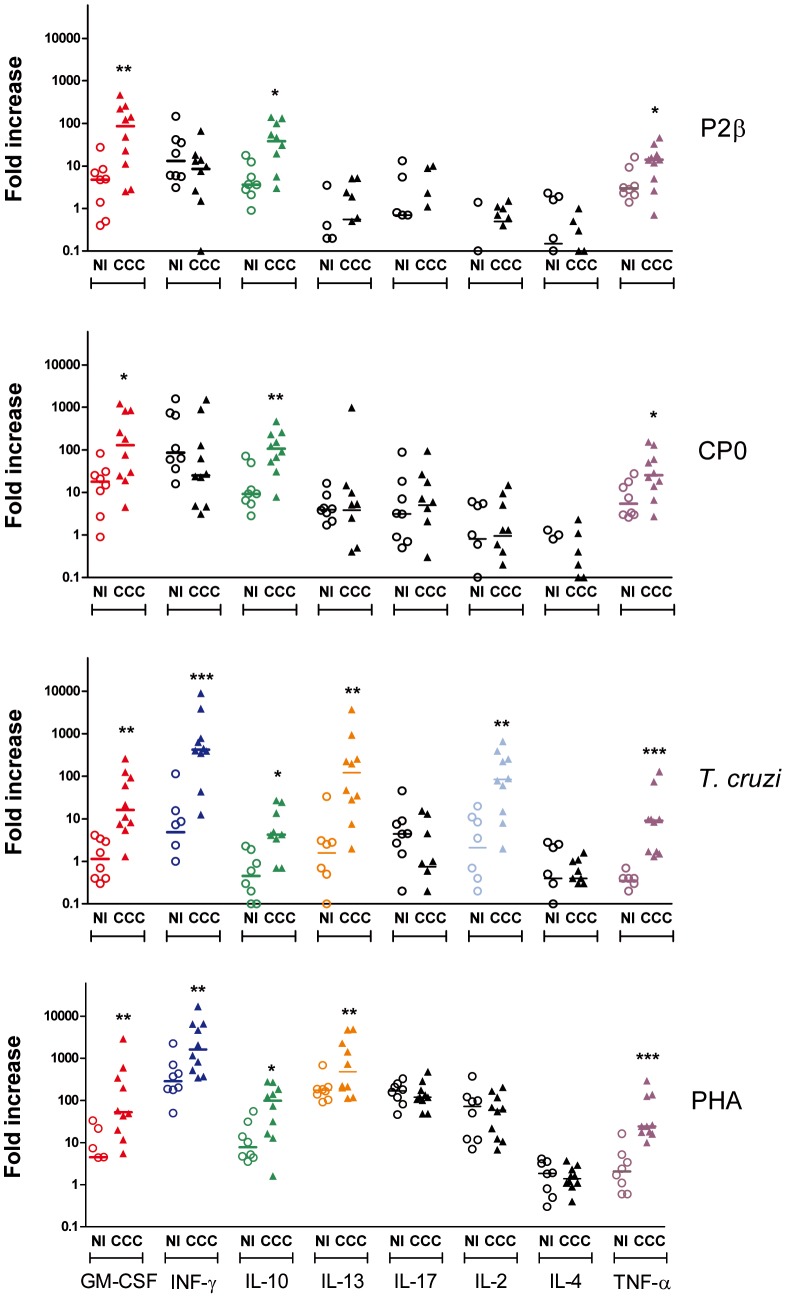
METHODOLOGY/PRINCIPAL FINDINGS: We evaluated proliferation, presence of surface activation markers and cytokine production in peripheral blood mononuclear cells (PBMC) stimulated with P2β, the C-terminal portion of P0 (CP0) proteins and T. cruzi lysate from CCC patients predominantly infected with TcVI lineage. PBMC from CCC patients cultured with P2β or CP0 proteins, failed to proliferate and express CD25 and HLA-DR on T cell populations. However, multiplex cytokine assays showed that these antigens triggered higher secretion of IL-10, TNF-α and GM-CSF by PBMC as well as both CD4+ and CD8+ T cells subsets of CCC subjects. Upon T. cruzi lysate stimulation, PBMC from CCC patients not only proliferated but also became activated within the context of Th1 response. Interestingly, T. cruzi lysate was also able to induce the secretion of GM-CSF by CD4+ or CD8+ T cells.
CONCLUSIONS/SIGNIFICANCE: Our results showed that although the lack of PBMC proliferation in CCC patients in response to ribosomal P proteins, the detection of IL-10, TNF-α and GM-CSF suggests that specific T cells could have both immunoregulatory and pro-inflammatory potential, which might modulate the immune response in Chagas' disease. Furthermore, it was possible to demonstrate for the first time that GM-CSF was produced by PBMC of CCC patients in response not only to recombinant ribosomal P proteins but also to parasite lysate, suggesting the value of this cytokine to evaluate T cells responses in T. cruzi infection.
克氏锥虫核糖体 P 蛋白 P2β 和 P0 可诱导慢性恰加斯病心肌病(CCC)患者产生高水平的抗体。众所周知,这些抗体通过与β1-肾上腺素能和 M2-毒蕈碱心脏受体相互作用,改变心肌细胞的跳动频率并引发细胞凋亡。基于这些发现,我们决定研究 CCC 患者与未感染个体相比,对这些蛋白的细胞免疫反应。
方法/主要发现:我们评估了 P2β、P0 的 C 端部分(CP0)蛋白和 T. cruzi 裂解物刺激下,来自主要感染 TcVI 谱系的 CCC 患者外周血单核细胞(PBMC)的增殖、表面激活标志物的存在和细胞因子的产生。与 P2β 或 CP0 蛋白培养的 CCC 患者的 PBMC 未能增殖,并在 T 细胞群体上表达 CD25 和 HLA-DR。然而,多重细胞因子测定显示,这些抗原触发 CCC 患者的 PBMC 以及 CD4+和 CD8+T 细胞亚群更高地分泌 IL-10、TNF-α和 GM-CSF。在用 T. cruzi 裂解物刺激后,不仅 CCC 患者的 PBMC 增殖,而且在 Th1 反应的背景下也被激活。有趣的是,T. cruzi 裂解物也能够诱导 CD4+或 CD8+T 细胞分泌 GM-CSF。
结论/意义:我们的结果表明,尽管 CCC 患者的 PBMC 对核糖体 P 蛋白无增殖反应,但检测到 IL-10、TNF-α和 GM-CSF 表明,特定的 T 细胞可能具有免疫调节和促炎潜力,这可能调节恰加斯病的免疫反应。此外,我们首次证明,不仅针对重组核糖体 P 蛋白,而且针对寄生虫裂解物,CCC 患者的 PBMC 均可产生 GM-CSF,提示该细胞因子可用于评估 T. cruzi 感染中的 T 细胞反应。