Zhang Xiyun, Zou Yong, Boccaletti S, Liu Zonghua
Department of Physics, East China Normal University, Shanghai, 200062, China.
CNR- Institute of Complex Systems, Via Madonna del Piano 10, 50019 Sesto Fiorentino, Florence, Italy.
Sci Rep. 2014 Jun 6;4:5200. doi: 10.1038/srep05200.
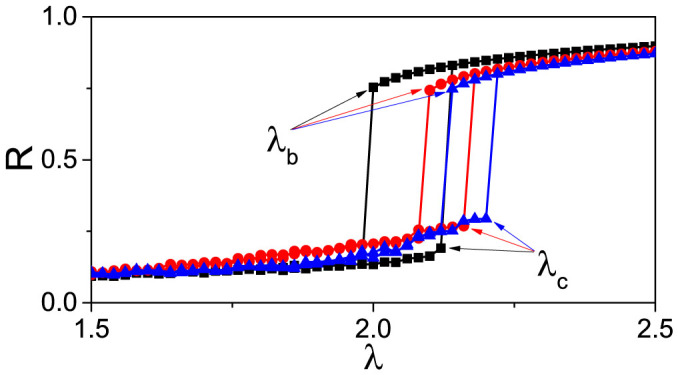
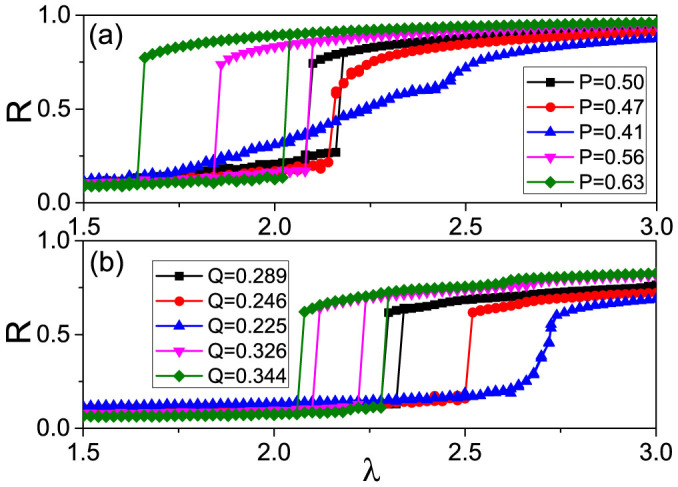
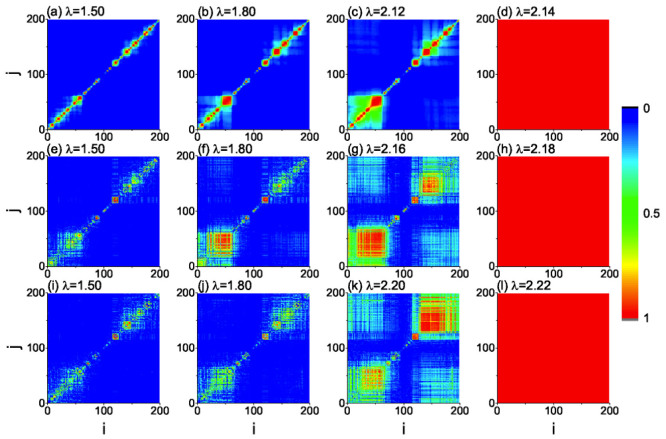
Explosive synchronization and explosive percolation are currently two independent phenomena occurring in complex networks, where the former takes place in dynamical phase space while the latter in configuration space. It has been revealed that the mechanism of EP can be explained by the Achlioptas process, where the formation of a giant component is controlled by a suppressive rule. We here introduce an equivalent suppressive rule for ES. Before the critical point of ES, the suppressive rule induces the presence of multiple, small sized, synchronized clusters, while inducing the abrupt formation of a giant cluster of synchronized oscillators at the critical coupling strength. We also show how the explosive character of ES degrades into a second-order phase transition when the suppressive rule is broken. These results suggest that our suppressive rule can be considered as a dynamical counterpart of the Achlioptas process, indicating that ES and EP can be unified into a same framework.
爆发性同步和爆发性渗流是目前在复杂网络中出现的两种独立现象,前者发生在动力学相空间,而后者发生在构型空间。研究表明,爆发性渗流的机制可以用阿赫利奥普塔斯过程来解释,其中巨分量的形成由一个抑制规则控制。我们在此引入一个与爆发性同步等效的抑制规则。在爆发性同步的临界点之前,该抑制规则导致存在多个小尺寸的同步簇,而在临界耦合强度下诱导出一个由同步振子组成的巨型簇的突然形成。我们还展示了,当抑制规则被打破时,爆发性同步的爆发特性如何退化为二阶相变。这些结果表明,我们的抑制规则可被视为阿赫利奥普塔斯过程的动力学对应物,这表明爆发性同步和爆发性渗流可以统一到同一个框架中。