Department of Earth and Environment, Boston University Boston, MA, USA.
Department of Earth and Environment, Boston University Boston, MA, USA ; Department of Biology, Boston University Boston, MA, USA.
Front Plant Sci. 2014 May 20;5:186. doi: 10.3389/fpls.2014.00186. eCollection 2014.
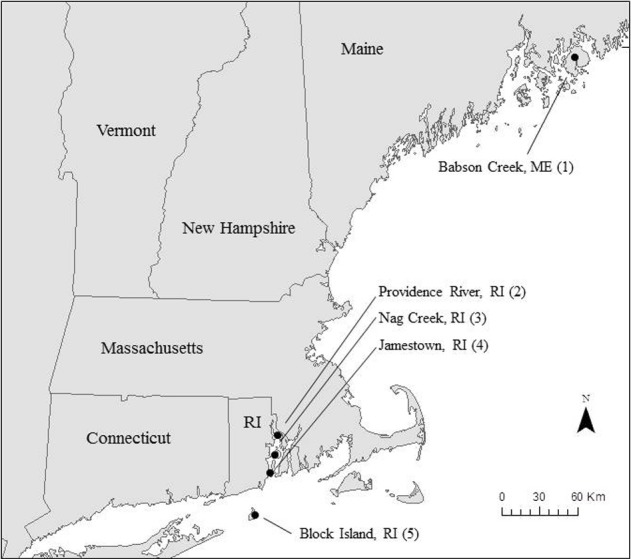
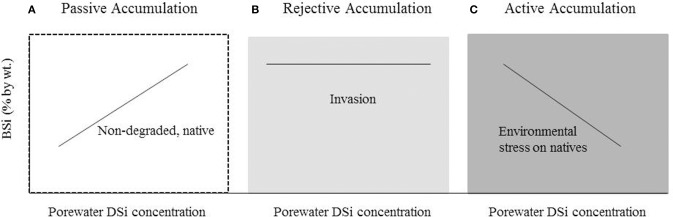
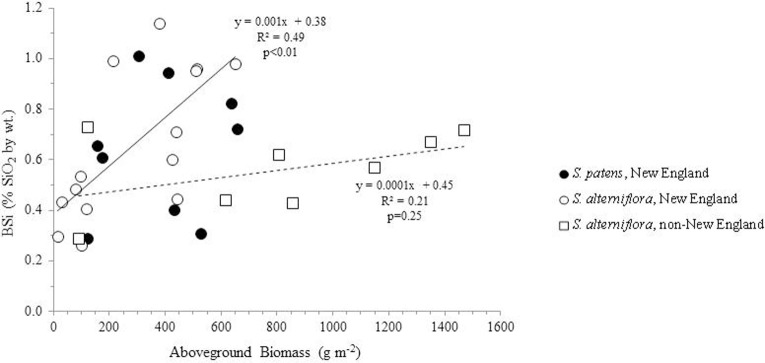
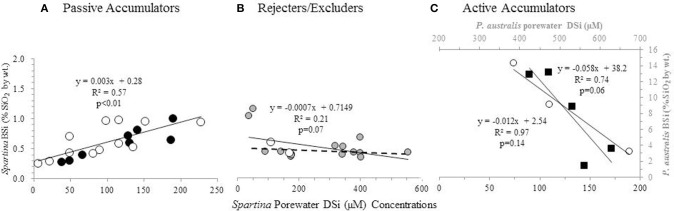
Silicon (Si) plays a critical role in plant functional ecology, protecting plants from multiple environmental stressors. While all terrestrial plants contain some Si, wetland grasses are frequently found to have the highest concentrations, although the mechanisms driving Si accumulation in wetland grasses remain in large part uncertain. For example, active Si accumulation is often assumed to be responsible for elevated Si concentrations found in wetland grasses. However, life stage and differences in Si availability in the surrounding environment also appear to be important variables controlling the Si concentrations of wetland grasses. Here we used original data from five North American salt marshes, as well as all known published literature values, to examine the primary drivers of Si accumulation in Spartina, a genus of prolific salt marsh grasses found worldwide. We found evidence of multiple modes of Si accumulation in Spartina, with passive accumulation observed in non-degraded marshes where Spartina was native, while rejective accumulation was found in regions where Spartina was invasive. Evidence of active accumulation was found in only one marsh where Spartina was native, but was also subjected to nutrient over-enrichment. We developed a conceptual model which hypothesizes that the mode of Si uptake by Spartina is dependent on local environmental factors and genetic origin, supporting the idea that plant species should be placed along a spectrum of Si accumulation. We hypothesize that Spartina exhibits previously unrecognized phenotypic plasticity with regard to Si accumulation, allowing these plants to respond to changes in marsh condition. These results provide new insight regarding how salt marsh ecosystems regulate Si exchange at the land-sea interface.
硅(Si)在植物功能生态学中起着至关重要的作用,可保护植物免受多种环境胁迫。虽然所有陆生植物都含有一定量的硅,但湿地草通常被发现含有最高浓度的硅,尽管驱动湿地草中硅积累的机制在很大程度上仍不确定。例如,通常认为主动硅积累是导致湿地草中硅浓度升高的原因。然而,生命阶段和周围环境中硅的可用性差异似乎也是控制湿地草硅浓度的重要变量。在这里,我们使用了来自北美五个盐沼的原始数据以及所有已知的已发表文献值,来研究在全世界广泛分布的盐沼草属(Spartina)中硅积累的主要驱动因素。我们发现 Spartina 中存在多种硅积累模式的证据,在原生非退化沼泽中观察到被动积累,而在 Spartina 入侵的地区则观察到排斥性积累。仅在一个原生 Spartina 的沼泽中发现了主动积累的证据,但该沼泽也受到营养过度富集的影响。我们提出了一个概念模型,假设 Spartina 吸收硅的模式取决于当地的环境因素和遗传起源,这支持了植物物种应该沿着硅积累的连续体排列的观点。我们假设 Spartina 在硅积累方面表现出以前未被认识到的表型可塑性,使这些植物能够对沼泽条件的变化做出反应。这些结果为盐沼生态系统如何在陆海界面调节硅交换提供了新的见解。