Jentschke Sebastian, Friederici Angela D, Koelsch Stefan
Freie Universität Berlin, Cluster "Languages of Emotion", Berlin, Germany.
Max Planck Institute for Human Cognitive and Brain Sciences, Department of Neuropsychology, Leipzig, Germany.
Dev Cogn Neurosci. 2014 Jul;9:200-8. doi: 10.1016/j.dcn.2014.04.005. Epub 2014 May 20.
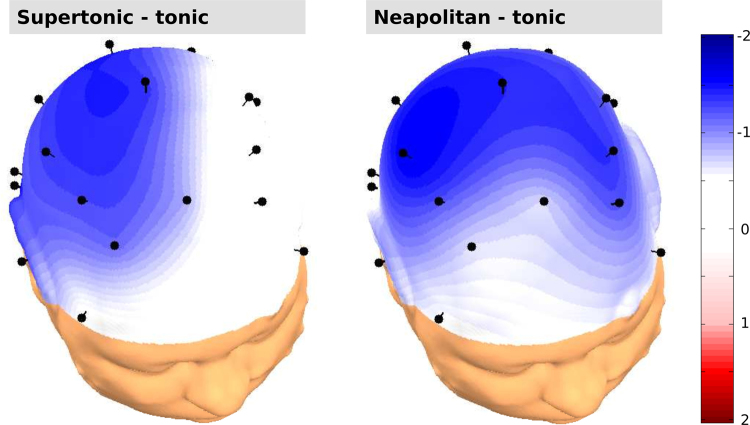
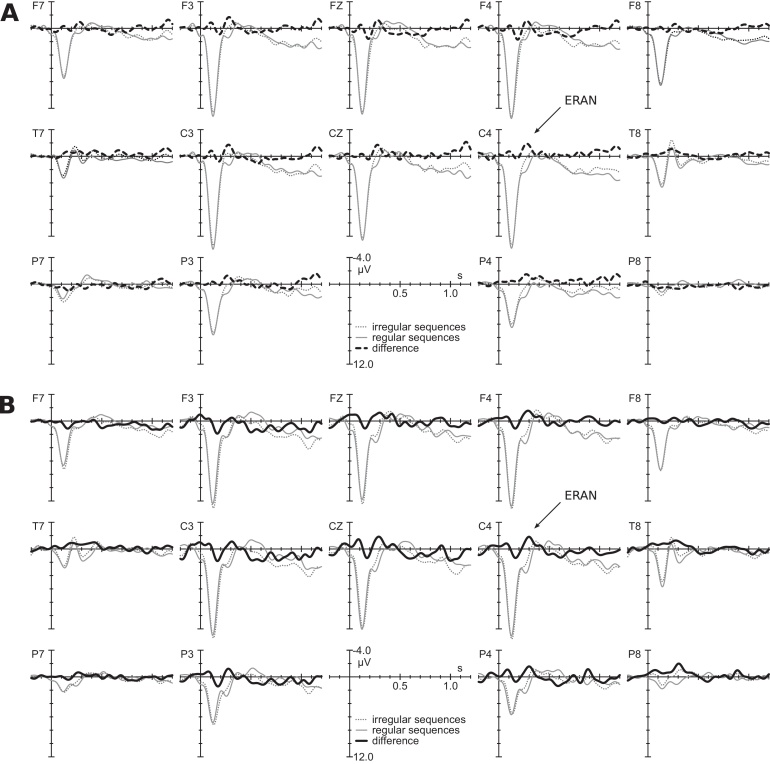
Music is a basic and ubiquitous socio-cognitive domain. However, our understanding of the time course of the development of music perception, particularly regarding implicit knowledge of music-syntactic regularities, remains contradictory and incomplete. Some authors assume that the acquisition of knowledge about these regularities lasts until late childhood, but there is also evidence for the presence of such knowledge in four- and five-year-olds. To explore whether such knowledge is already present in younger children, we tested whether 30-month-olds (N=62) show neurophysiological responses to music-syntactically irregular harmonies. We observed an early right anterior negativity in response to both irregular in-key and out-of-key chords. The N5, a brain response usually present in older children and adults, was not observed, indicating that processes of harmonic integration (as reflected in the N5) are still in development in this age group. In conclusion, our results indicate that 30-month-olds already have acquired implicit knowledge of complex harmonic music-syntactic regularities and process musical information according to this knowledge.
音乐是一个基本且普遍存在的社会认知领域。然而,我们对音乐感知发展的时间进程的理解,尤其是关于音乐句法规律的隐性知识,仍然存在矛盾且不完整。一些作者认为,关于这些规律的知识获取一直持续到童年晚期,但也有证据表明,四五岁的儿童就已经具备此类知识。为了探究年幼儿童是否已经拥有此类知识,我们测试了30个月大的幼儿(N = 62)对音乐句法不规则和声的神经生理反应。我们观察到,对调内和调外的不规则和弦均出现了早期右前负波。未观察到通常出现在大龄儿童和成年人中的N5脑反应,这表明该年龄组中谐波整合过程(如N5所反映的)仍在发展。总之,我们的结果表明,30个月大的幼儿已经获得了复杂和声音乐句法规律的隐性知识,并根据这一知识处理音乐信息。