Marine Science Institute, University of Texas at Austin Port Aransas, TX, USA.
Front Neurosci. 2014 May 30;8:130. doi: 10.3389/fnins.2014.00130. eCollection 2014.
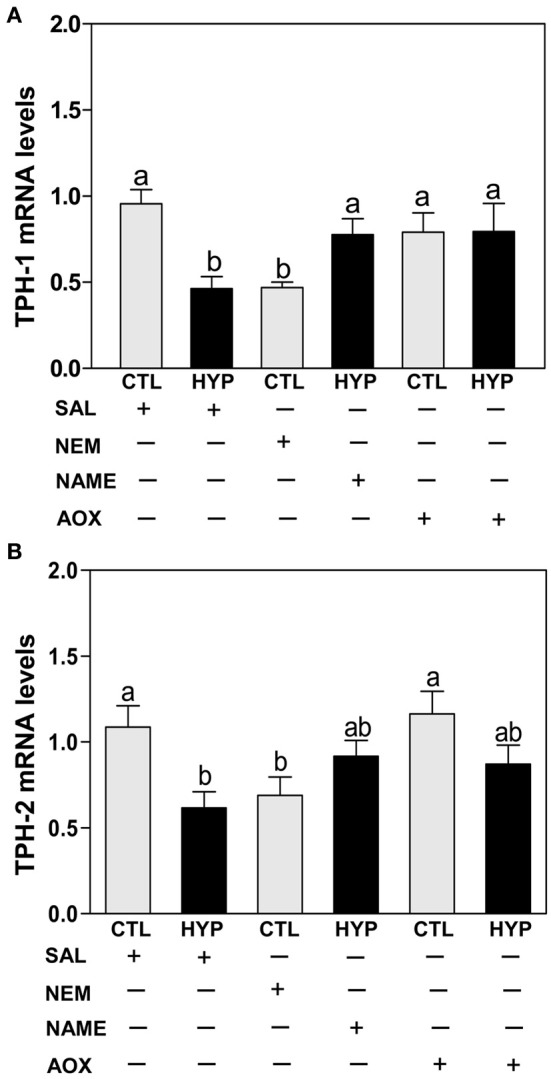
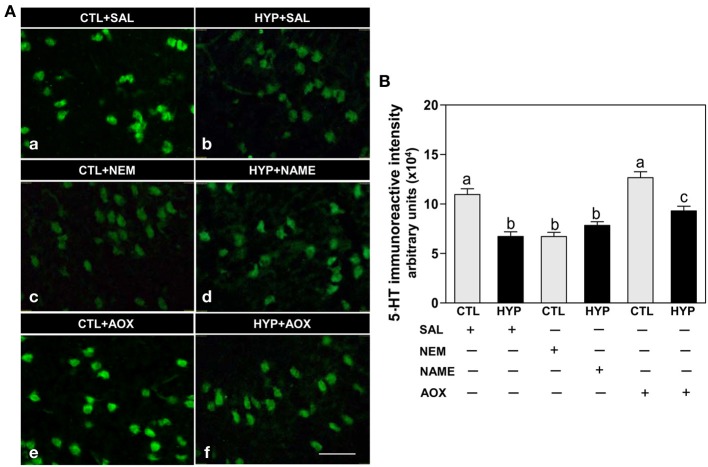
Antioxidants are prototypical scavengers of oxygen-free radicals and have been shown to prevent neuroendocrine dysfunction in vertebrates during oxidative stress. In the present study, we investigated whether antioxidant treatment can reverse hypoxia-induced down-regulation of hypothalamic tryptophan hydroxylase (TPH) and serotonergic functions in Atlantic croaker. Hypothalamic neuronal contents of TPH-1 and TPH-2 proteins, serotonin (5-hydroxytryptamine, 5-HT) and its precursor, 5-hydroxytryptophan (5-HTP) as well as hypothalamic TPH-1 and TPH-2 mRNA expression and TPH activity were measured in croaker after exposure to hypoxia and treatment with pharmacological agents. Multiple injections of N-ethylmaleimide, a sulfhydryl alkylating agent, caused comparable decreases in hypothalamic TPHs functions and 5-HT contents to that induced by hypoxia exposure (dissolved oxygen: 1.7 mg/L for 4 weeks) which were partially restored by repeated injections with a nitric oxide synthase (NOS)-inhibitor and/or vitamin E. Double-labeled immunohistochemical results showed that TPHs and 5-HT neurons were co-expressed with neuronal NOS (nNOS, a neuroenzyme) that catalyzes the production of nitric oxide, a free radical, in hypothalamic neurons. These results suggest that hypoxia-induced impairment of TPH and serotonergic functions are mediated by nNOS and involve the generation of free radicals and a decrease in the antioxidant status. This study provides, to our knowledge, the first evidence of a protective role for an antioxidant in maintaining neural TPHs functions and 5-HT regulation in an aquatic vertebrate during hypoxic stress.
抗氧化剂是典型的氧自由基清除剂,已被证明可防止脊椎动物在氧化应激期间的神经内分泌功能障碍。在本研究中,我们研究了抗氧化剂治疗是否可以逆转hypoxia 诱导的大西洋石首鱼下丘脑色氨酸羟化酶(TPH)和 5-羟色胺能功能的下调。在暴露于低氧和用药物处理后,测量了石首鱼下丘脑 TPH-1 和 TPH-2 蛋白、5-羟色胺(5-羟色胺,5-HT)及其前体 5-羟色氨酸(5-HTP)以及下丘脑 TPH-1 和 TPH-2 mRNA 表达和 TPH 活性。多次注射巯基烷化剂 N-乙基马来酰亚胺导致下丘脑 TPH 功能和 5-HT 含量下降与暴露于低氧(溶解氧:4 周 1.7 mg/L)相似,这部分被重复注射一氧化氮合酶(NOS)抑制剂和/或维生素 E 所恢复。双标记免疫组织化学结果表明,TPH 和 5-HT 神经元与神经元 NOS(nNOS,一种神经酶)共表达,该酶催化自由基一氧化氮的产生,在下丘脑神经元中。这些结果表明,nNOS 介导了 hypoxiainduced TPH 和 5-羟色胺能功能的损伤,涉及自由基的产生和抗氧化状态的降低。这项研究提供了,据我们所知,在水生脊椎动物低氧应激期间,抗氧化剂在维持神经 TPHs 功能和 5-HT 调节中的保护作用的第一个证据。