Lotfi Farhad, Kalhor Rohollah, Bastani Peivand, Shaarbafchi Zadeh Nasrin, Eslamian Maryam, Dehghani Mohammad Reza, Kiaee Mohamad Zakaria
School of Health Management and Information Sciences, Iran University of Medical Sciences, Tehran, IR Iran.
Research Center for Health Information Management, Hormozgan University of Medical Sciences, Bandar Abbas, IR Iran ; Department of Health Service Management, School of Public Health, Qazvin University of Medical Sciences, Qazvin, IR Iran.
Iran Red Crescent Med J. 2014 Apr;16(4):e12950. doi: 10.5812/ircmj.12950. Epub 2014 Apr 5.
Hospitals are the most costly operational and really important units of health system because they consume about 50%-89% of total health resources. Therefore efficient use of resources could help in saving and reallocating the financial and physical resources.
The aim of this study was to obtain an overview of hospitals' performance status by applying different techniques, to compare similarities and differences between these methods and suggest the most comprehensive and practical method of appraisal for managers and policy makers.
This is a cross sectional study conducted in all hospitals of Ahvaz (eight hospitals affiliated with Jundishapur University of Medical Sciences and eight non-affiliated hospitals) during 2007 to 2011. Two kinds of data were collected through separate special checklists. Excel 2007 and Windeap 2.1 software were applied for data analysis.
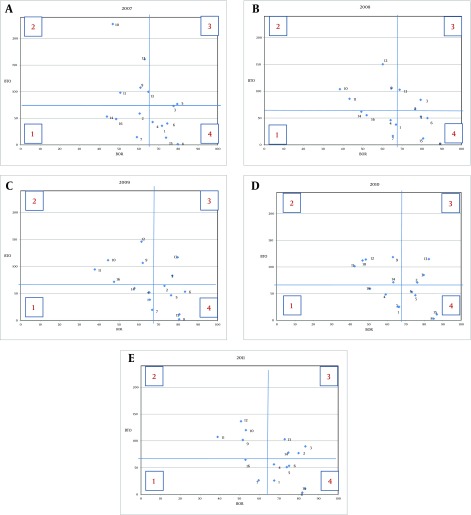
The present findings show that the average of bed occupancy rate (BOR) in the studied hospitals was about 65.91 ± 1.16. The maximum number of inefficient hospitals in the present study happened in the years 2007, 2008 and 2010 (four hospitals) but there were two hospitals in the third part of the present graph which had maximum level of efficiency and optimal level of productivity in the years 2007 and 2009. Data Envelopment Analysis (DEA) showed that the mean score of technical efficiency for the studied hospitals is 0.924 ± 0.105 with the minimum of 0.585 ± 0.905 for hospital number 1. Furthermore It shows that only five hospitals (31.25%) reach complete technical efficiency (TE) scores across all five years of 2007-11 (TE = 1).
Results of the present and similar studies should be considered for the future planning and resource allocation of Iranian public hospitals. At the same time it is very important to consider need assessment results for each region according to its potentials, population under the coverage and other geographical and cultural indices. Furthermore because of potential limitations of each of the above models it is highly recommended to apply different methods of performance evaluation to reach a complete and real status view of the hospitals for future planning.
医院是卫生系统中运营成本最高且极为重要的单位,因为它们消耗了约50% - 89%的卫生资源总量。因此,有效利用资源有助于节约和重新分配财政及物质资源。
本研究旨在通过应用不同技术来全面了解医院的绩效状况,比较这些方法之间的异同,并为管理者和政策制定者推荐最全面且实用的评估方法。
这是一项横断面研究,于2007年至2011年在阿瓦士的所有医院(八所与赞詹医科大学附属的医院和八所非附属医院)开展。通过单独的特殊检查表收集了两类数据。使用Excel 2007和Windeap 2.1软件进行数据分析。
目前的研究结果显示,所研究医院的平均床位占用率(BOR)约为65.91 ± 1.16。本研究中效率低下的医院数量最多的年份是2007年、2008年和2010年(四家医院),但在本图表的第三部分有两家医院在2007年和2009年达到了最高效率水平和最佳生产率水平。数据包络分析(DEA)表明,所研究医院的技术效率平均得分为0.924 ± 0.105,其中1号医院的最低分为0.585 ± 0.905。此外,研究表明在2007 - 11年的所有五年中,只有五家医院(31.25%)达到了完全技术效率(TE)得分(TE = 1)。
本研究及类似研究的结果应在伊朗公立医院的未来规划和资源分配中予以考虑。同时,根据各地区的潜力、覆盖人口以及其他地理和文化指标来考虑需求评估结果非常重要。此外,由于上述每个模型都存在潜在局限性,强烈建议应用不同的绩效评估方法,以全面真实地了解医院状况,为未来规划提供依据。