Mercy Medical Center, Cedar Rapids, Iowa.
Cancer Cytopathol. 2014 Oct;122(10):745-50. doi: 10.1002/cncy.21440. Epub 2014 Jun 9.
Fine-needle aspiration of the thyroid is a common procedure, with an established role in reducing unnecessary thyroid surgery and identifying neoplasms and malignancies.
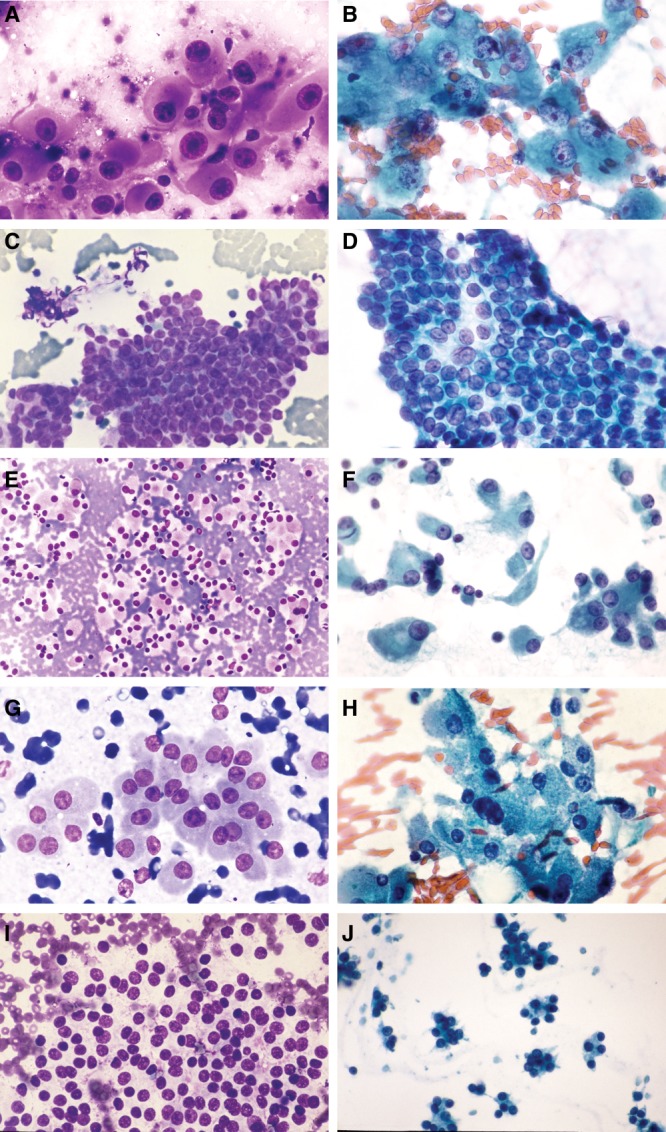
The study evaluated 1558 responses in the American Society for Clinical Pathology (ASCP) Non-GYN Assessment program of aspirates of thyroid neoplasms and malignancies and placed them into the following groups: group A (target or correct interpretation), group B (incorrect interpretation as a benign thyroid nodule), group C (incorrect interpretation malignant aspirate as thyroid neoplasm), and group D (malignant diagnosis with incorrect interpretation). In clinical practice, responses in groups A, C, and D would lead to surgical excision, whereas responses in group B would not.
Of a total of 1558 responses, 78.5% of the responses were in group A, 8.5% in group B, 3.75% in group C, and 9.25% in group D. By individual diagnosis, the group rates were 86.5%, 0%, 11%, and 2.5% for anaplastic thyroid carcinoma; 83%, 5.5%, 4.25%, and 7.25% for papillary thyroid carcinoma; 79%, 7%, 6%, and 8% for medullary thyroid carcinoma; 83.5% 6.75%, 0%, and 9.75% for Hürthle cell neoplasm; and 61%, 22%, 0%, and 17% for follicular neoplasm in groups A, B, C, and D respectively.
Fine-needle aspiration was effective in diagnosing thyroid neoplasms and malignancies and in separating thyroid nodules into surgical and nonsurgical categories. Data from a large group of cytology professionals showed good performance; however, there is room for improvement, especially in making specific diagnoses. In particular, follicular neoplasm and follicular variant of papillary thyroid carcinoma were challenging diagnoses for participants.
甲状腺细针穿刺是一种常见的操作,在减少不必要的甲状腺手术和识别肿瘤及恶性肿瘤方面具有明确的作用。
本研究评估了美国临床病理学会(ASCP)非妇科评估项目中 1558 例甲状腺肿瘤和恶性肿瘤的抽吸物,将其分为以下组别:A 组(目标或正确的解释)、B 组(良性甲状腺结节的错误解释)、C 组(恶性抽吸物作为甲状腺肿瘤的错误解释)和 D 组(恶性诊断的错误解释)。在临床实践中,A、C 和 D 组的反应将导致手术切除,而 B 组的反应则不会。
在总共 1558 例反应中,78.5%的反应在 A 组,8.5%在 B 组,3.75%在 C 组,9.25%在 D 组。按个体诊断,各组的比率分别为:间变性甲状腺癌为 86.5%、0%、11%和 2.5%;乳头状甲状腺癌为 83%、5.5%、4.25%和 7.25%;髓样甲状腺癌为 79%、7%、6%和 8%;Hurthle 细胞肿瘤为 83.5%、6.75%、0%和 9.75%;滤泡性肿瘤为 61%、22%、0%和 17%。
细针穿刺在诊断甲状腺肿瘤和恶性肿瘤以及将甲状腺结节分为手术和非手术类别方面是有效的。来自一大群细胞学专业人员的数据显示了良好的表现;然而,仍有改进的空间,特别是在做出具体诊断方面。特别是滤泡性肿瘤和滤泡性甲状腺癌的变异型对参与者来说是具有挑战性的诊断。