Laboratory of Pathology, Faculty of Veterinary Medicine, Aristotle University of Thessaloniki, Thessaloniki, Greece.
Laboratory of Biochemistry and Toxicology, Faculty of Veterinary Medicine, Aristotle University of Thessaloniki, Thessaloniki, Greece.
Transl Oncol. 2014 Apr;7(2):174-187.e5. doi: 10.1016/j.tranon.2014.02.002. Epub 2014 Mar 4.
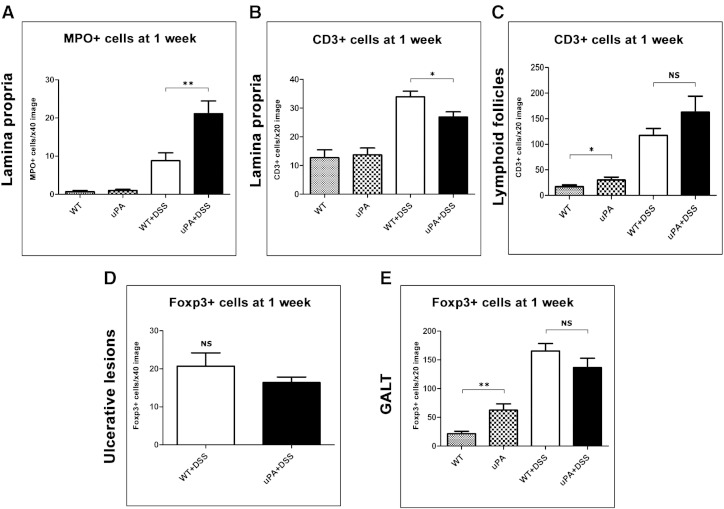
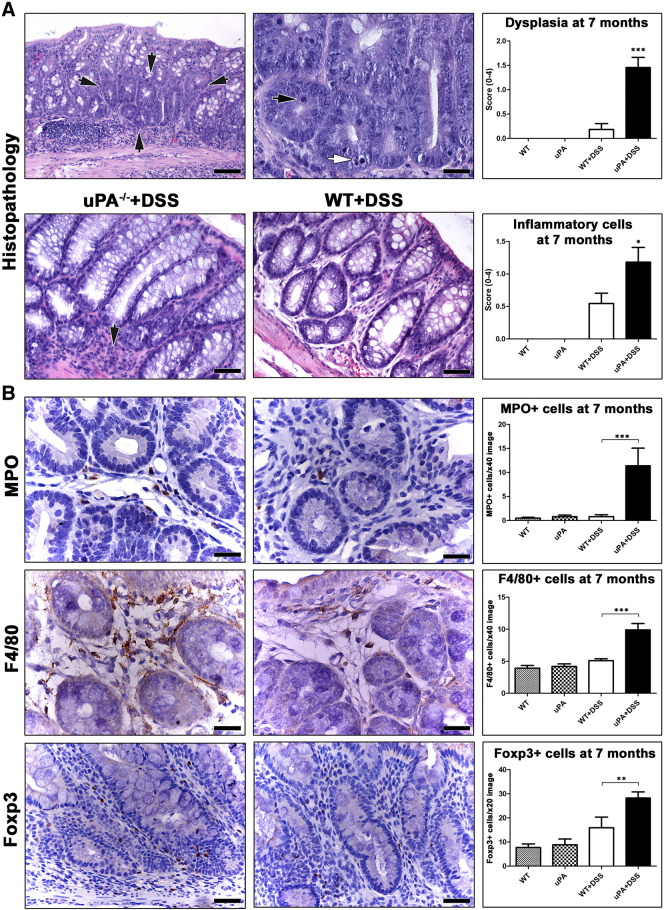
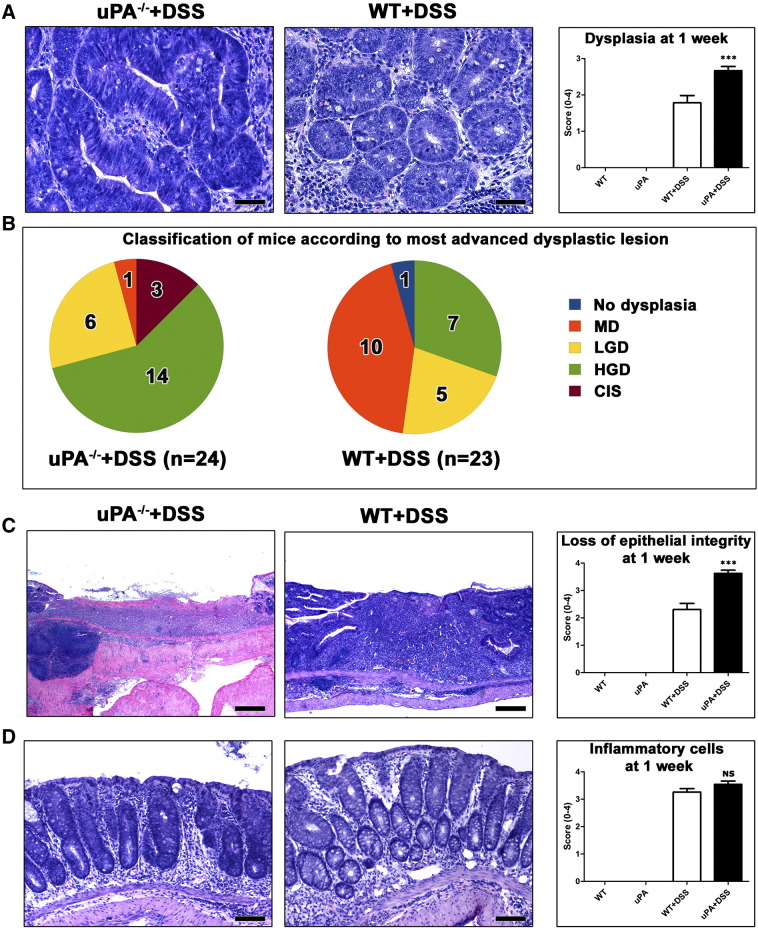
Urokinase-type plasminogen activator (uPA) participates in cancer-related biologic processes, such as wound healing and inflammation. The present study aimed to investigate the effect of uPA deficiency on the long-term outcome of early life episodes of dextran sodium sulfate (DSS)-induced colitis in mice. Wild-type (WT) and uPA-deficient (uPA(-/-)) BALB/c mice were treated with DSS or remained untreated. Mice were necropsied either 1 week or 7 months after DSS treatment. Colon samples were analyzed by histopathology, immunohistochemistry, ELISA, and real-time polymerase chain reaction. At 7 months, with no colitis evident, half of the uPA(-/-) mice had large colonic polypoid adenomas, whereas WT mice did not. One week after DSS treatment, there were typical DSS-induced colitis lesions in both WT and uPA(-/-) mice. The affected colon of uPA(-/-) mice, however, had features of delayed ulcer re-epithelialization and dysplastic lesions of higher grade developing on the basis of a significantly altered mucosal inflammatory milieu. The later was characterized by more neutrophils and macrophages, less regulatory T cells (Treg), significantly upregulated cytokines, including interleukin-6 (IL-6), IL-17, tumor necrosis factor-α, and IL-10, and lower levels of active transforming growth factor-β1 (TGF-β1) compared to WT mice. Dysfunctional Treg, more robust protumorigenic inflammatory events, and an inherited inability to produce adequate amounts of extracellular active TGF-β1 due to uPA deficiency are interlinked as probable explanations for the inflammatory-induced neoplasmatogenesis in the colon of uPA(-/-) mice.
尿激酶型纤溶酶原激活物 (uPA) 参与与癌症相关的生物学过程,如伤口愈合和炎症。本研究旨在探讨 uPA 缺乏对早期生活中葡聚糖硫酸钠 (DSS) 诱导的结肠炎小鼠长期结局的影响。野生型 (WT) 和 uPA 缺陷型 (uPA(-/-)) BALB/c 小鼠用 DSS 处理或不处理。在 DSS 处理后 1 周或 7 个月时对小鼠进行尸检。通过组织病理学、免疫组织化学、ELISA 和实时聚合酶链反应分析结肠样本。在 7 个月时,在没有结肠炎明显的情况下,一半的 uPA(-/-) 小鼠有大的结肠息肉状腺瘤,而 WT 小鼠没有。在 DSS 处理后 1 周,WT 和 uPA(-/-) 小鼠均有典型的 DSS 诱导的结肠炎病变。然而,uPA(-/-) 小鼠的受影响结肠具有延迟溃疡再上皮化的特征,并且在明显改变的粘膜炎症环境的基础上发展出更高等级的发育不良病变。后者的特征是更多的中性粒细胞和巨噬细胞,更少的调节性 T 细胞 (Treg),细胞因子包括白细胞介素-6 (IL-6)、IL-17、肿瘤坏死因子-α和 IL-10 的显著上调,以及活性转化生长因子-β1 (TGF-β1) 的水平较低与 WT 小鼠相比。由于 uPA 缺乏导致的 Treg 功能障碍、更强大的促肿瘤炎症事件以及不能产生足够数量的细胞外活性 TGF-β1 的遗传能力是 uPA(-/-) 小鼠结肠炎症诱导性肿瘤发生的可能解释。