Todi Subhash, Bhattacharya Mahuya
Department of Critical Care Medicine, AMRI Hospitals, Kolkata, West Bengal, India.
Indian J Crit Care Med. 2014 May;18(5):285-90. doi: 10.4103/0972-5229.132484.
Acute hyperglycemia, hypoglycemia and glycemic variability (GV) have been found to be the three principal domains of glycemic control, which can adversely affect patient outcome. GV may be the confounding factor in tight glycemic control trials in surgical and medical patient.
This study was conducted to establish if there was any relationship between GV and intensive care unit (ICU) mortality in the Indian context.
A retrospective review of a large cohort of prospectively collected database.
Adult Medical/Surgical/Trauma/Neuro ICU of a tertiary care hospital.
All patients who had four or more blood glucose measured during the ICU stay.
ICU mortality.
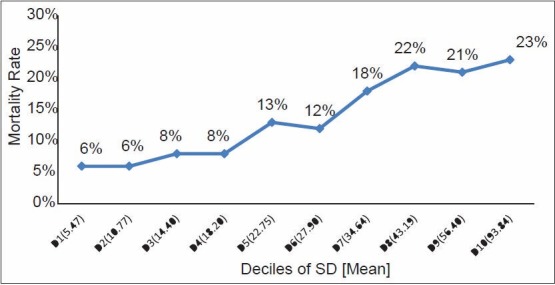
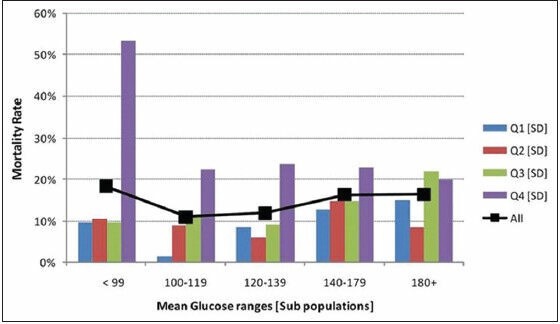
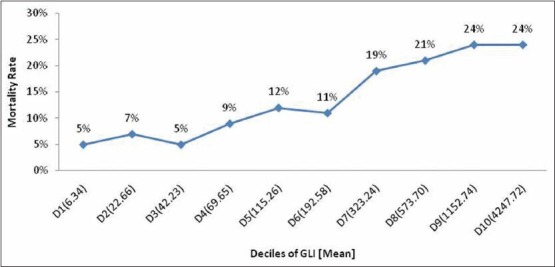
2208 patients with a total of 11,335 blood glucose values were analyzed. GV measured by the standard deviation (SD) of mean blood glucose and glycemic lability index (GLI), both were significantly (P < 0.001) associated with ICU mortality. This relationship was maintained (odds ratio (OR): 2.023, 95% confidence interval (CI): 1.483-2.758) even after excluding patients with hypoglycemia (<60 mg/dl). Patients with blood glucose values in the euglycemic range but highest SD had higher mortality (54%) compared to mortality (24%) in patients above the euglycemic range. Similarly patients with blood sugar values below the average for study cohort and high GLI, another marker of GV had higher mortality (OR: 5.62, CI: 3.865-8.198) than compared to patients in the hyperglycemic range, reflecting the importance of GV as a prognostic marker in patients with blood sugar in the euglycemic range.
This study demonstrated that high glucose variability is associated with increased ICU mortality in a large heterogeneous cohort of ICU patients. This effect was particularly evident among patients in the euglycemic range.
急性高血糖、低血糖和血糖变异性(GV)已被发现是血糖控制的三个主要方面,它们会对患者的预后产生不利影响。GV可能是手术和内科患者严格血糖控制试验中的混杂因素。
本研究旨在确定在印度背景下,GV与重症监护病房(ICU)死亡率之间是否存在任何关联。
对大量前瞻性收集的数据库进行回顾性分析。
一家三级医院的成人内科/外科/创伤/神经ICU。
所有在ICU住院期间测量了四次或更多次血糖的患者。
ICU死亡率。
对2208例患者的11335次血糖值进行了分析。通过平均血糖标准差(SD)和血糖不稳定指数(GLI)测量的GV均与ICU死亡率显著相关(P<0.001)。即使排除低血糖患者(<60mg/dl),这种关系仍然存在(比值比(OR):2.023,95%置信区间(CI):1.483-2.758)。血糖值处于正常血糖范围但标准差最高的患者死亡率(54%)高于正常血糖范围以上患者的死亡率(24%)。同样,血糖值低于研究队列平均值且GLI高(GV的另一个指标)的患者死亡率(OR:5.62,CI:3.865-8.198)高于高血糖范围的患者,这反映了GV作为正常血糖范围内血糖患者预后标志物的重要性。
本研究表明,在一大组异质性ICU患者中,高血糖变异性与ICU死亡率增加相关。这种影响在正常血糖范围内的患者中尤为明显。