Estrada Karol, Aukrust Ingvild, Bjørkhaug Lise, Burtt Noël P, Mercader Josep M, García-Ortiz Humberto, Huerta-Chagoya Alicia, Moreno-Macías Hortensia, Walford Geoffrey, Flannick Jason, Williams Amy L, Gómez-Vázquez María J, Fernandez-Lopez Juan C, Martínez-Hernández Angélica, Jiménez-Morales Silvia, Centeno-Cruz Federico, Mendoza-Caamal Elvia, Revilla-Monsalve Cristina, Islas-Andrade Sergio, Córdova Emilio J, Soberón Xavier, González-Villalpando María E, Henderson E, Wilkens Lynne R, Le Marchand Loic, Arellano-Campos Olimpia, Ordóñez-Sánchez Maria L, Rodríguez-Torres Maribel, Rodríguez-Guillén Rosario, Riba Laura, Najmi Laeya A, Jacobs Suzanne B R, Fennell Timothy, Gabriel Stacey, Fontanillas Pierre, Hanis Craig L, Lehman Donna M, Jenkinson Christopher P, Abboud Hanna E, Bell Graeme I, Cortes Maria L, Boehnke Michael, González-Villalpando Clicerio, Orozco Lorena, Haiman Christopher A, Tusié-Luna Teresa, Aguilar-Salinas Carlos A, Altshuler David, Njølstad Pål R, Florez Jose C, MacArthur Daniel G
Program in Medical and Population Genetics, Broad Institute of Harvard and MIT, Cambridge, Massachusetts2Analytic and Translational Genetics Unit, Massachusetts General Hospital, Boston3Department of Medicine, Harvard Medical School, Boston, Massachusetts.
KG Jebsen Center for Diabetes Research, Department of Clinical Science, University of Bergen, Bergen, Norway6Department of Biomedicine, University of Bergen, Bergen, Norway.
JAMA. 2014 Jun 11;311(22):2305-14. doi: 10.1001/jama.2014.6511.
Latino populations have one of the highest prevalences of type 2 diabetes worldwide.
To investigate the association between rare protein-coding genetic variants and prevalence of type 2 diabetes in a large Latino population and to explore potential molecular and physiological mechanisms for the observed relationships.
DESIGN, SETTING, AND PARTICIPANTS: Whole-exome sequencing was performed on DNA samples from 3756 Mexican and US Latino individuals (1794 with type 2 diabetes and 1962 without diabetes) recruited from 1993 to 2013. One variant was further tested for allele frequency and association with type 2 diabetes in large multiethnic data sets of 14,276 participants and characterized in experimental assays.
Prevalence of type 2 diabetes. Secondary outcomes included age of onset, body mass index, and effect on protein function.
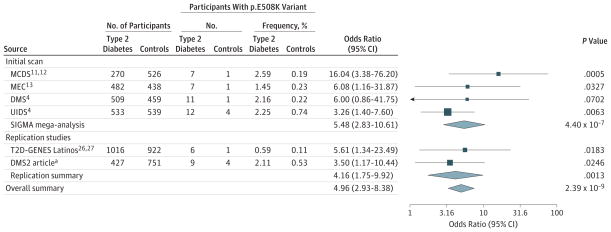
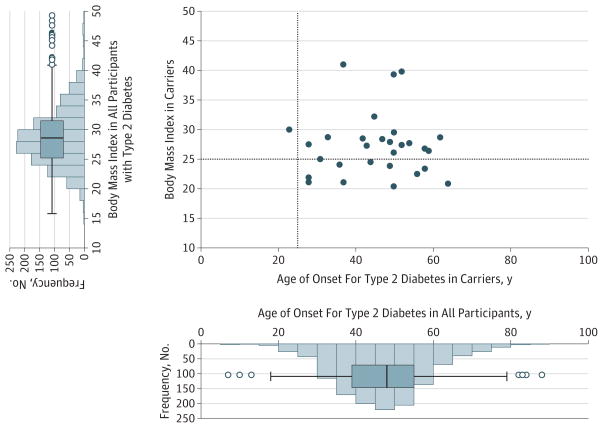
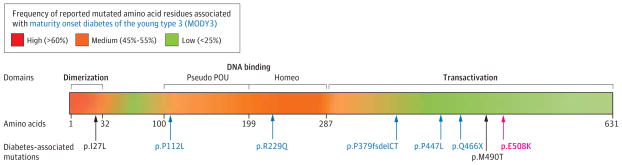
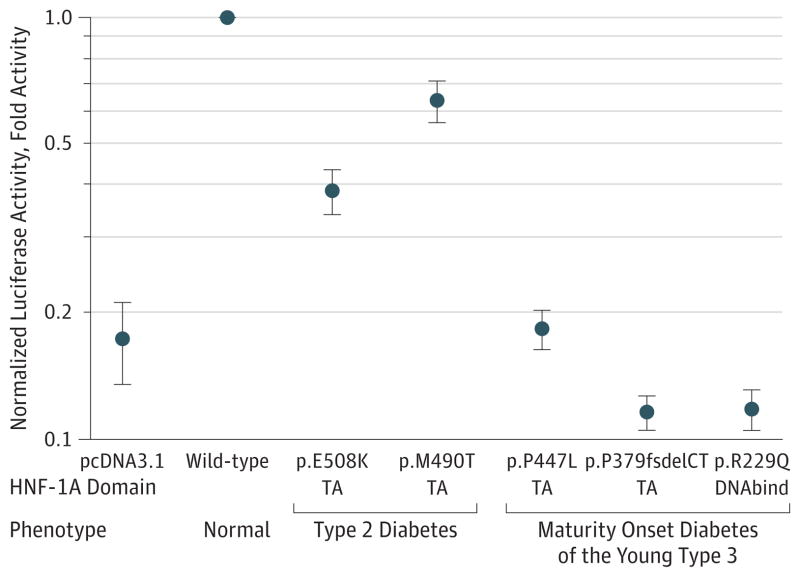
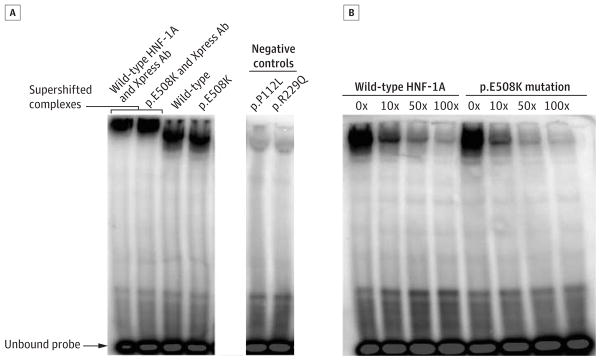
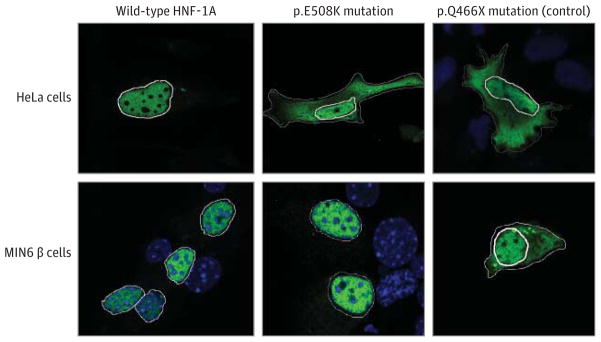
A single rare missense variant (c.1522G>A [p.E508K]) was associated with type 2 diabetes prevalence (odds ratio [OR], 5.48; 95% CI, 2.83-10.61; P = 4.4 × 10(-7)) in hepatocyte nuclear factor 1-α (HNF1A), the gene responsible for maturity onset diabetes of the young type 3 (MODY3). This variant was observed in 0.36% of participants without type 2 diabetes and 2.1% of participants with it. In multiethnic replication data sets, the p.E508K variant was seen only in Latino patients (n = 1443 with type 2 diabetes and 1673 without it) and was associated with type 2 diabetes (OR, 4.16; 95% CI, 1.75-9.92; P = .0013). In experimental assays, HNF-1A protein encoding the p.E508K mutant demonstrated reduced transactivation activity of its target promoter compared with a wild-type protein. In our data, carriers and noncarriers of the p.E508K mutation with type 2 diabetes had no significant differences in compared clinical characteristics, including age at onset. The mean (SD) age for carriers was 45.3 years (11.2) vs 47.5 years (11.5) for noncarriers (P = .49) and the mean (SD) BMI for carriers was 28.2 (5.5) vs 29.3 (5.3) for noncarriers (P = .19).
Using whole-exome sequencing, we identified a single low-frequency variant in the MODY3-causing gene HNF1A that is associated with type 2 diabetes in Latino populations and may affect protein function. This finding may have implications for screening and therapeutic modification in this population, but additional studies are required.
拉丁裔人群是全球2型糖尿病患病率最高的群体之一。
在大量拉丁裔人群中研究罕见蛋白质编码基因变异与2型糖尿病患病率之间的关联,并探讨所观察到的关系的潜在分子和生理机制。
设计、地点和参与者:对1993年至2013年招募的3756名墨西哥和美国拉丁裔个体(1794名2型糖尿病患者和1962名非糖尿病患者)的DNA样本进行全外显子组测序。在14276名参与者的大型多民族数据集中,对一个变异进行了等位基因频率和与2型糖尿病关联的进一步检测,并在实验分析中对其进行了表征。
2型糖尿病患病率。次要结局包括发病年龄、体重指数以及对蛋白质功能的影响。
一个罕见的错义变异(c.1522G>A [p.E508K])与2型糖尿病患病率相关(优势比[OR],5.48;95%置信区间,2.83 - 10.61;P = 4.4×10⁻⁷),该变异位于肝细胞核因子1-α(HNF1A)基因中,该基因是导致青年型3型成年发病型糖尿病(MODY3)的原因。在无2型糖尿病的参与者中,该变异的观察频率为0.36%,在有2型糖尿病的参与者中为2.1%。在多民族重复数据集中,p.E508K变异仅在拉丁裔患者中出现(1443名2型糖尿病患者和1673名非糖尿病患者),并且与2型糖尿病相关(OR,4.16;95%置信区间,1.75 - 9.92;P = 0.0013)。在实验分析中,编码p.E508K突变体的HNF - 1A蛋白与其野生型蛋白相比,其靶启动子的反式激活活性降低。在我们的数据中,患有2型糖尿病的p.E508K突变携带者和非携带者在包括发病年龄在内的临床特征方面没有显著差异。携带者的平均(标准差)年龄为45.3岁(11.2),非携带者为47.5岁(11.5)(P = 0.49),携带者的平均(标准差)体重指数为28.2(5.5),非携带者为29.3(5.3)(P = 0.19)。
通过全外显子组测序,我们在导致MODY3的基因HNF1A中鉴定出一个单一的低频变异,该变异与拉丁裔人群的2型糖尿病相关,并且可能影响蛋白质功能。这一发现可能对该人群的筛查和治疗调整具有意义,但还需要更多研究。