Müller Barbara, Anders Maria, Reinstein Jochen
Department of Infectious Diseases, Virology, University Hospital Heidelberg, Heidelberg, Germany.
Department of Biomolecular Mechanisms, Max Planck Institute for Medical Research, Heidelberg, Germany.
PLoS One. 2014 Jun 10;9(6):e99504. doi: 10.1371/journal.pone.0099504. eCollection 2014.
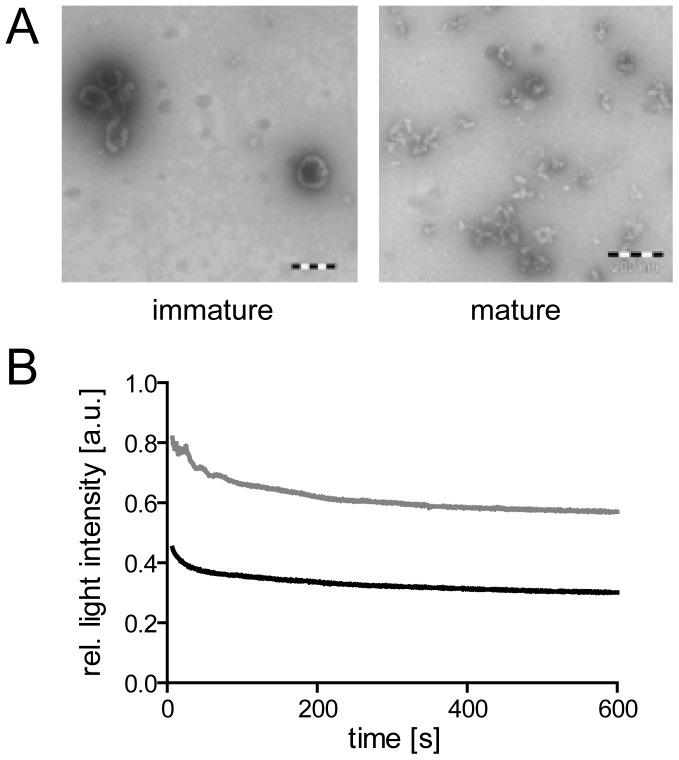
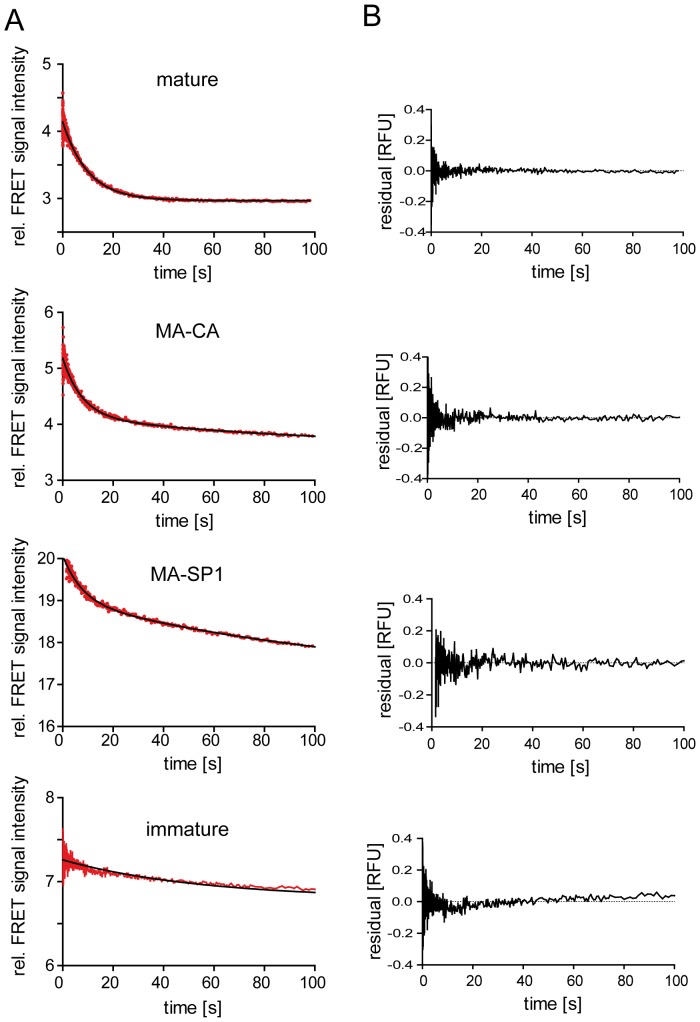
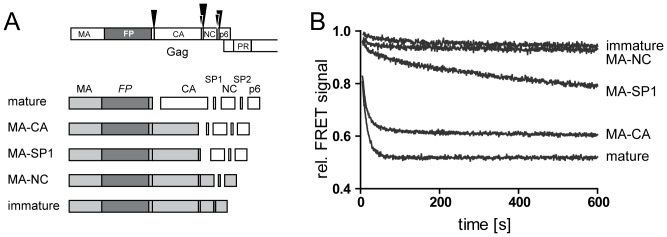
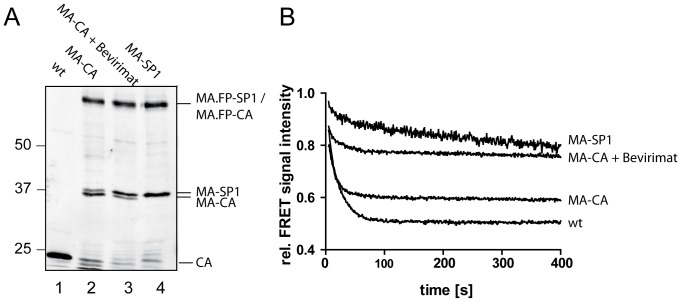
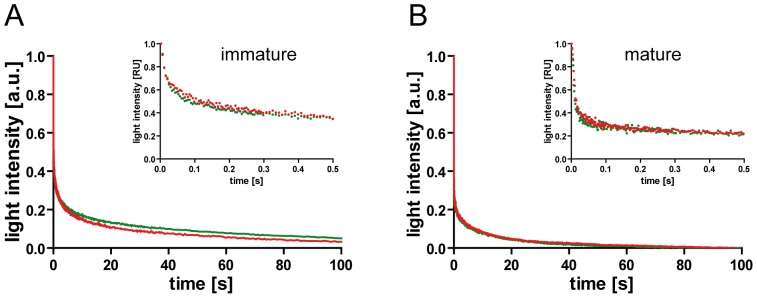
Human immunodeficiency virus particles undergo a step of proteolytic maturation, in which the main structural polyprotein Gag is cleaved into its mature subunits matrix (MA), capsid (CA), nucleocapsid (NC) and p6. Gag proteolytic processing is accompanied by a dramatic structural rearrangement within the virion, which is necessary for virus infectivity and has been proposed to proceed through a sequence of dissociation and reformation of the capsid lattice. Morphological maturation appears to be tightly regulated, with sequential cleavage events and two small spacer peptides within Gag playing important roles by regulating the disassembly of the immature capsid layer and formation of the mature capsid lattice. In order to measure the influence of individual Gag domains on lattice stability, we established Förster's resonance energy transfer (FRET) reporter virions and employed rapid kinetic FRET and light scatter measurements. This approach allowed us to measure dissociation properties of HIV-1 particles assembled in eukaryotic cells containing Gag proteins in different states of proteolytic processing. While the complex dissociation behavior of the particles prevented an assignment of kinetic rate constants to individual dissociation steps, our analyses revealed characteristic differences in the dissociation properties of the MA layer dependent on the presence of additional domains. The most striking effect observed here was a pronounced stabilization of the MA-CA layer mediated by the presence of the 14 amino acid long spacer peptide SP1 at the CA C-terminus, underlining the crucial role of this peptide for the resolution of the immature particle architecture.
人类免疫缺陷病毒颗粒经历一个蛋白水解成熟步骤,其中主要结构多聚蛋白Gag被切割成其成熟亚基基质(MA)、衣壳(CA)、核衣壳(NC)和p6。Gag的蛋白水解加工伴随着病毒粒子内显著的结构重排,这对于病毒感染性是必需的,并且有人提出这一过程是通过衣壳晶格的一系列解离和重新形成来进行的。形态成熟似乎受到严格调控,Gag内的连续切割事件和两个小间隔肽通过调节未成熟衣壳层的解体和成熟衣壳晶格的形成发挥重要作用。为了测量单个Gag结构域对晶格稳定性的影响,我们建立了福斯特共振能量转移(FRET)报告病毒粒子,并采用快速动力学FRET和光散射测量。这种方法使我们能够测量在含有处于不同蛋白水解加工状态的Gag蛋白的真核细胞中组装的HIV-1颗粒的解离特性。虽然颗粒的复杂解离行为阻止了将动力学速率常数分配给各个解离步骤,但我们的分析揭示了依赖于其他结构域的存在,MA层解离特性的特征差异。此处观察到的最显著效应是由CA C末端14个氨基酸长的间隔肽SP1的存在介导的MA-CA层的显著稳定,强调了该肽对于解决未成熟颗粒结构的关键作用。