Baines Holly L, Stewart James B, Stamp Craig, Zupanic Anze, Kirkwood Thomas B L, Larsson Nils-Göran, Turnbull Douglass M, Greaves Laura C
Centre for Brain Ageing and Vitality, Institute for Ageing and Health, The Medical School, Newcastle upon Tyne NE2 4HH, UK.
Max Planck Institute for Biology of Ageing, Cologne, Germany.
Mech Ageing Dev. 2014 Jul;139:22-30. doi: 10.1016/j.mad.2014.06.003. Epub 2014 Jun 7.
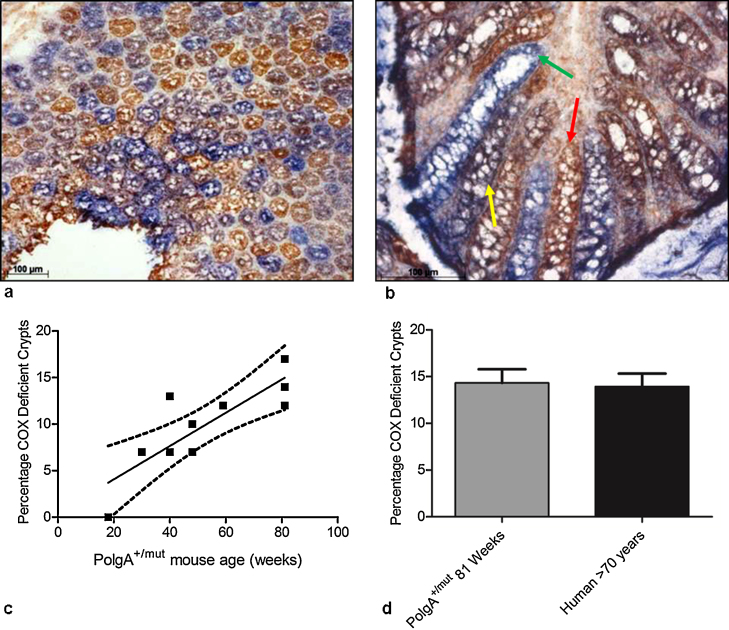
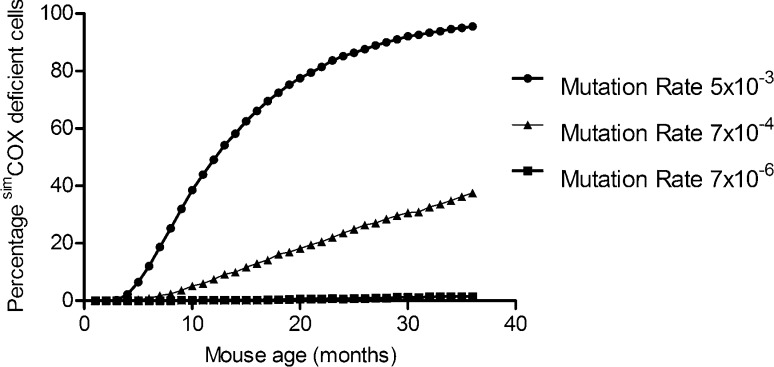
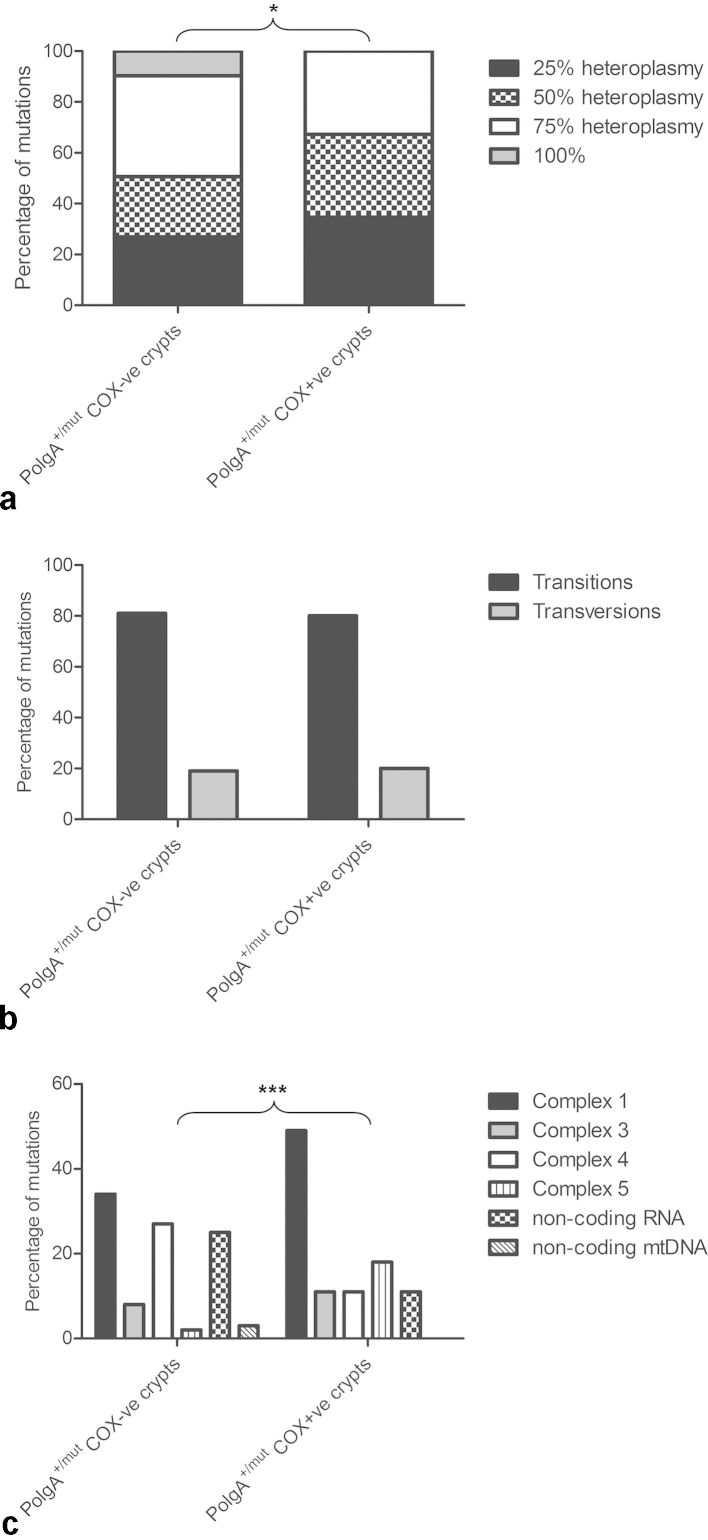
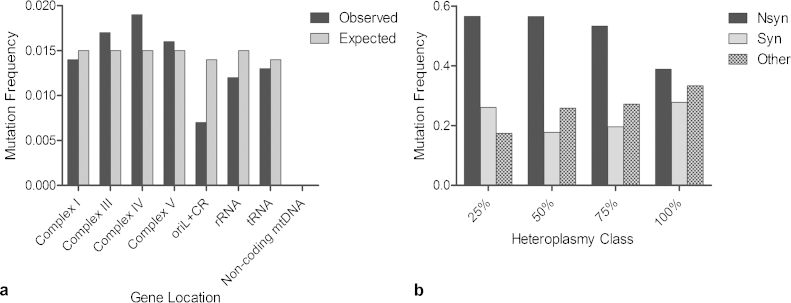
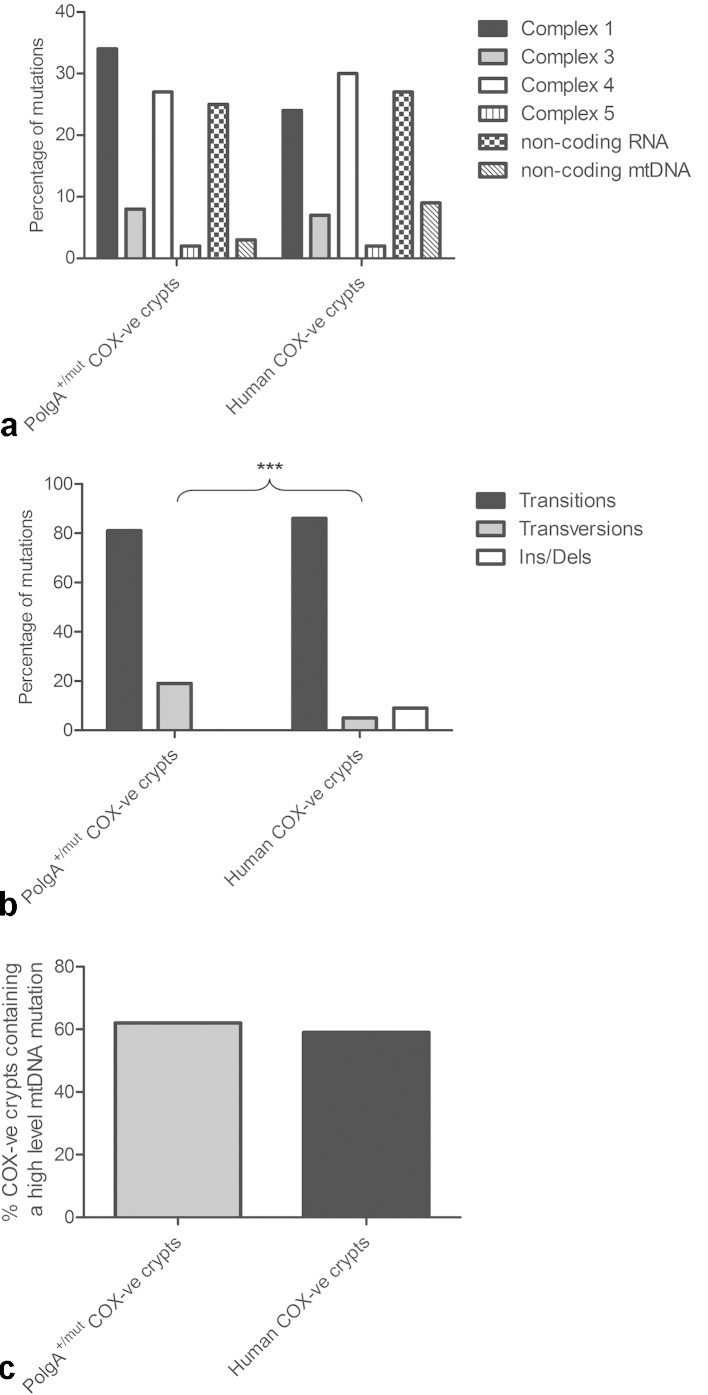
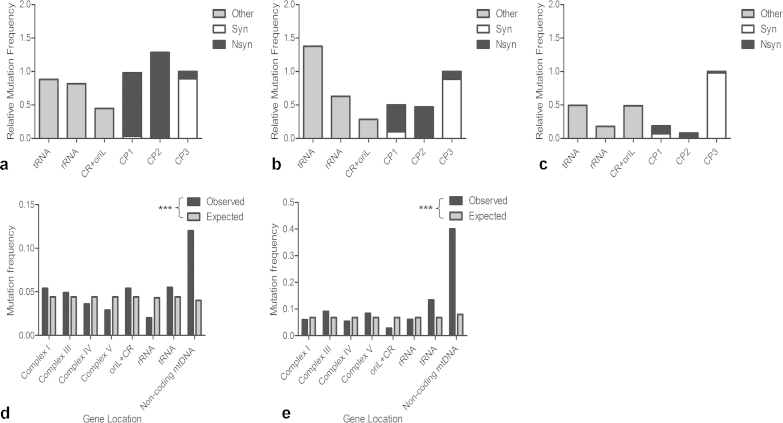
Clonally expanded mitochondrial DNA (mtDNA) mutations resulting in focal respiratory chain deficiency in individual cells are proposed to contribute to the ageing of human tissues that depend on adult stem cells for self-renewal; however, the consequences of these mutations remain unclear. A good animal model is required to investigate this further; but it is unknown whether mechanisms for clonal expansion of mtDNA mutations, and the mutational spectra, are similar between species. Here we show that mice, heterozygous for a mutation disrupting the proof-reading activity of mtDNA polymerase (PolgA(+/mut)) resulting in an increased mtDNA mutation rate, accumulate clonally expanded mtDNA point mutations in their colonic crypts with age. This results in focal respiratory chain deficiency, and by 81 weeks of age these animals exhibit a similar level and pattern of respiratory chain deficiency to 70-year-old human subjects. Furthermore, like in humans, the mtDNA mutation spectrum appears random and there is an absence of selective constraints. Computer simulations show that a random genetic drift model of mtDNA clonal expansion can accurately model the data from the colonic crypts of wild-type, PolgA(+/mut) animals, and humans, providing evidence for a similar mechanism for clonal expansion of mtDNA point mutations between these mice and humans.
克隆性扩增的线粒体DNA(mtDNA)突变导致单个细胞中局灶性呼吸链缺陷,这被认为与依赖成体干细胞进行自我更新的人体组织衰老有关;然而,这些突变的后果仍不清楚。需要一个良好的动物模型来进一步研究这一问题;但目前尚不清楚mtDNA突变的克隆性扩增机制以及突变谱在不同物种之间是否相似。在这里,我们表明,携带破坏mtDNA聚合酶校对活性的突变(PolgA(+/mut))的杂合小鼠,其mtDNA突变率增加,随着年龄增长,其结肠隐窝中会积累克隆性扩增的mtDNA点突变。这导致局灶性呼吸链缺陷,到81周龄时,这些动物表现出与70岁人类受试者相似水平和模式的呼吸链缺陷。此外,与人类一样,mtDNA突变谱似乎是随机的,并且不存在选择限制。计算机模拟表明,mtDNA克隆性扩增的随机遗传漂变模型可以准确模拟野生型、PolgA(+/mut)动物以及人类结肠隐窝的数据,为这些小鼠和人类之间mtDNA点突变的克隆性扩增机制相似提供了证据。