Tol Jacqueline, Swinkels Ilse C, De Bakker Dinny H, Veenhof Cindy, Seidell Jaap C
NIVEL (The Netherlands Institute for Health Services Research), P,O, box 1568, Utrecht 3500 BN, The Netherlands.
BMC Public Health. 2014 Jun 11;14:582. doi: 10.1186/1471-2458-14-582.
The prevalence of obesity is growing worldwide. Obesity guidelines recommend increasing the level of weight-related care for persons with elevated levels of weight-related health risk (WRHR). However, there seems to be a discrepancy between need for and use of weight-related care. The primary aim of this study is to examine predisposing factors that may influence readiness to lose weight and intention to use weight-related care in an overweight population.
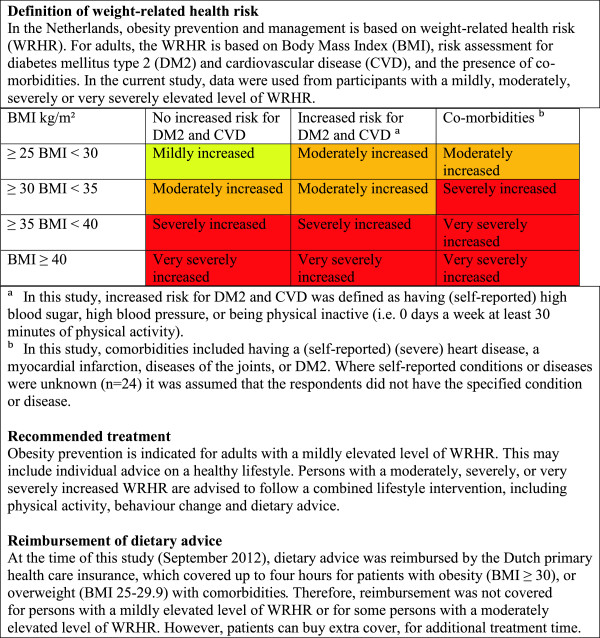
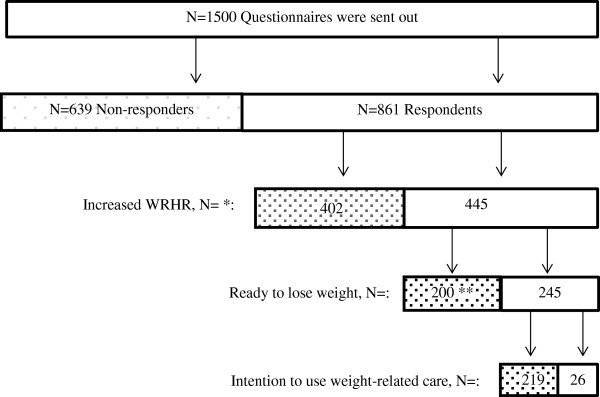
A population-based, cross-sectional survey was conducted. Data were collected using an online self-administered questionnaire sent to a population-representative sample of 1,500 Dutch adults on the Health Care Consumer Panel (n = 861 responded). Data were used from individuals (n = 445) with a mildly, moderately or severely elevated level of WRHR. WRHR status was based on self-reported data on Body Mass Index, risk assessment for diabetes mellitus type 2 (DM2) and cardiovascular disease (CVD), or co-morbidities.
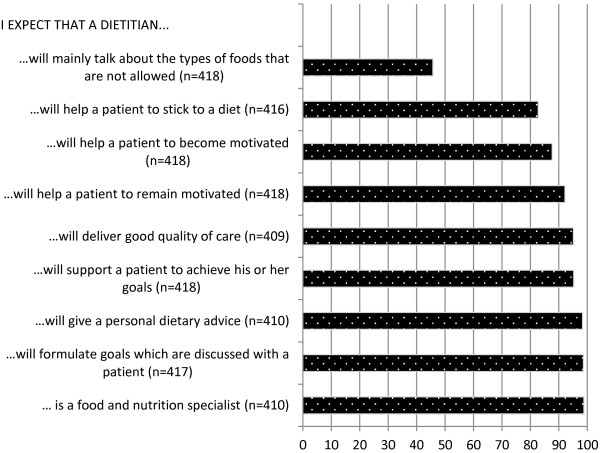
55.1% of persons with increased WRHR were ready to lose weight (n = 245). Depending on level of WRHR; educational level, marital status, individuals with an accurate perception of their weight and better perceptions and expectations of dietitians were significantly related to readiness to lose weight. Most of them preferred individual weight-loss methods (82.0% of n = 245). 11% (n = 26 of n = 245) intended to use weight-related care. Weight-related care seeking was higher for those with moderate or severe WRHR. Expectations and trust in dietitians did not seem to influence care seeking.
Many Dutch adults who are medically in need of weight-related care are ready to lose weight. Most intend to lose weight individually, and only a few intend to use weight-related care. Therefore, obesity prevention initiatives should focus on monitoring weight change and weight-loss plans, and timely referral to obesity management. However, many people are not ready to lose weight. For this group, strategies for behaviour change may depend on WRHR, perceptions of weight and dietitians, educational level and marital status. Obesity prevention initiatives should focus on increasing the awareness of the seriousness of their condition and offering individually appropriate weight management programmes.
全球肥胖症患病率正在上升。肥胖症指南建议,对于体重相关健康风险(WRHR)水平升高的人群,应提高与体重相关护理的水平。然而,在对体重相关护理的需求和使用之间似乎存在差异。本研究的主要目的是调查可能影响超重人群减肥意愿和使用体重相关护理意愿的诱发因素。
开展了一项基于人群的横断面调查。通过向荷兰医疗保健消费者小组中1500名具有人群代表性的成年人发送在线自填问卷来收集数据(n = 861人回复)。使用了WRHR水平轻度、中度或重度升高的个体(n = 445)的数据。WRHR状态基于自我报告的体重指数、2型糖尿病(DM2)和心血管疾病(CVD)风险评估或合并症数据。
WRHR升高的人群中,55.1%的人准备好减肥(n = 245)。根据WRHR水平;教育程度、婚姻状况、对自己体重有准确认知的个体以及对营养师有更好认知和期望的个体与减肥意愿显著相关。他们中的大多数人更喜欢个体化的减肥方法(n = 245中的82.0%)。11%(n = 245中的26人)打算使用体重相关护理。WRHR为中度或重度的人群寻求体重相关护理的比例更高。对营养师的期望和信任似乎并未影响护理寻求行为。
许多在医学上需要体重相关护理的荷兰成年人准备好减肥。大多数人打算单独减肥,只有少数人打算使用体重相关护理。因此,肥胖预防举措应侧重于监测体重变化和减肥计划,并及时转诊至肥胖管理。然而,许多人尚未准备好减肥。对于这一群体,行为改变策略可能取决于WRHR、对体重和营养师的认知、教育程度和婚姻状况。肥胖预防举措应侧重于提高他们对自身病情严重性的认识,并提供适合个体的体重管理方案。