Haddad Fares Sami, Sukeik Mohamed, Alazzawi Sulaiman
Department of Trauma and Orthopaedics, University College London Hospital, 235 Euston Road, London, NW1 2BU, UK.
Clin Orthop Relat Res. 2015 Jan;473(1):8-14. doi: 10.1007/s11999-014-3721-8.
The increasing number of patients experiencing periprosthetic total knee arthroplasty (TKA) infections and the cost of treating them suggest that we seek alternatives to two-stage revision. Single-stage revision is a potential alternative to the standard two-stage procedure because it involves only one surgical procedure, so if it is comparably effective, it would be associated with less patient morbidity and lower cost.
QUESTIONS/PURPOSES: We compared (1) the degree to which our protocol of a highly selective single-stage revision approach achieved infection control compared with a two-stage revision approach to TKA infections; and (2) Knee Society scores and radiographic evidence of implant fixation between the single-stage and two-stage patients who were treated for more complicated infections.
Between 2004 and 2009, we treated 102 patients for chronic TKA infections, of whom 28 (27%) were treated using a single-stage approach and 74 (73%) were treated using a two-stage approach. All patients were available for followup at a minimum of 3 years (mean, 6.5 years; range, 3-9 years). The indications for using a single-stage approach were minimal/moderate bone loss, the absence of immunocompromise, healthy soft tissues, and a known organism with known sensitivities for which appropriate antibiotics are available. Participants included 38 men and 64 women with a mean age of 65 years (range, 45-87 years). We used the Musculoskeletal Infection Society definition of periprosthetic joint infection to confirm infection control at the last followup appointment. Radiographs were evaluated for signs of loosening, and patients completed Knee Society Scores for clinical evaluation.
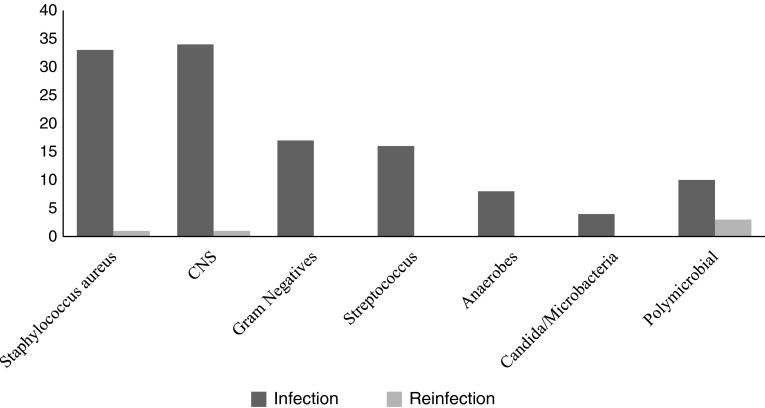
None of the patients in the single-stage revision group developed recurrence of infection, and five patients (93%) in the two-stage revision group developed reinfection (p=0.16). Patients treated with a single-stage approach had higher Knee Society scores than did patients treated with the two-stage approach (88 versus 76, p<0.001). However, radiographic findings showed a well-fixed prosthesis in all patients with no evidence of loosening at last followup in either group.
Our data provide preliminary support to the use of a single-stage approach in highly selected patients with chronically infected TKAs as an alternative to a two-stage procedure. However, larger, multicenter, prospective trials are called for to validate our findings.
Level III, therapeutic study. See Instructions for Authors for a complete description of levels of evidence.
接受全膝关节置换术(TKA)后假体周围感染的患者数量不断增加,以及治疗这些感染的成本表明,我们需要寻求两阶段翻修术的替代方法。单阶段翻修术是标准两阶段手术的一种潜在替代方法,因为它只涉及一次外科手术,所以如果它具有同等疗效,那么患者的发病率会更低,成本也会更低。
问题/目的:我们比较了(1)与TKA感染的两阶段翻修方法相比,我们高度选择性单阶段翻修方法方案实现感染控制的程度;(2)接受更复杂感染治疗的单阶段和两阶段患者之间的膝关节协会评分以及植入物固定的影像学证据。
2004年至2009年期间,我们治疗了102例慢性TKA感染患者,其中28例(27%)采用单阶段方法治疗,74例(73%)采用两阶段方法治疗。所有患者均至少随访3年(平均6.5年;范围3 - 9年)。采用单阶段方法的指征为轻度/中度骨丢失、无免疫功能低下、健康的软组织以及已知有敏感性且有合适抗生素可用的已知病原体。参与者包括38名男性和64名女性,平均年龄65岁(范围45 - 87岁)。我们采用肌肉骨骼感染协会对假体周围关节感染的定义来确认在最后一次随访时的感染控制情况。对X线片进行松动迹象评估,患者完成膝关节协会评分以进行临床评估。
单阶段翻修组中没有患者发生感染复发,两阶段翻修组中有5例患者(93%)发生再感染(p = 0.16)。采用单阶段方法治疗的患者膝关节协会评分高于采用两阶段方法治疗的患者(88分对76分,p < 0.001)。然而,影像学检查结果显示所有患者的假体固定良好,两组在最后一次随访时均无松动迹象。
我们的数据为在经过严格筛选的慢性感染TKA患者中使用单阶段方法替代两阶段手术提供了初步支持。然而,需要更大规模、多中心的前瞻性试验来验证我们的发现。
III级,治疗性研究。有关证据水平的完整描述,请参阅作者指南。