Wu Ying, Liu Hong-Bing, Shi Xue-Fei, Song Yong
Department of Respiratory Medicine, Jinling Hospital, Nanjing University School of Medicine, Nanjing, China.
PLoS One. 2014 Jun 12;9(6):e99577. doi: 10.1371/journal.pone.0099577. eCollection 2014.
Accumulating evidence suggests that hypoglycaemic agents influence lung cancer risk in patients with diabetes. It remains to be fully elucidated whether conventional hypoglycaemic agents (metformin, sulfonylureas, thiazolidinediones [TZDs] or insulin) affect lung cancer incidence in patients with diabetes.
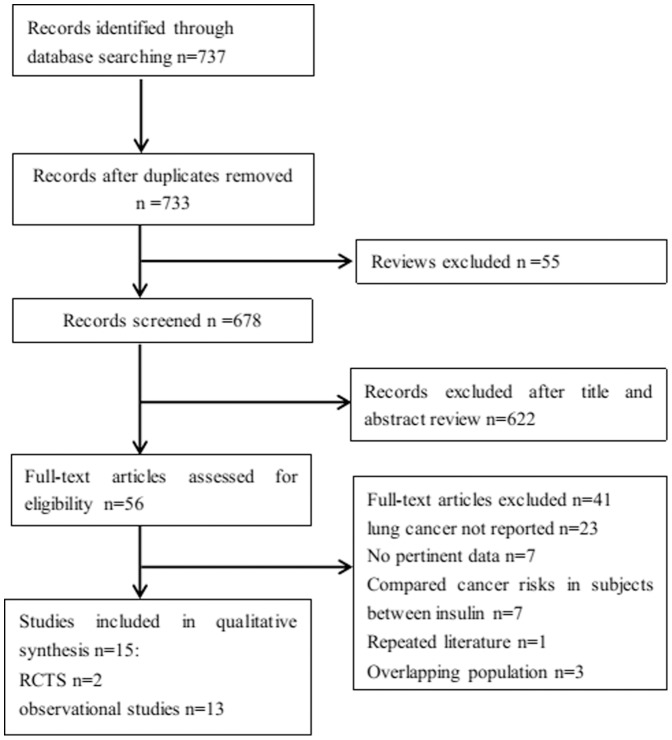
We performed a meta-analysis using EMBASE, MEDLINE and Web of Science to search randomised controlled trials (RCTs), cohort studies, and case-control studies published up to October 2013 that assessed the effects of metformin, sulfonylurea, TZDs or insulin on lung cancer risk in subjects with diabetes. Fixed and random effects meta-analysis models were used, and the effect size was expressed as a summary odds ratio (OR) with 95% confidence intervals (CI). The Grades of Research, Assessment, Development and Evaluation (GRADE) approach was applied to define the quality of the evidence.
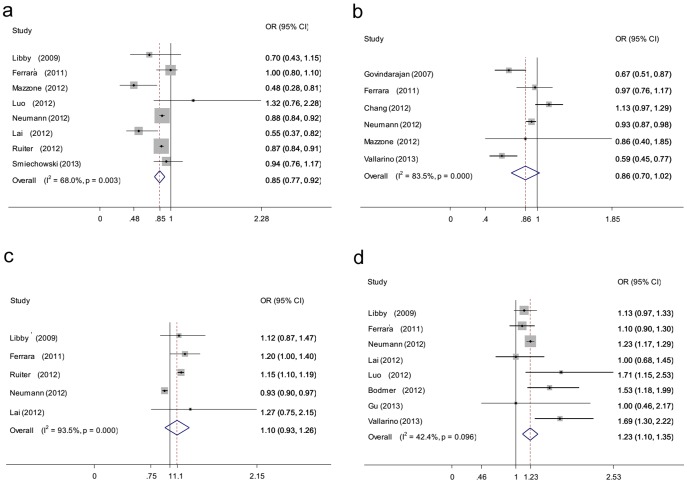
Analysis of 15 studies (11 cohort studies, 2 case-control studies, and 2 RCTs) showed that metformin use was associated with a 15% reduction in risk of lung cancer (OR 0.85, 95% CI 0.77 to 0.92), but this finding was not supported by sub-analysis of smoking-adjusted studies (OR 0.84, 95% CI 0.61 to 1.06). Moreover, sulfonylurea or TZDs use was not associated with increased or decreased lung cancer risk, respectively (OR 1.10, 95% CI 0.93 to 1.26), (OR 0.86, 95% CI 0.70 to 1.02). Higher lung cancer risk was related to insulin (OR 1.23, 95% CI 1.10 to 1.35). However, all data from RCTs failed to demonstrate a statistically significant effect.
This analysis demonstrated that metformin use may reduce lung cancer risk in patients with diabetes but not in a smoking-adjusted subgroup and that insulin use may be associated with an increased lung cancer risk in subjects with diabetes.
越来越多的证据表明,降糖药物会影响糖尿病患者患肺癌的风险。传统降糖药物(二甲双胍、磺脲类药物、噻唑烷二酮类药物[TZDs]或胰岛素)是否会影响糖尿病患者的肺癌发病率仍有待充分阐明。
我们使用EMBASE、MEDLINE和科学网进行了一项荟萃分析,以检索截至2013年10月发表的随机对照试验(RCT)、队列研究和病例对照研究,这些研究评估了二甲双胍、磺脲类药物、TZDs或胰岛素对糖尿病患者肺癌风险的影响。使用固定效应和随机效应荟萃分析模型,效应大小表示为汇总比值比(OR)及95%置信区间(CI)。采用研究、评估、发展与评价分级(GRADE)方法来界定证据质量。
对15项研究(11项队列研究、2项病例对照研究和2项RCT)的分析表明,使用二甲双胍与肺癌风险降低15%相关(OR 0.85,95% CI 0.77至0.92),但经吸烟调整研究的亚组分析未支持这一发现(OR 0.84,95% CI 0.61至1.06)。此外,使用磺脲类药物或TZDs分别与肺癌风险增加或降低无关(OR 1.10,95% CI 0.93至1.26),(OR 0.86,95% CI 0.70至1.02)。较高的肺癌风险与胰岛素相关(OR 1.23,95% CI 1.10至1.35)。然而,来自RCT的所有数据均未显示出统计学上的显著效果。
该分析表明,使用二甲双胍可能降低糖尿病患者的肺癌风险,但在经吸烟调整的亚组中并非如此,且使用胰岛素可能与糖尿病患者的肺癌风险增加相关。