Park Kyungjoon, Song Beomjong, Kim Jeongyeon, Hong Ingie, Song Sangho, Lee Junuk, Park Sungmo, Kim Jihye, An Bobae, Lee Hyun Woo, Lee Seungbok, Kim Hyun, Lee Justin C, Lee Sukwon, Choi Sukwoo
School of Biological Sciences, College of Natural Sciences, Seoul National University, Seoul, Korea (ROK).
Center for Neural Science and Center for Connectomics, Korea Institute of Science and Technology, Seoul, Korea (ROK).
PLoS One. 2014 Jun 12;9(6):e100108. doi: 10.1371/journal.pone.0100108. eCollection 2014.
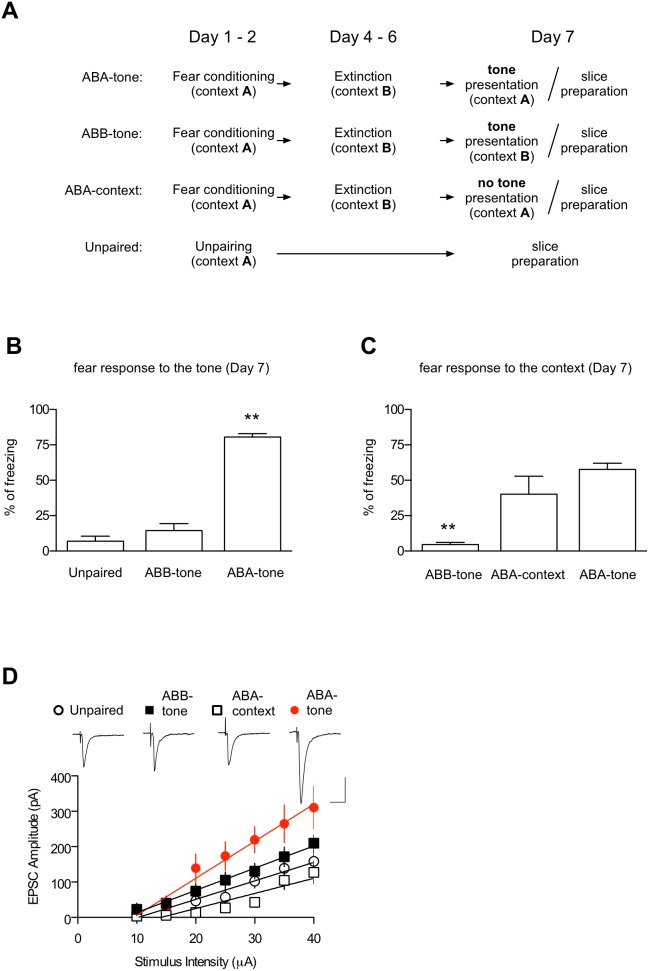
Fear renewal, the context-specific relapse of fear following fear extinction, is a leading animal model of post-traumatic stress disorders (PTSD) and fear-related disorders. Although fear extinction can diminish fear responses, this effect is restricted to the context where the extinction is carried out, and the extinguished fear strongly relapses when assessed in the original acquisition context (ABA renewal) or in a context distinct from the conditioning and extinction contexts (ABC renewal). We have previously identified Ser831 phosphorylation of GluA1 subunit in the lateral amygdala (LA) as a key molecular mechanism for ABC renewal. However, molecular mechanisms underlying ABA renewal remain to be elucidated. Here, we found that both the excitatory synaptic efficacy and GluA2-lacking AMPAR activity at thalamic input synapses onto the LA (T-LA synapses) were enhanced upon ABA renewal. GluA2-lacking AMPAR activity was also increased during low-threshold potentiation, a potential cellular substrate of renewal, at T-LA synapses. The microinjection of 1-naphtylacetyl-spermine (NASPM), a selective blocker of GluA2-lacking AMPARs, into the LA attenuated ABA renewal, suggesting a critical role of GluA2-lacking AMPARs in ABA renewal. We also found that Ser831 phosphorylation of GluA1 in the LA was increased upon ABA renewal. We developed a short peptide mimicking the Ser831-containing C-tail region of GluA1, which can be phosphorylated upon renewal (GluA1S); thus, the phosphorylated GluA1S may compete with Ser831-phosphorylated GluA1. This GluA1S peptide blocked the low-threshold potentiation when dialyzed into a recorded neuron. The microinjection of a cell-permeable form of GluA1S peptide into the LA attenuated ABA renewal. In support of the GluA1S experiments, a GluA1D peptide (in which the serine at 831 is replaced with a phosphomimetic amino acid, aspartate) attenuated ABA renewal when microinjected into the LA. These findings suggest that enhancements in both the GluA2-lacking AMPAR activity and GluA1 phosphorylation at Ser831 are required for ABA renewal.
恐惧恢复,即恐惧消退后特定情境下恐惧的复发,是创伤后应激障碍(PTSD)及恐惧相关障碍的主要动物模型。尽管恐惧消退可减弱恐惧反应,但这种效应仅限于进行消退的情境,并且当在原始习得情境(ABA恢复)或与条件化和消退情境不同的情境(ABC恢复)中进行评估时,消退的恐惧会强烈复发。我们之前已确定外侧杏仁核(LA)中GluA1亚基的Ser831磷酸化是ABC恢复的关键分子机制。然而,ABA恢复背后的分子机制仍有待阐明。在此,我们发现,在ABA恢复时,丘脑输入到LA的突触(T-LA突触)上的兴奋性突触效能和缺乏GluA2的AMPAR活性均增强。在T-LA突触的低阈值增强过程中,缺乏GluA2的AMPAR活性也增加,低阈值增强是恢复的一种潜在细胞底物。向LA微量注射1-萘乙酰精胺(NASPM),一种缺乏GluA2的AMPAR的选择性阻断剂,可减弱ABA恢复,这表明缺乏GluA2的AMPAR在ABA恢复中起关键作用。我们还发现,在ABA恢复时,LA中GluA1的Ser831磷酸化增加。我们开发了一种短肽,其模拟GluA1含Ser831的C末端区域,在恢复时可被磷酸化(GluA1S);因此,磷酸化的GluA1S可能与Ser831磷酸化的GluA1竞争。当将这种GluA1S肽透析到记录的神经元中时,它会阻断低阈值增强。向LA微量注射可透过细胞的GluA1S肽形式可减弱ABA恢复。作为对GluA1S实验的支持,当向LA微量注射GluA1D肽(其中831位的丝氨酸被模拟磷酸化的氨基酸天冬氨酸取代)时,可减弱ABA恢复。这些发现表明,ABA恢复需要缺乏GluA2的AMPAR活性和GluA1在Ser831处的磷酸化均增强。