Mansfield Aaron Scott, Roden Anja C, Peikert Tobias, Sheinin Yuri M, Harrington Susan M, Krco Christopher J, Dong Haidong, Kwon Eugene D
Division of Medical Oncology, Mayo Clinic, Rochester, MN.
Department of Laboratory Medicine and Pathology, Mayo Clinic, Rochester, MN.
J Thorac Oncol. 2014 Jul;9(7):1036-1040. doi: 10.1097/JTO.0000000000000177.
B7 homolog 1 (B7-H1; aka programmed cell death 1 ligand 1) is a negative costimulatory molecule that is associated with poor prognosis in many tumor types. Given the poor prognosis and the limited treatments available for mesothelioma, we decided to examine B7-H1 expression and its association with survival in patients with mesothelioma.
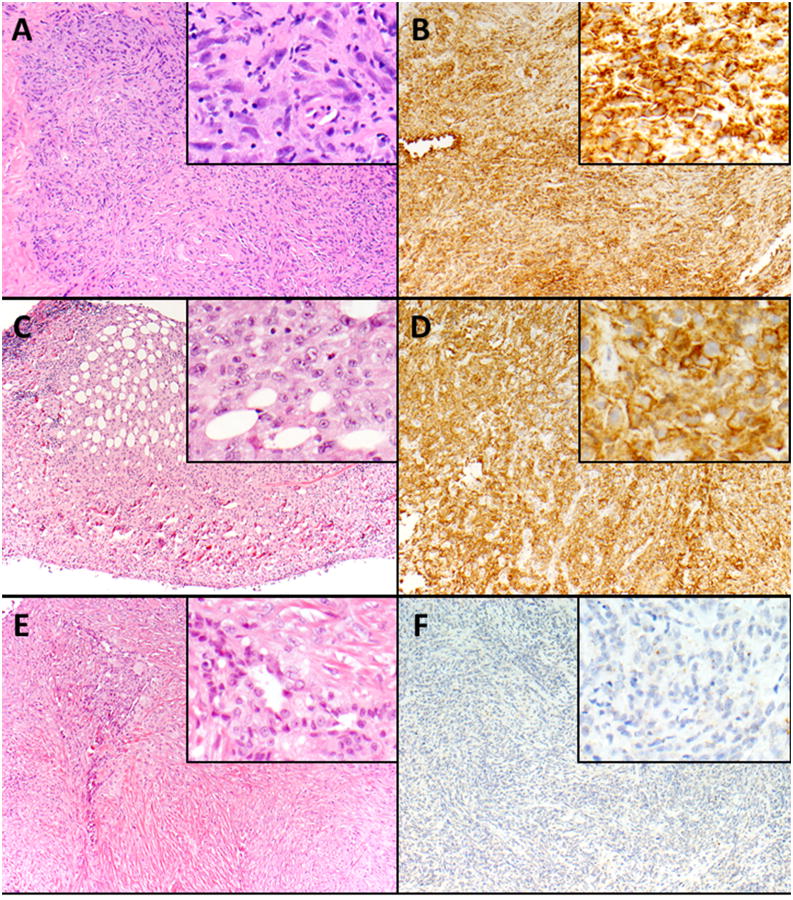
Expression of B7-H1 was determined in 106 patients using a mouse monoclonal antihuman B7-H1 (clone 5H1-A3) antibody with immunohistochemistry. Positive expression was defined as ≥5% positively stained cells. Clinicopathologic features and survival were compared between B7-H1-positive and B7-H1-negative groups.
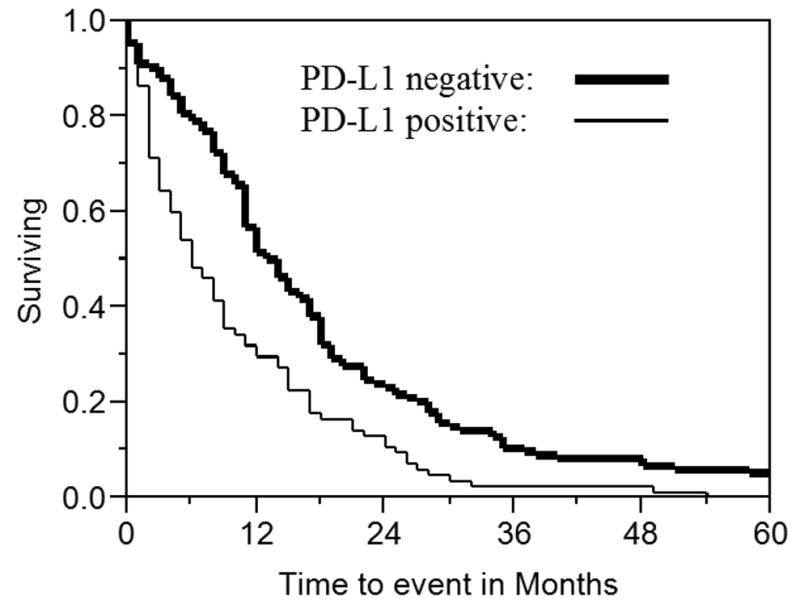
Malignant mesotheliomas of 42 patients (40%) expressed B7-H1. Patients with B7-H1-postive tumors were less likely to be offered or undergo therapeutic surgery (p = 0.03). All sarcomatoid mesotheliomas except one desmoplastic subtype expressed B7-H1. Survival was significantly decreased for patients whose tumors expressed B7-H1 (5 months median, 2-9.5 months interquartile range) compared with those whose tumors did not (14.5 months, 9.25-19 months; p < 0.0001). In a multivariate model, B7-H1 expression and sarcomatoid mesothelioma remained significantly associated with worse survival (risk ratio 1.71, 95% confidence interval 1.03-2.78 [p = 0.04] and risk ratio 2.18, 1.08-4.23 [p = 0.03], respectively).
B7-H1 is expressed in a substantial proportion of malignant pleural mesotheliomas and is associated with poor survival. Almost all malignant pleural mesotheliomas with sarcomatoid differentiation expressed B7-H1. The expression of B7-H1 may have important therapeutic implications for the management of malignant pleural mesothelioma.
B7同源物1(B7-H1;又名程序性细胞死亡1配体1)是一种负性共刺激分子,与多种肿瘤类型的不良预后相关。鉴于间皮瘤预后较差且可用治疗方法有限,我们决定研究B7-H1在间皮瘤患者中的表达及其与生存的关系。
使用小鼠单克隆抗人B7-H1(克隆5H1-A3)抗体通过免疫组织化学法检测106例患者中B7-H1的表达。阳性表达定义为阳性染色细胞≥5%。比较B7-H1阳性组和B7-H1阴性组的临床病理特征及生存情况。
42例患者(40%)的恶性间皮瘤表达B7-H1。B7-H1阳性肿瘤患者接受治疗性手术的可能性较小(p = 0.03)。除一种促纤维组织增生性亚型外,所有肉瘤样间皮瘤均表达B7-H1。肿瘤表达B7-H1的患者生存时间显著缩短(中位生存时间5个月,四分位间距2 - 9.5个月),而肿瘤未表达B7-H1的患者生存时间为14.5个月(9.25 - 19个月;p < 0.0001)。在多变量模型中,B7-H1表达和肉瘤样间皮瘤仍与较差的生存显著相关(风险比分别为1.71,95%置信区间1.03 - 2.78 [p = 0.04]和风险比2.18,1.08 - 4.23 [p = 0.03])。
B7-H1在相当比例的恶性胸膜间皮瘤中表达,且与生存不良相关。几乎所有具有肉瘤样分化的恶性胸膜间皮瘤均表达B7-H1。B7-H1的表达可能对恶性胸膜间皮瘤的治疗具有重要意义。