Gibbs R B, Nelson D, Hammond R
University of Pittsburgh School of Pharmacy, 1004 Salk Hall, Pittsburgh, PA 15261, USA.
University of Pittsburgh School of Pharmacy, 1004 Salk Hall, Pittsburgh, PA 15261, USA.
Horm Behav. 2014 Jul;66(2):339-45. doi: 10.1016/j.yhbeh.2014.06.002. Epub 2014 Jun 11.
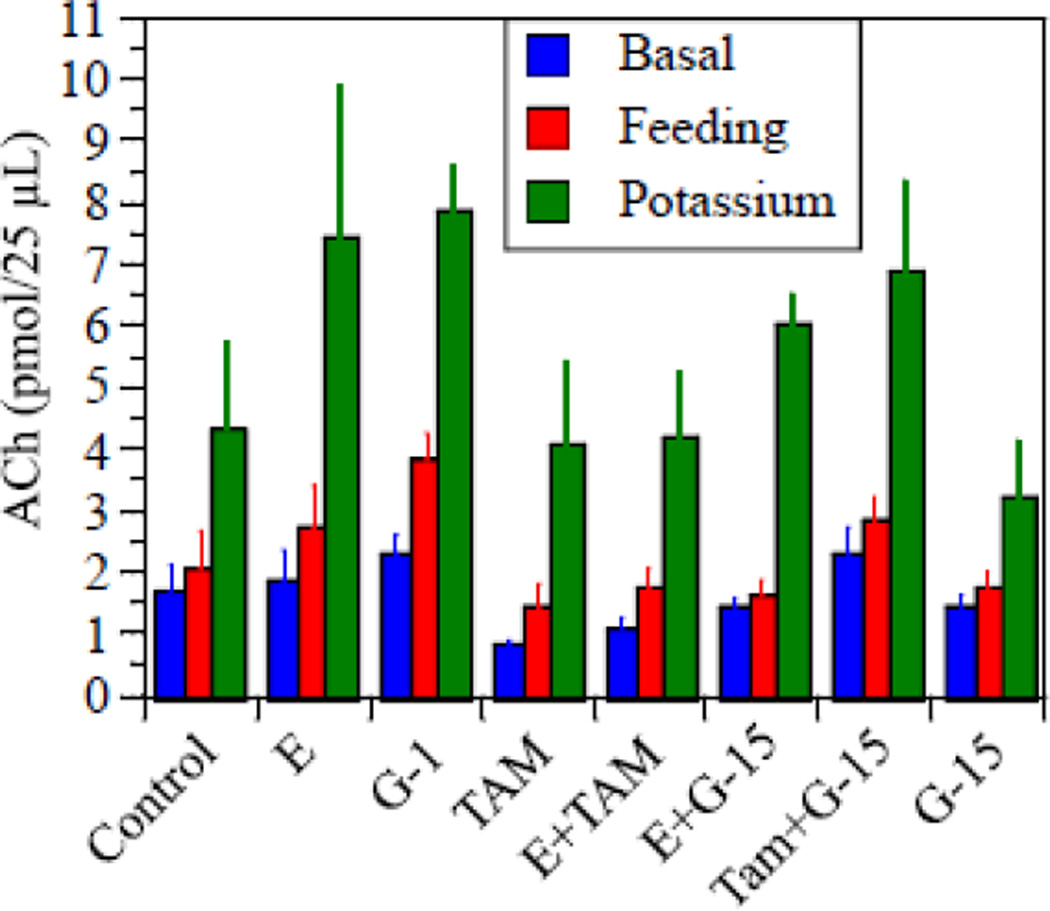
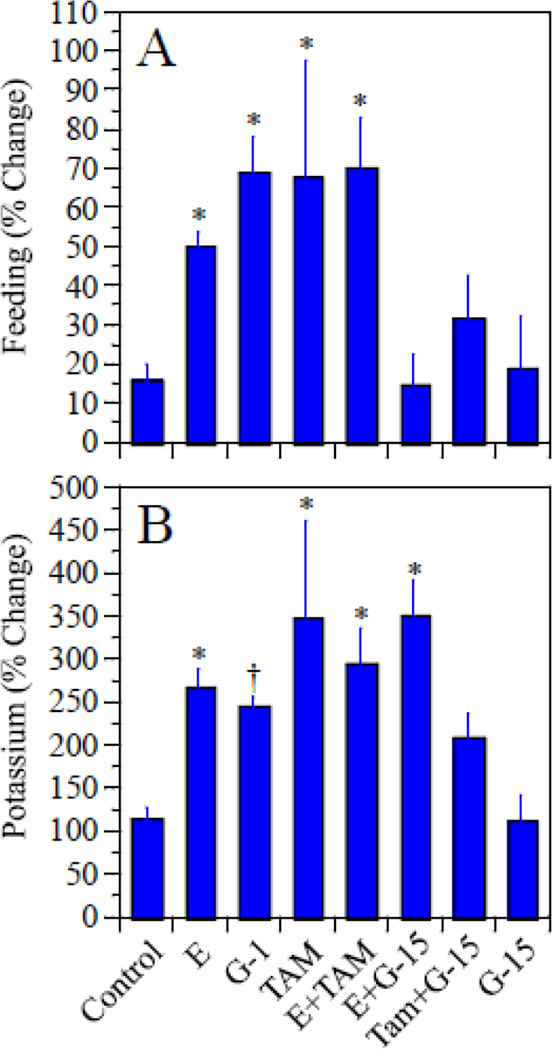
We have hypothesized that estradiol enhances basal forebrain cholinergic function and cognitive performance, at least in part, via activation of the novel estrogen receptor GPR30. Here we evaluated the effects of estradiol, G-1 (a selective GPR30 agonist), and tamoxifen (TAM; an ERα/ERβ antagonist that also acts as a GPR30 agonist), on acetylcholine (ACh) release in the hippocampus, as well as the ability to block the effects of 17β-estradiol (E) or TAM with the GPR30 antagonist G-15. Note that G-1 was included to evaluate the effects of selectively activating GPR30, whereas TAM was included to differentiate effects of E associated with activation of GPR30 vs. ERα or ERβ. The study was designed to test effects on potassium-stimulated release, as well as on ACh release stimulated by feeding. Effects of feeding were included because the tasks we used previously to demonstrate beneficial effects of E on cognitive performance were motivated by food reward, and we hypothesized that E may enhance performance by increasing ACh release in association with that reward. Ovariectomized rats were treated for 1week, and ACh release was evaluated using in vivo microdialysis. In addition, rats were fed at the same time daily for several days and were fasted overnight prior to microdialysis. For each rat, ACh release was evaluated under basal conditions, in response to feeding, and in response to elevated potassium. Both feeding and elevated potassium increased ACh release in the hippocampus. In response to feeding, E, G-1, and TAM all significantly increased the percent change in release. The effects of E and TAM were blocked by G-15, and the effects of combining E+TAM did not differ significantly from the effects of E or TAM alone. In response to elevated potassium, E, and TAM significantly increased the percent change in ACh release. G-1 produced a slightly lesser effect. The effect of TAM was reduced by G-15, but the effect of E was not. These findings suggest that activation of GPR30 is both necessary and sufficient to account for the effects of E on ACh release associated with feeding. In contrast, activation of GPR30 appears to be sufficient, but may not be necessary for increased release associated with elevated potassium. The changes associated with feeding are consistent with the effects of E, G-1 and G-15 on acquisition of a spatial learning task previously described. These data confirm and extend previous reports, and support a hypothesis wherein E treatment can improve learning on specific tasks by activating GPR30 and enhancing ACh release in association with food reward.
我们已经提出假设,即雌二醇至少部分地通过激活新型雌激素受体GPR30来增强基底前脑胆碱能功能和认知表现。在此,我们评估了雌二醇、G-1(一种选择性GPR30激动剂)和他莫昔芬(TAM;一种ERα/ERβ拮抗剂,也可作为GPR30激动剂)对海马中乙酰胆碱(ACh)释放的影响,以及用GPR30拮抗剂G-15阻断17β-雌二醇(E)或TAM作用的能力。请注意,纳入G-1是为了评估选择性激活GPR30的效果,而纳入TAM是为了区分与GPR30激活相关的E的作用与ERα或ERβ激活相关的E的作用。该研究旨在测试对钾刺激释放以及进食刺激的ACh释放的影响。纳入进食的影响是因为我们之前用于证明E对认知表现有益作用的任务是由食物奖励驱动的,并且我们假设E可能通过增加与该奖励相关的ACh释放来提高表现。对去卵巢大鼠进行为期1周的治疗,并使用体内微透析评估ACh释放。此外,大鼠连续几天每天在同一时间进食,并在微透析前禁食过夜。对于每只大鼠,在基础条件下、对进食的反应以及对钾升高的反应下评估ACh释放。进食和钾升高均增加了海马中的ACh释放。对进食的反应中,E、G-1和TAM均显著增加了释放的百分比变化。E和TAM的作用被G-15阻断,并且E+TAM联合使用的效果与单独使用E或TAM的效果无显著差异。对钾升高的反应中,E和TAM显著增加了ACh释放的百分比变化。G-1产生了稍小的作用。TAM的作用被G-15降低,但E的作用未被降低。这些发现表明,激活GPR30对于E对与进食相关的ACh释放的影响既是必要的也是充分的。相比之下,激活GPR30似乎是充分的,但对于与钾升高相关的释放增加可能不是必要的。与进食相关的变化与之前描述的E、G-1和G-15对空间学习任务习得的影响一致。这些数据证实并扩展了先前的报道,并支持一种假设,即E治疗可以通过激活GPR30并增强与食物奖励相关的ACh释放来改善特定任务的学习能力。