Hayashi Shinya, Tanaka Hidekazu, Kajiura Yuuichi, Ohno Yasushi, Hoshi Hiroaki
Department of Radiology, Gifu University Graduate School of Medicine, Yanagido 1-1, Gifu 501-1194, Japan.
Radiat Oncol. 2014 Jun 16;9:138. doi: 10.1186/1748-717X-9-138.
Stereotactic body radiotherapy (SBRT) for non-small cell lung cancer (NSCLC) is primarily a treatment option for medically inoperable patients, who are often elderly. However, few studies report the effects of SBRT in elderly patients. Thus, we retrospectively analyzed clinical outcomes and feasibility following treatment of very elderly patients (age ≥ 85 years) with stage Ι NSCLC and younger patients (age < 85 years) with SBRT in our institution.
From January 2006 to December 2012, 81 patients (20 very elderly; median age, 80 years; age range 64-93 years) with stage Ι NSCLC received SBRT. Prescription doses of 48 Gy were delivered in 4 fractions over 2 weeks or doses of 60 Gy were delivered in 10 fractions over 3 weeks.
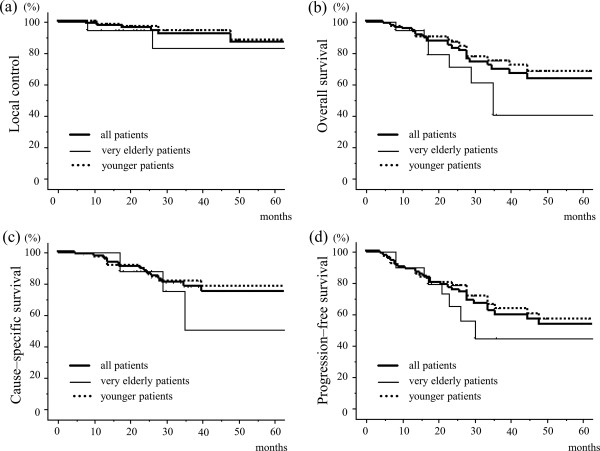
Local control was achieved in 91.8% of all patients at 3 years (83.1% and 93.8% of very elderly and younger patients, respectively), and the 3-year overall survival (OS) rate was 69.4% (40.7% and 75.0% of very elderly and younger patients, respectively). OS rates were significantly shorter for the very elderly group than for the younger group, with a 3-year cause-specific survival (CSS) rate of 77.9% (50.4% and 81.6% of very elderly and younger patients, respectively) and a 3-year progression-free survival (PFS) rate of 59.5% (44.7% and 63.5% in very elderly and younger groups, respectively). Multivariate analysis revealed a significant correlation between T stage and OS. Grades 2 and 3 radiation pneumonitis (RP) occurred in 7 (8.6%) and 2 (2.5%) patients, respectively. Among patients of very elderly and younger groups, grade 2 RP occurred in 4 (20%) and 3 (4.9%) patients, and grade 3 occurred in 2 (10%) and 0 (0%) patients, respectively. No grade 4 or 5 toxicity was observed, RP was significantly more severe among very elderly patients.
SBRT for stage Ι NSCLC was well tolerated and feasible in very elderly patients. The efficacy of SBRT was comparable to that achieved in younger patients, although very elderly patients experienced significantly more severe RP. Although this study cohort included only 20 very elderly patients, the present data suggest that decreasing volumes of normal lung tissues exposed to ≥ 20 Gy and mean lung doses reduces the risk of RP in very elderly patients. The present data warrant studies of larger very elderly cohorts.
立体定向体部放疗(SBRT)用于非小细胞肺癌(NSCLC)主要是针对那些通常为老年的医学上无法手术的患者的一种治疗选择。然而,很少有研究报道SBRT在老年患者中的效果。因此,我们回顾性分析了我院对年龄≥85岁的Ⅰ期NSCLC老年患者和年龄<85岁的年轻患者进行SBRT治疗后的临床结果和可行性。
2006年1月至2012年12月,81例Ⅰ期NSCLC患者(20例老年患者;中位年龄80岁;年龄范围64 - 93岁)接受了SBRT。处方剂量48 Gy分4次在2周内给予,或剂量60 Gy分10次在3周内给予。
所有患者3年局部控制率为91.8%(老年患者和年轻患者分别为83.1%和93.8%),3年总生存率(OS)为69.4%(老年患者和年轻患者分别为40.7%和75.0%)。老年组的OS率显著短于年轻组,3年疾病特异性生存率(CSS)为77.9%(老年患者和年轻患者分别为50.4%和81.6%),3年无进展生存率(PFS)为59.5%(老年组和年轻组分别为44.7%和63.5%)。多因素分析显示T分期与OS之间存在显著相关性。2级和3级放射性肺炎(RP)分别发生在7例(8.6%)和2例(%)患者中。在老年组和年轻组患者中,2级RP分别发生在4例(20%)和3例(4.9%)患者中,3级分别发生在2例(10%)和0例(0%)患者中。未观察到4级或5级毒性,老年患者的RP明显更严重。
SBRT用于Ⅰ期NSCLC在老年患者中耐受性良好且可行。SBRT的疗效与年轻患者相当,尽管老年患者的RP明显更严重。尽管本研究队列仅包括20例老年患者,但目前的数据表明减少暴露于≥20 Gy的正常肺组织体积和平均肺剂量可降低老年患者发生RP的风险。目前的数据值得对更大规模的老年队列进行研究。