Nohlert Eva, Ohrvik John, Helgason Asgeir R
Centre for Clinical Research, Uppsala University, Västmanland County Hospital, Västerås 721 89, Sweden.
Department of Medicine, Karolinska Institutet, Stockholm, Sweden.
Tob Induc Dis. 2014 Jun 3;12(1):9. doi: 10.1186/1617-9625-12-9. eCollection 2014.
The Swedish National Tobacco Quitline (SNTQ), which has both a proactive and a reactive service, has successfully provided tobacco cessation support since 1998. As there is a demand for an increase in national cessation support, and because the quitline works under funding constraints, it is crucial to identify the most clinically effective and cost-effective service. A randomized controlled trial was performed to compare the effectiveness of the high-intensity proactive service with the low-intensity reactive service at the SNTQ.
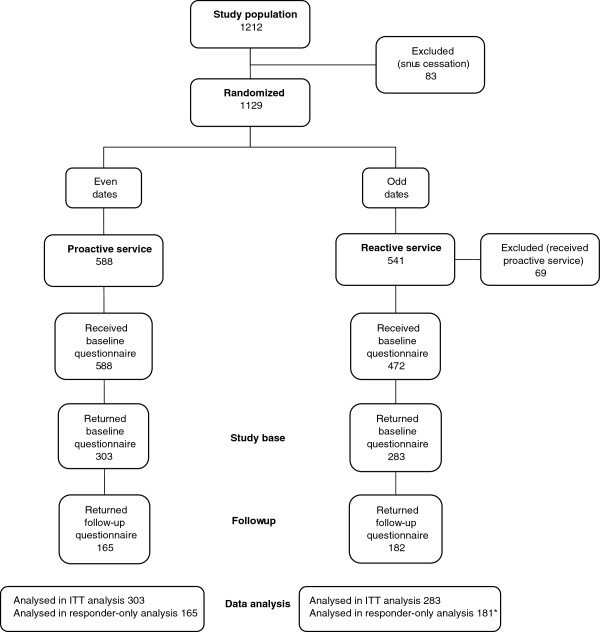
Those who called the SNTQ for smoking or tobacco cessation from February 2009 to September 2010 were randomized to proactive service (even dates) and reactive service (odd dates). Data were collected through postal questionnaires at baseline and after 12 months. Those who replied to the baseline questionnaire constituted the study base. Outcome measures were self-reported point prevalence and 6-month continuous abstinence at the 12-month follow-up. Intention-to-treat (ITT) and responder-only analyses were performed.
The study base consisted of 586 persons, and 59% completed the 12-month follow-up. Neither ITT- nor responder-only analyses showed any differences in outcome between proactive and reactive service. Point prevalence was 27% and continuous abstinence was 21% in analyses treating non-responders as smokers, and 47% and 35%, respectively, in responder-only analyses.
Reactive service may be used as the standard procedure to optimize resource utilization at the SNTQ. However, further research is needed to assess effectiveness in different subgroups of clients.
ClinicalTrials.gov: NCT02085616.
瑞典国家戒烟热线(SNTQ)自1998年以来成功提供戒烟支持,其服务包括主动服务和被动服务。由于全国对戒烟支持的需求增加,且戒烟热线在资金限制下运作,确定最具临床效果和成本效益的服务至关重要。进行了一项随机对照试验,以比较SNTQ高强度主动服务与低强度被动服务的效果。
2009年2月至2010年9月拨打SNTQ咨询吸烟或戒烟的人被随机分为主动服务组(偶数日期)和被动服务组(奇数日期)。在基线和12个月后通过邮寄问卷收集数据。回复基线问卷的人构成研究样本。结局指标为12个月随访时自我报告的时点患病率和6个月持续戒烟率。进行意向性分析(ITT)和仅应答者分析。
研究样本包括586人,59%完成了12个月随访。ITT分析和仅应答者分析均未显示主动服务与被动服务在结局上有任何差异。在将未应答者视为吸烟者的分析中,时点患病率为27%,持续戒烟率为21%;在仅应答者分析中,分别为47%和35%。
被动服务可作为优化SNTQ资源利用的标准程序。然而,需要进一步研究评估不同客户亚组的效果。
ClinicalTrials.gov:NCT02085616。