Gupta P S P, Folger Joseph K, Rajput Sandeep K, Lv Lihua, Yao Jianbo, Ireland James J, Smith George W
Laboratory of Mammalian Reproductive Biology and Genomics, Michigan State University, East Lansing, Michigan, United States of America; Department of Animal Science, Michigan State University, East Lansing, Michigan, United States of America.
College of Animal Science and Technology, Shanxi Agricultural University, Taigu, Shanxi, China.
PLoS One. 2014 Jun 17;9(6):e100201. doi: 10.1371/journal.pone.0100201. eCollection 2014.
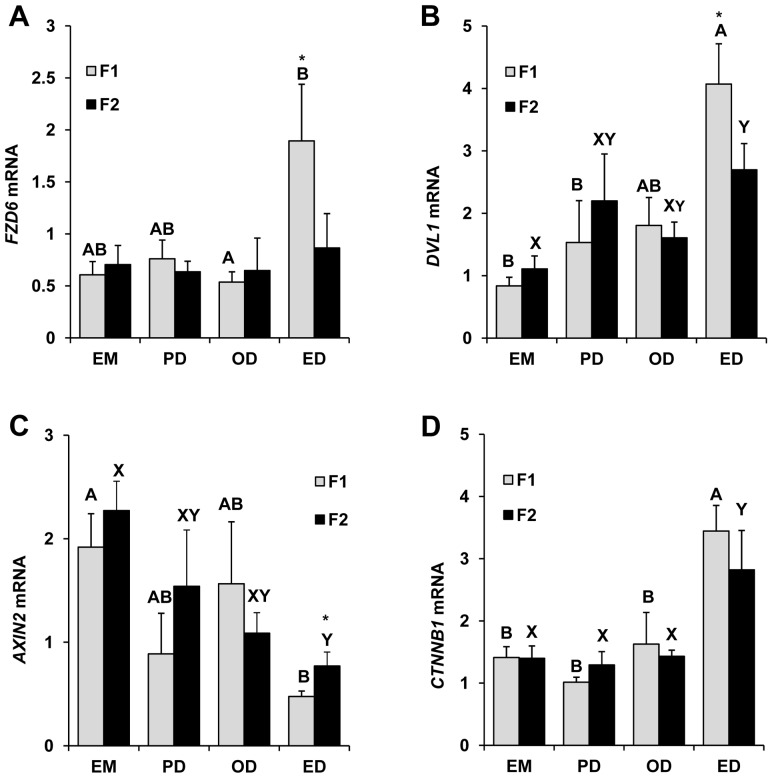
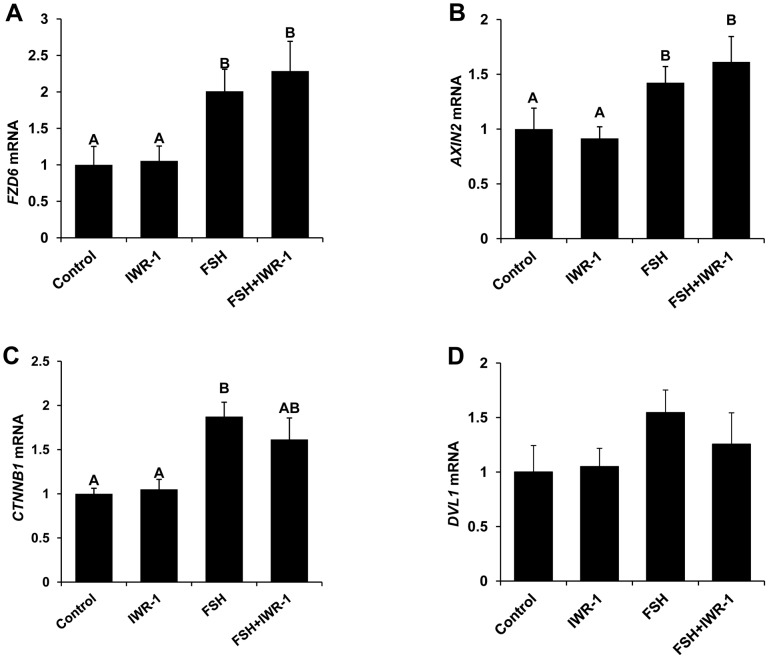
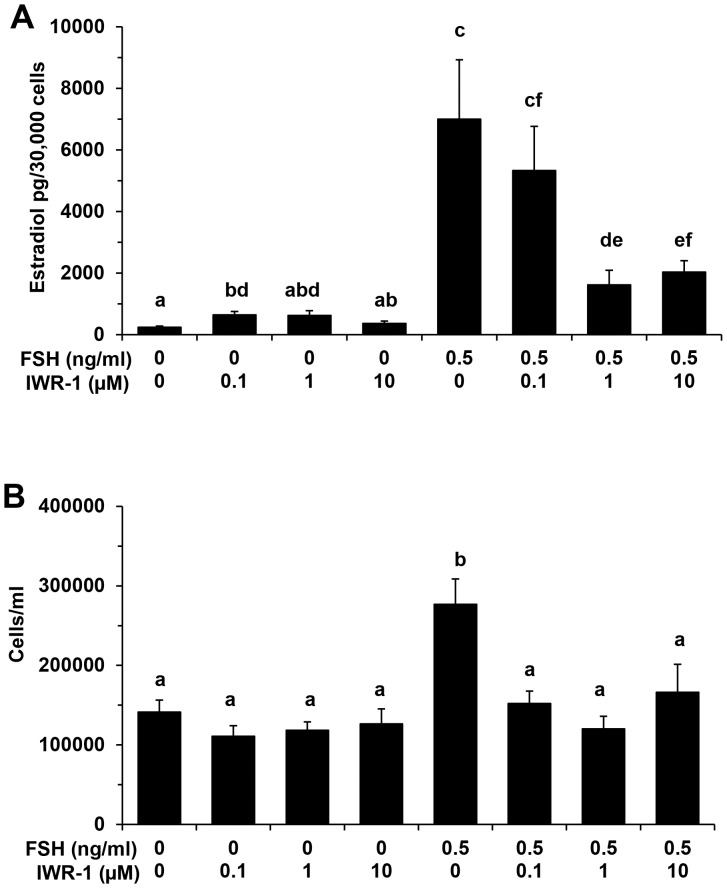
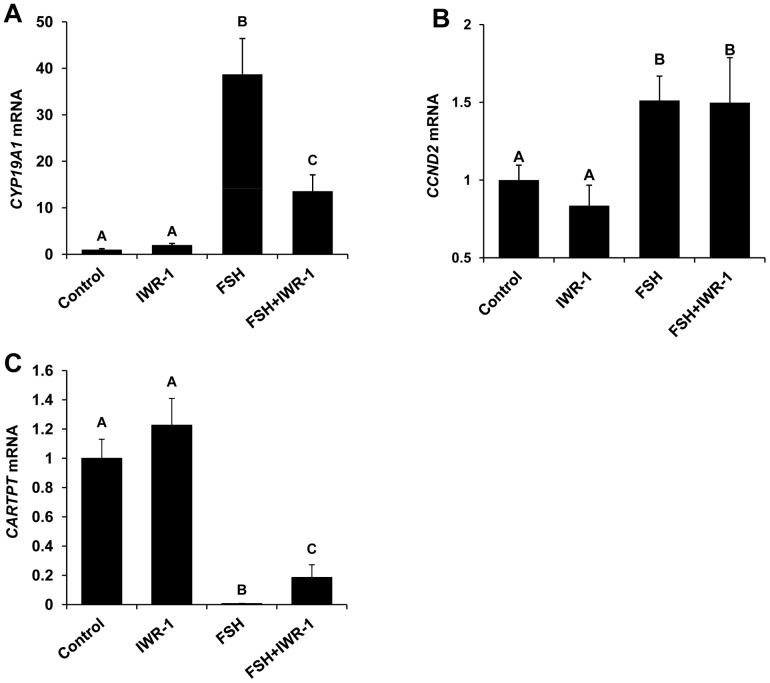
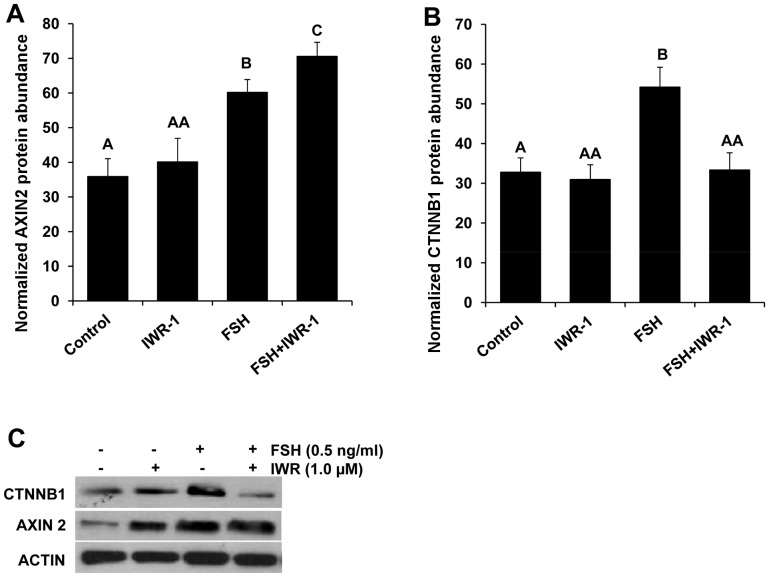
Follicular development occurs in wave like patterns in monotocous species such as cattle and humans and is regulated by a complex interaction of gonadotropins with local intrafollicular regulatory molecules. To further elucidate potential mechanisms controlling dominant follicle selection, granulosa cell RNA harvested from F1 (largest) and F2 (second largest) follicles isolated at predeviation (PD) and onset of diameter deviation (OD) stages of the first follicular wave was subjected to preliminary RNA transcriptome analysis. Expression of numerous WNT system components was observed. Hence experiments were performed to test the hypothesis that WNT signaling modulates FSH action on granulosa cells during follicular waves. Abundance of mRNA for WNT pathway members was evaluated in granulosa cells harvested from follicles at emergence (EM), PD, OD and early dominance (ED) stages of the first follicular wave. In F1 follicles, abundance of CTNNB1 and DVL1 mRNAs was higher and AXIN2 mRNA was lower at ED versus EM stages and DVL1 and FZD6 mRNAs were higher and AXIN2 mRNA was lower in F1 versus F2 follicle at the ED stage. Bovine granulosa cells were treated in vitro with increasing doses of the WNT inhibitor IWR-1+/- maximal stimulatory dose of FSH. IWR-1 treatment blocked the FSH-induced increase in granulosa cell numbers and reduced the FSH-induced increase in estradiol. Granulosa cells were also cultured in the presence or absence of FSH +/- IWR-1 and hormonal regulation of mRNA for WNT pathway members and known FSH targets determined. FSH treatment increased CYP19A1, CCND2, CTNNB1, AXIN2 and FZD6 mRNAs and the stimulatory effect on CYP19A1 mRNA was reduced by IWR-1. In contrast, FSH reduced CARTPT mRNA and IWR-1 partially reversed the inhibitory effect of FSH. Results support temporal and hormonal regulation and a potential role for WNT signaling in potentiating FSH action during dominant follicle selection.
在单胎物种如牛和人类中,卵泡发育呈波浪状模式,并且受促性腺激素与卵泡内局部调节分子的复杂相互作用调控。为了进一步阐明控制优势卵泡选择的潜在机制,对在第一个卵泡波的直径偏差前(PD)和直径偏差开始(OD)阶段分离的F1(最大)和F2(第二大)卵泡收获的颗粒细胞RNA进行了初步RNA转录组分析。观察到许多WNT系统成分的表达。因此进行了实验以检验WNT信号在卵泡波期间调节FSH对颗粒细胞作用的假说。在第一个卵泡波的出现(EM)、PD、OD和早期优势(ED)阶段从卵泡收获的颗粒细胞中评估WNT途径成员的mRNA丰度。在F1卵泡中,与EM阶段相比,ED阶段CTNNB1和DVL1 mRNA丰度较高而AXIN2 mRNA丰度较低,并且在ED阶段F1卵泡中DVL1和FZD6 mRNA丰度较高而AXIN2 mRNA丰度较低。用递增剂量的WNT抑制剂IWR-1和/或FSH最大刺激剂量体外处理牛颗粒细胞。IWR-1处理阻断了FSH诱导的颗粒细胞数量增加,并减少了FSH诱导的雌二醇增加。颗粒细胞也在有或无FSH和/或IWR-1的情况下培养,并确定WNT途径成员和已知FSH靶标的mRNA的激素调节。FSH处理增加了CYP19A1、CCND2、CTNNB1、AXIN2和FZD6 mRNA,并且IWR-1降低了对CYP19A1 mRNA的刺激作用。相反,FSH降低了CARTPT mRNA,IWR-1部分逆转了FSH的抑制作用。结果支持了时间和激素调节以及WNT信号在优势卵泡选择期间增强FSH作用中的潜在作用。