Nita Małgorzata, Strzałka-Mrozik Barbara, Grzybowski Andrzej, Mazurek Urszula, Romaniuk Wanda
Domestic and Specialized Medicine Centre "Dilmed", Katowice, Poland.
Department of Molecular Biology, Medical University of Silesia, Sosnowiec, Poland.
Med Sci Monit. 2014 Jun 18;20:1003-16. doi: 10.12659/MSM.889887.
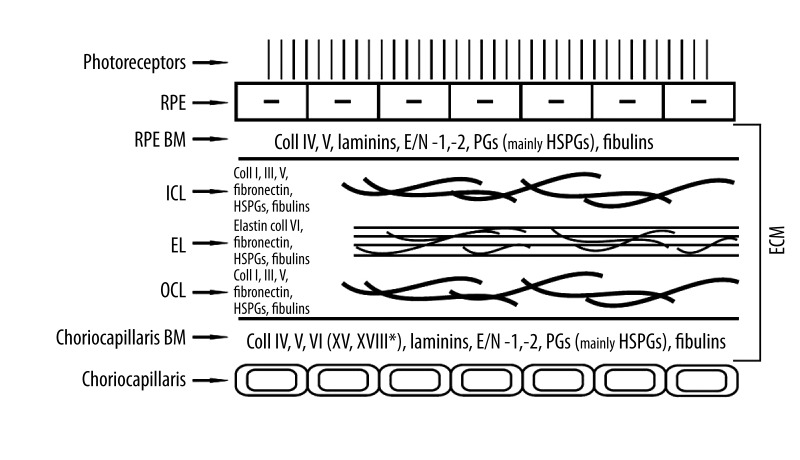
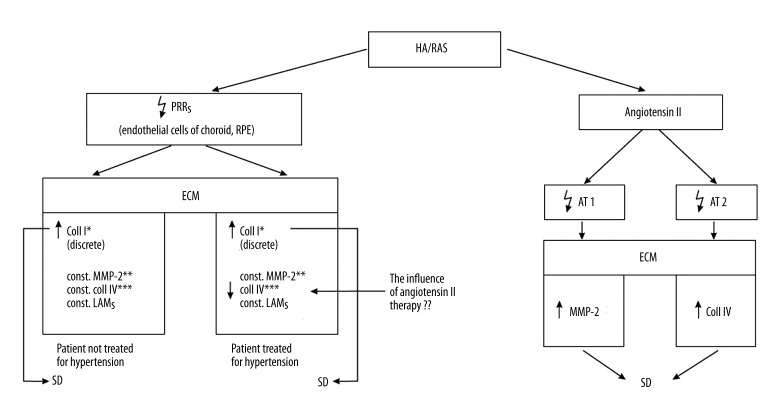
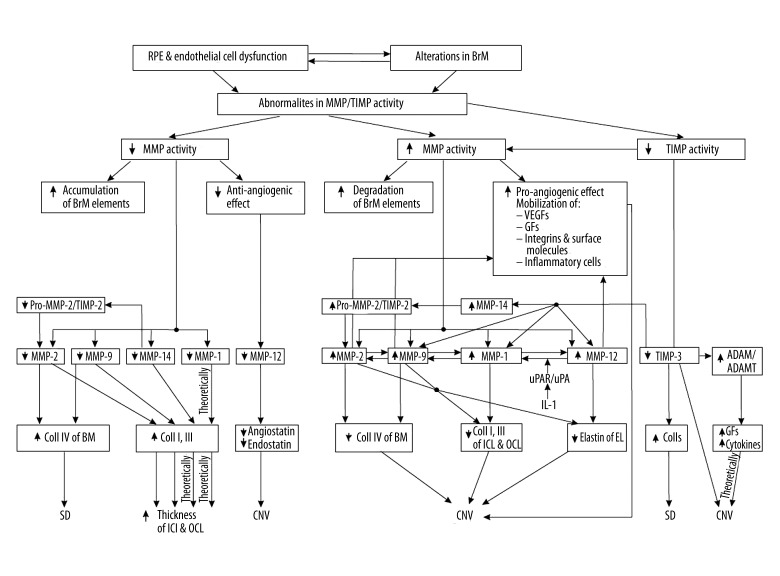
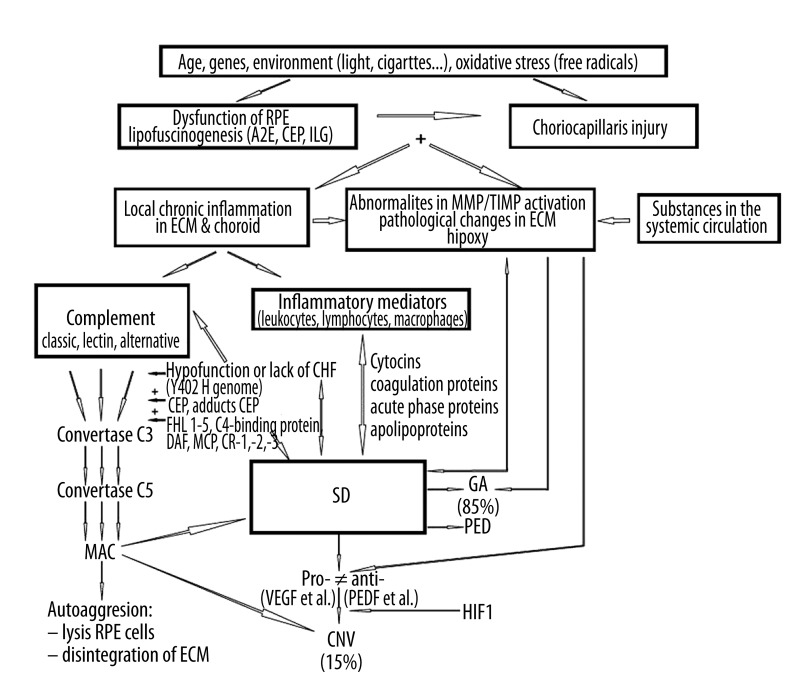
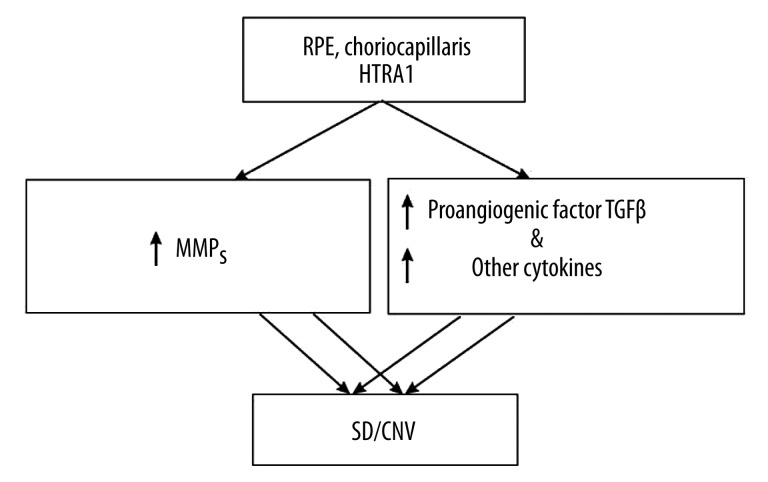
Age-related macular degeneration (AMD) is the leading cause of permanent, irreversible, central blindness (scotoma in the central visual field that makes reading and writing impossible, stereoscopic vision, recognition of colors and details) in patients over the age of 50 years in European and North America countries, and an important role is attributed to disorders in the regulation of the extracellular matrix (ECM). The main aim of this article is to present the crucial processes that occur on the level of Bruch's membrane, with special consideration of the metalloproteinase substrates, metalloproteinase, and tissue inhibitor of metalloproteinase (TIMP). A comprehensive review of the literature was performed through MEDLINE and PubMed searches, covering the years 2005-2012, using the following keywords: AMD, extracellular matrix, metalloproteinases, tissue inhibitors of metalloproteinases, Bruch's membrane, collagen, elastin. In the pathogenesis of AMD, a significant role is played by collagen type I and type IV; elastin; fibulin-3, -5, and -6; matrix metalloproteinase (MMP)-2, MMP-9, MMP-14, and MMP-1; and TIMP-3. Other important mechanisms include: ARMS2 and HTR1 proteins, the complement system, the urokinase plasminogen activator system, and pro-renin receptor activation. Continuous rebuilding of the extracellular matrix occurs in both early and advanced AMD, simultaneously with the dysfunction of retinal pigment epithelium (RPE) cells and endothelial cells. The pathological degradation or accumulation of ECM structural components are caused by impairment or hyperactivity of specific MMPs/TIMPs complexes, and is also endangered by the influence of other mechanisms connected with both genetic and environmental factors.
年龄相关性黄斑变性(AMD)是欧美国家50岁以上患者永久性、不可逆性中央视力丧失(中央视野出现暗点,导致无法读写、缺乏立体视觉、无法识别颜色和细节)的主要原因,细胞外基质(ECM)调节紊乱被认为起到了重要作用。本文的主要目的是介绍在布鲁赫膜水平上发生的关键过程,特别关注金属蛋白酶底物、金属蛋白酶和金属蛋白酶组织抑制剂(TIMP)。通过MEDLINE和PubMed搜索对2005年至2012年的文献进行了全面综述,使用了以下关键词:AMD、细胞外基质、金属蛋白酶、金属蛋白酶组织抑制剂、布鲁赫膜、胶原蛋白、弹性蛋白。在AMD的发病机制中,I型和IV型胶原蛋白、弹性蛋白、纤维连接蛋白-3、-5和-6、基质金属蛋白酶(MMP)-2、MMP-9、MMP-14和MMP-1以及TIMP-3发挥了重要作用。其他重要机制包括:ARMS2和HTR1蛋白、补体系统、尿激酶型纤溶酶原激活系统以及前肾素受体激活。在早期和晚期AMD中,细胞外基质都在持续重塑,同时视网膜色素上皮(RPE)细胞和内皮细胞功能失调。ECM结构成分的病理性降解或积累是由特定MMPs/TIMPs复合物的功能受损或活性过高引起的,同时也受到与遗传和环境因素相关的其他机制的影响。