Ye Jia-Xiang, Liu Ai-Qun, Ge Lian-Ying, Zhou Shao-Zhang, Liang Zhong-Guo
Department of Medical Oncology, The Cancer Institute, Affiliated Tumor Hospital of Guangxi Medical University, Nanning, Guangxi 530021, P.R. China.
Department of Radiation Oncology, The Cancer Institute, Affiliated Tumor Hospital of Guangxi Medical University, Nanning, Guangxi 530021, P.R. China.
Exp Ther Med. 2014 May;7(5):1271-1278. doi: 10.3892/etm.2014.1576. Epub 2014 Feb 24.
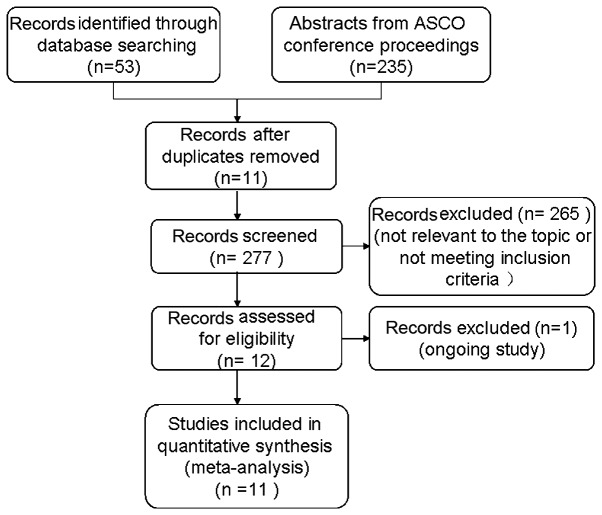
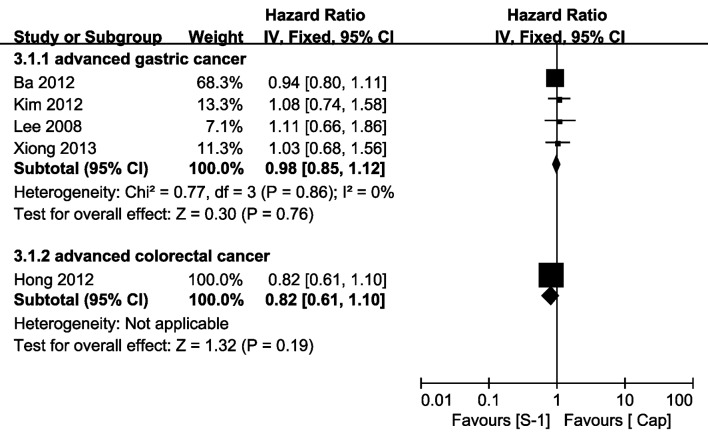
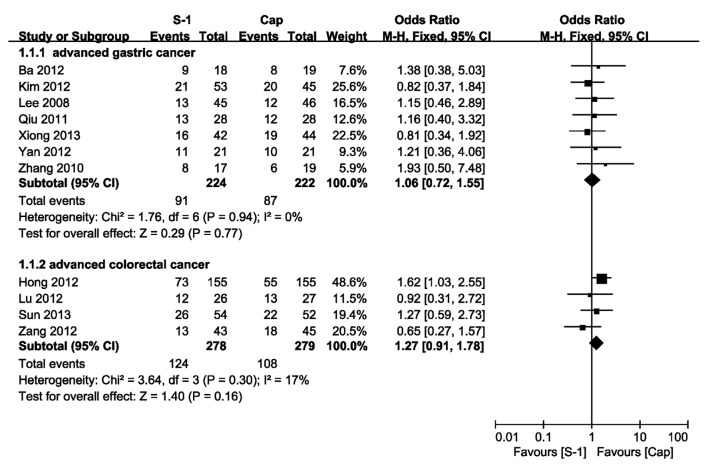
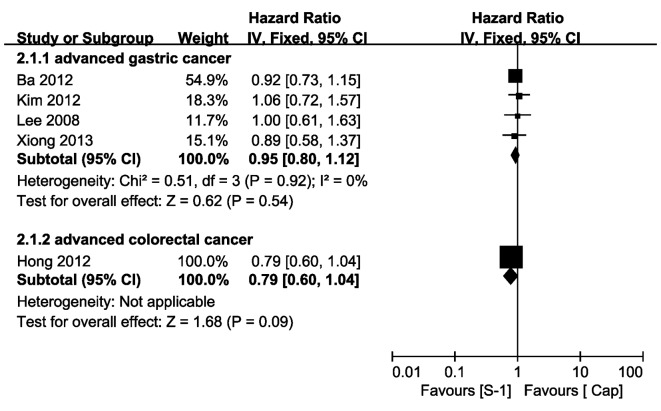
The aim of the present analysis was to compare the efficacy and safety profile of S-1-based chemotherapy (SBCT) versus capecitabine-based chemotherapy (CBCT) for advanced gastric cancer (AGC) and advanced colorectal cancer (ACRC). A meta-analysis was performed, which included eligible randomized controlled trials (RCTs) that were identified using RevMan 5.1.0 software. A total of 1,064 patients from 11 RCTs, comprising of 527 patients in the SBCT group and 537 patients in the CBCT group, were included in the analysis. For AGC, the meta-analysis of overall survival (OS) [hazard ratio (HR), 0.98; 95% confidence interval (CI), 0.85-1.12], time to progression (HR, 0.95; 95% CI, 0.80-1.12) and overall response rate (ORR) [odds ratio (OR), 1.06; 95% CI, 0.72-1.55] of patients in the SBCT group indicated no statistical significance when compared with those in the CBCT group. Furthermore, for ACRC, a pooled analysis demonstrated no significant difference between the SBCT and CBCT groups (OS: HR, 0.82; 95% CI, 0.61-1.10; progression-free survival: HR, 0.79; 95% CI=0.60-1.04; ORR: OR, 1.27; 95% CI, 0.91-1.78). The statistically significant differences identified in the overall meta-analysis indicated a low incidence of grade 3-4 hand-foot-syndrome (OR, 0.15; 95% CI, 0.06-0.36) in the SBCT group; however no statistically significant difference was observed in the incidence of grade 3-4 anemia, thrombocytopenia, leucopenia, neutropenia, diarrhea, stomatitis or nausea/vomiting. The SBCT treatment exhibited similar efficacy and an approximately equivalent safety profile compared with the CBCT treatment and was an alternative to CBCT for patients with AGC or ACRC; however, further investigation is required to provide confirmation.
本分析的目的是比较基于S-1的化疗(SBCT)与基于卡培他滨的化疗(CBCT)治疗晚期胃癌(AGC)和晚期结直肠癌(ACRC)的疗效和安全性。进行了一项荟萃分析,纳入了使用RevMan 5.1.0软件识别出的符合条件的随机对照试验(RCT)。分析共纳入了11项RCT中的1064例患者,其中SBCT组527例,CBCT组537例。对于AGC,SBCT组患者的总生存期(OS)[风险比(HR),0.98;95%置信区间(CI),0.85 - 1.12]、疾病进展时间(HR,0.95;95% CI,0.80 - 1.12)和总缓解率(ORR)[优势比(OR),1.06;95% CI,0.72 - 1.55]与CBCT组相比无统计学意义。此外,对于ACRC,汇总分析显示SBCT组和CBCT组之间无显著差异(OS:HR,0.82;95% CI,0.61 - 1.10;无进展生存期:HR,0.79;95% CI = 0.60 - 1.04;ORR:OR,1.27;95% CI,0.91 - 1.78)。在整体荟萃分析中确定的统计学显著差异表明,SBCT组3 - 4级手足综合征的发生率较低(OR,0.15;95% CI,0.06 - 0.36);然而,在3 - 4级贫血、血小板减少、白细胞减少、中性粒细胞减少、腹泻、口腔炎或恶心/呕吐的发生率方面未观察到统计学显著差异。与CBCT治疗相比,SBCT治疗表现出相似的疗效和大致相当的安全性,是AGC或ACRC患者CBCT治疗的替代方案;然而,需要进一步研究以提供证实。