Culpepper Larry, Mathews Maju, Ghori Razi, Edwards John
Department of Family Medicine, Boston University School of Medicine, Boston, Massachusetts (Dr Culpepper); and Departments of Clinical Development (Dr Mathews), Biostatistics (Dr Ghori), and Medical Affairs (Dr Edwards), Forest Research Institute, Jersey City, New Jersey.
Prim Care Companion CNS Disord. 2014;16(1). doi: 10.4088/PCC.13m01571. Epub 2014 Jan 30.
To assess clinically relevant symptom improvement in patients with major depressive disorder (MDD) receiving vilazodone by using the Montgomery-Asberg Depression Rating Scale (MADRS), a clinician-rated scale used to measure MDD symptom severity and improvement.
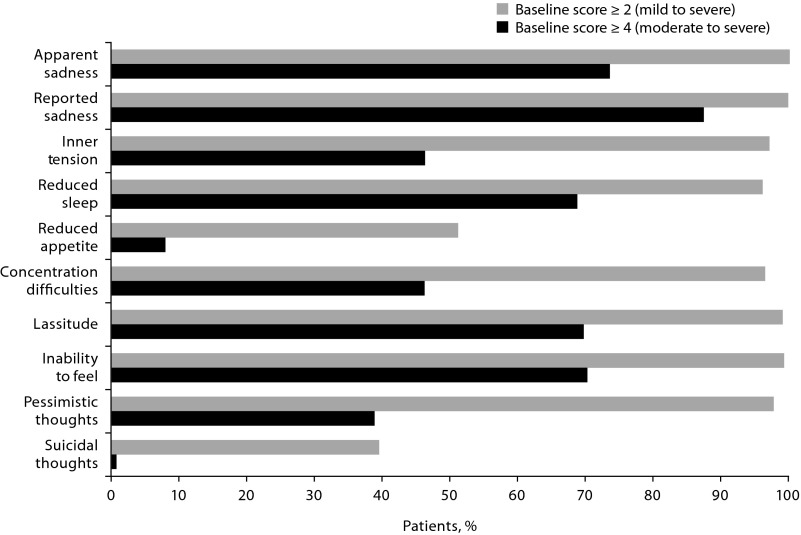
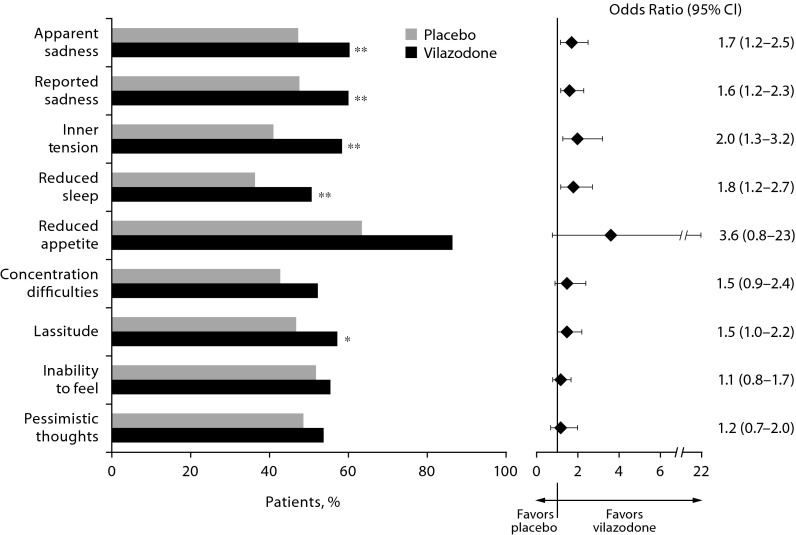
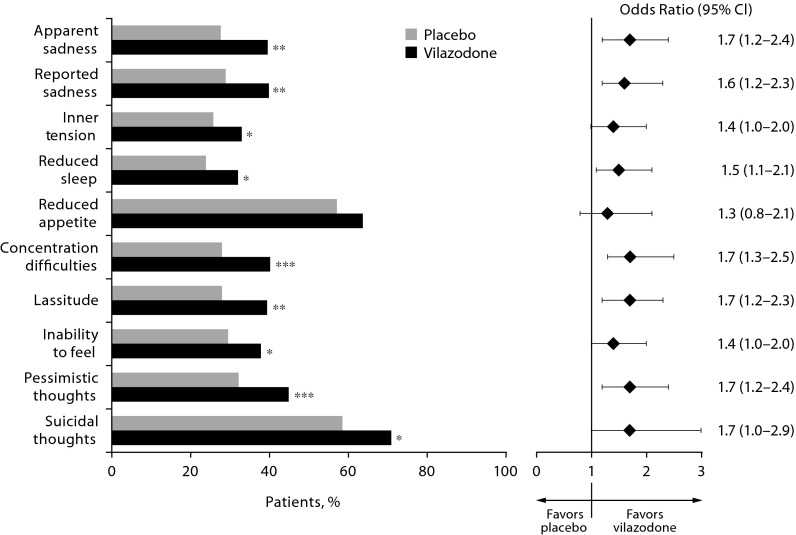
Pooled data from 2 positive, phase 3, 8-week, double-blind, randomized, placebo-controlled trials in patients with MDD were analyzed. Patients received vilazodone 40 mg/d or placebo; post hoc analyses were conducted on study completers. Depression symptom improvement was evaluated by analyzing the proportions of patients who shifted from the baseline MADRS single-item symptom severity category of ≥ 2 (mild to severe symptoms) to an end-of-study category < 2 (minimal to no symptoms) or from ≥ 4 (moderate to severe symptoms) to ≤ 2 (mild to no symptoms). The proportion of patients who shifted from anxious depression to no anxious depression was also analyzed.
The percentage of patients who completed these studies with severity category shift from baseline ≥ 2 to end of study < 2 was significantly higher for vilazodone versus placebo on all MADRS items (odds ratio [OR] range, 1.4-1.7, P < .05) except reduced appetite (OR = 1.3, P = .232). A significantly greater proportion of vilazodone-treated versus placebo-treated patients shifted from baseline ≥ 4 to end of study ≤ 2 on MADRS items of apparent sadness, reported sadness, inner tension, reduced sleep, and lassitude (OR range, 1.5-2.0, P < .05). Additionally, a significantly greater proportion of vilazodone-treated versus placebo-treated patients shifted from anxious depression at baseline to no anxious depression at end of study (OR = 1.5, P = .031).
These results suggest that vilazodone treatment is associated with clinically relevant changes in depression symptoms in patients with MDD.
ClinicalTrials.gov identifiers: NCT00285376 and NCT00683592.
使用蒙哥马利-阿斯伯格抑郁评定量表(MADRS)评估接受维拉唑酮治疗的重度抑郁症(MDD)患者临床上相关症状的改善情况,该量表是一种由临床医生评定的量表,用于衡量MDD症状的严重程度和改善情况。
分析了两项针对MDD患者的阳性、3期、8周、双盲、随机、安慰剂对照试验的汇总数据。患者接受40mg/d的维拉唑酮或安慰剂治疗;对完成研究的患者进行事后分析。通过分析从基线MADRS单项症状严重程度类别≥2(轻度至重度症状)转变为研究结束时类别<2(极轻微至无症状)或从≥4(中度至重度症状)转变为≤2(轻度至无症状)的患者比例来评估抑郁症状的改善情况。还分析了从焦虑性抑郁转变为无焦虑性抑郁的患者比例。
在所有MADRS项目上,与安慰剂相比,维拉唑酮治疗组从基线严重程度类别≥2转变为研究结束时<2的完成研究患者百分比显著更高(优势比[OR]范围为1.4 - 1.7,P <.05),食欲减退项目除外(OR = 1.3,P =.232)。在明显悲伤、报告的悲伤、内心紧张、睡眠减少和疲倦等MADRS项目上,与安慰剂治疗组相比,维拉唑酮治疗组从基线≥4转变为研究结束时≤2的患者比例显著更高(OR范围为1.5 - 2.0,P <.05)。此外,与安慰剂治疗组相比,维拉唑酮治疗组从基线时的焦虑性抑郁转变为研究结束时无焦虑性抑郁的患者比例显著更高(OR = 1.5,P =.031)。
这些结果表明,维拉唑酮治疗与MDD患者抑郁症状的临床相关变化有关。
ClinicalTrials.gov标识符:NCT00285376和NCT00683592。