Department of Biology, American University, 101 Hurst Hall 4440 Massachusetts Ave, Washington, DC 20016, USA.
BMC Evol Biol. 2014 Jun 20;14:137. doi: 10.1186/1471-2148-14-137.
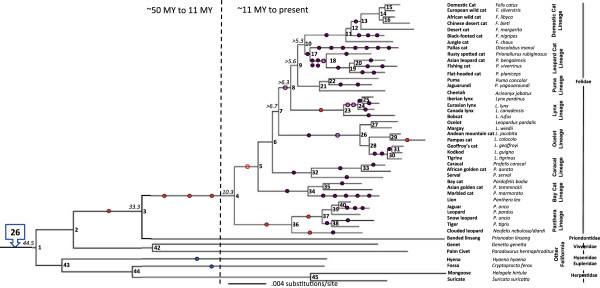
Repetitive short interspersed elements (SINEs) are retrotransposons ubiquitous in mammalian genomes and are highly informative markers to identify species and phylogenetic associations. Of these, SINEs unique to the order Carnivora (CanSINEs) yield novel insights on genome evolution in domestic dogs and cats, but less is known about their role in related carnivores. In particular, genome-wide assessment of CanSINE evolution has yet to be completed across the Feliformia (cat-like) suborder of Carnivora. Within Feliformia, the cat family Felidae is composed of 37 species and numerous subspecies organized into eight monophyletic lineages that likely arose 10 million years ago. Using the Felidae family as a reference phylogeny, along with representative taxa from other families of Feliformia, the origin, proliferation and evolution of CanSINEs within the suborder were assessed.
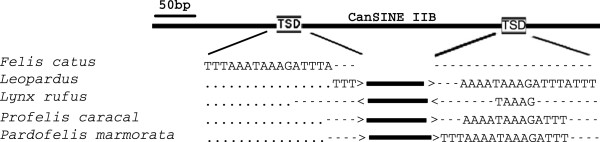
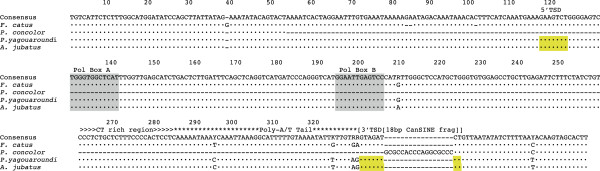
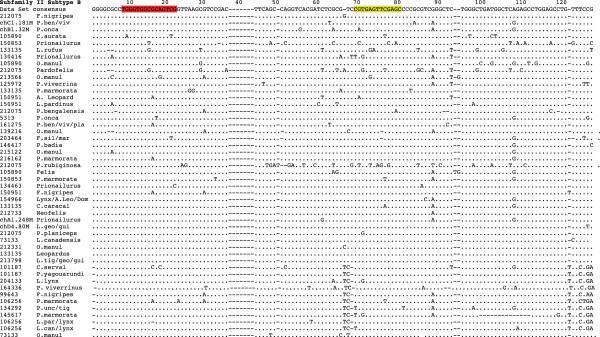
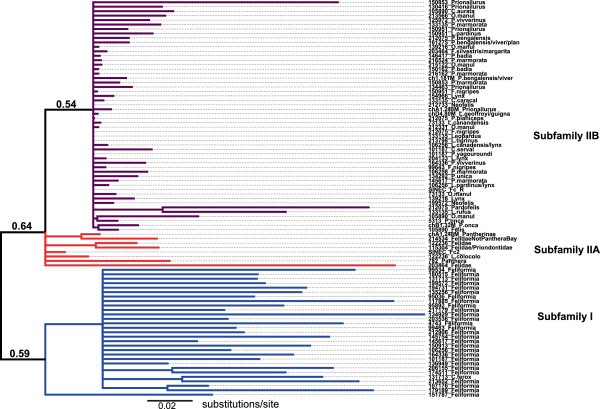
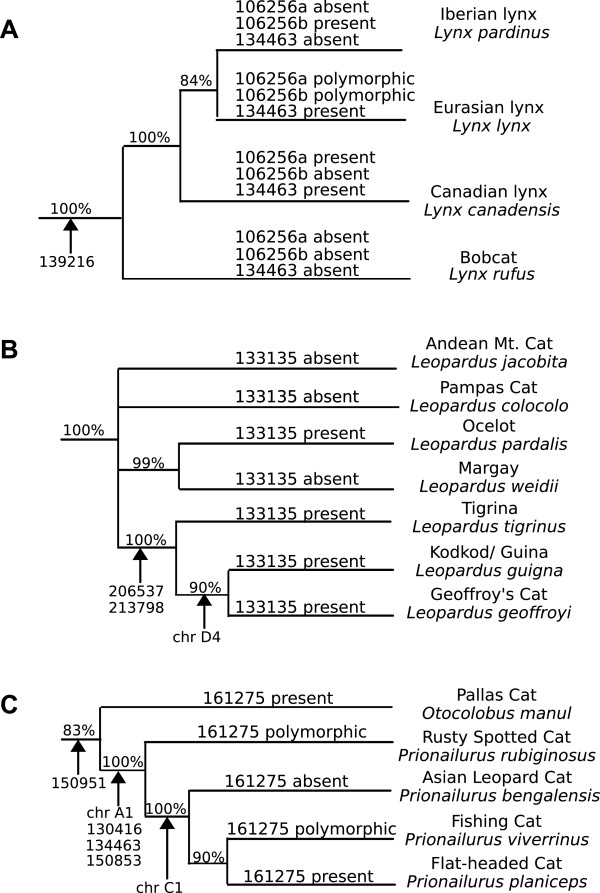
We identified 93 novel intergenic CanSINE loci in Feliformia. Sequence analyses separated Feliform CanSINEs into two subfamilies, each characterized by distinct RNA polymerase binding motifs and phylogenetic associations. Subfamily I CanSINEs arose early within Feliformia but are no longer under active proliferation. Subfamily II loci are more recent, exclusive to Felidae and show evidence for adaptation to extant RNA polymerase activity. Further, presence/absence distributions of CanSINE loci are largely congruent with taxonomic expectations within Feliformia and the less resolved nodes in the Felidae reference phylogeny present equally ambiguous CanSINE data. SINEs are thought to be nearly impervious to excision from the genome. However, we observed a nearly complete excision of a CanSINEs locus in puma (Puma concolor). In addition, we found that CanSINE proliferation in Felidae frequently targeted existing CanSINE loci for insertion sites, resulting in tandem arrays.
We demonstrate the existence of at least two SINE families within the Feliformia suborder, one of which is actively involved in insertional mutagenesis. We find SINEs are powerful markers of speciation and conclude that the few inconsistencies with expected patterns of speciation likely represent incomplete lineage sorting, species hybridization and SINE-mediated genome rearrangement.
重复短散布元件(SINEs)是哺乳动物基因组中普遍存在的反转录转座子,是识别物种和系统发育关系的高度信息性标记。其中,仅在食肉目(CanSINEs)中发现的 SINEs 为家犬和猫的基因组进化提供了新的见解,但关于它们在相关食肉动物中的作用知之甚少。特别是,在食肉目(猫形类)的猫形亚目内,还没有完成对 CanSINE 进化的全基因组评估。在猫形亚目内,猫科由 37 个物种和许多亚种组成,分为八个单系谱系,这些谱系可能起源于 1000 万年前。使用猫科家族作为参考系统发育,以及来自猫形亚目其他科的代表分类群,评估了该亚目内 CanSINEs 的起源、增殖和进化。
我们在猫形亚目内鉴定出 93 个新的基因间 CanSINE 基因座。序列分析将猫形类 CanSINEs 分为两个亚家族,每个亚家族都具有独特的 RNA 聚合酶结合基序和系统发育关系。I 亚家族的 CanSINEs 在猫形亚目内起源较早,但不再处于活跃的增殖状态。II 亚家族的 CanSINE 基因座是最近的,仅限于猫科,并且有证据表明它们适应了现存的 RNA 聚合酶活性。此外,CanSINE 基因座的存在/缺失分布在很大程度上与猫形亚目内的分类学预期一致,而在猫科参考系统发育中解析度较低的节点呈现出同样模糊的 CanSINE 数据。SINEs 几乎不能从基因组中切除。然而,我们观察到美洲狮(Puma concolor)中一个 CanSINEs 基因座几乎完全被切除。此外,我们发现猫科中的 CanSINE 增殖经常将现有的 CanSINE 基因座作为插入位点,导致串联排列。
我们证明了在猫形亚目内至少存在两个 SINE 家族,其中一个家族积极参与插入诱变。我们发现 SINEs 是物种形成的有力标记,并得出结论,与预期的物种形成模式的少数不一致可能代表不完全谱系分选、物种杂交和 SINE 介导的基因组重排。