Ryu HyungChul, Seo Sejin, Cho Seong-Hee, Kim Ho Shin, Jung Aeran, Kang Dong Wook, Son Karam, Cui Minghua, Hong Sun-hye, Sharma Pankaz Kumar, Choi Sun, Blumberg Peter M, Frank-Foltyn Robert, Bahrenberg Gregor, Stockhausen Hannelore, Schiene Klaus, Christoph Thomas, Frormann Sven, Lee Jeewoo
Laboratory of Medicinal Chemistry, Research Institute of Pharmaceutical Sciences, College of Pharmacy, Seoul National University, Seoul 151-742, Republic of Korea.
Laboratory of Medicinal Chemistry, Research Institute of Pharmaceutical Sciences, College of Pharmacy, Seoul National University, Seoul 151-742, Republic of Korea; Department of Pharmaceutical Science and Technology, College of Health and Medical Science, Catholic University of Deagu, Gyeongsan-si, Gyeongsangbuk-do 712-702, Republic of Korea.
Bioorg Med Chem Lett. 2014 Aug 15;24(16):4039-43. doi: 10.1016/j.bmcl.2014.05.074. Epub 2014 Jun 2.
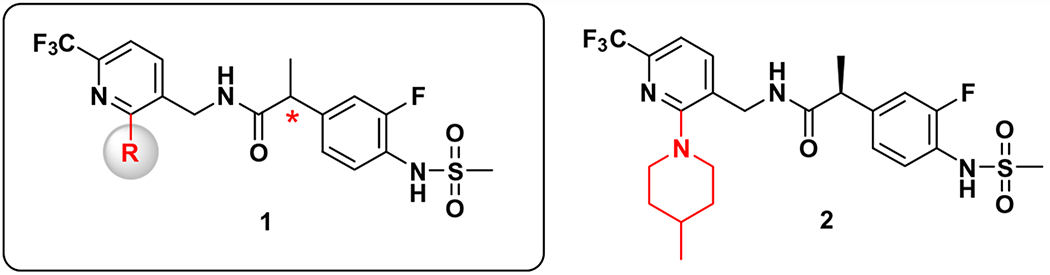
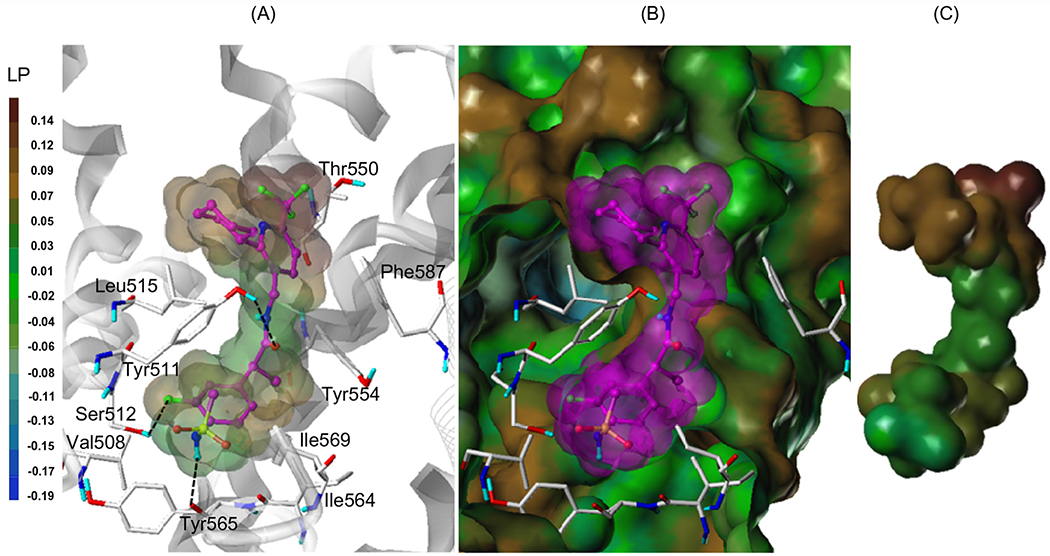
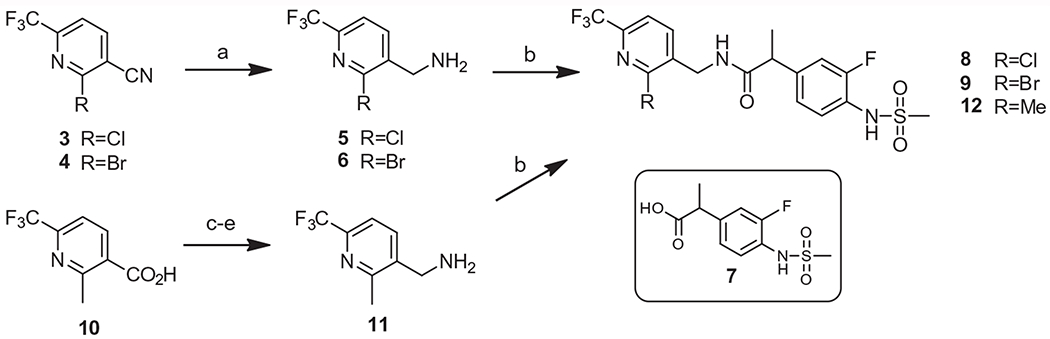
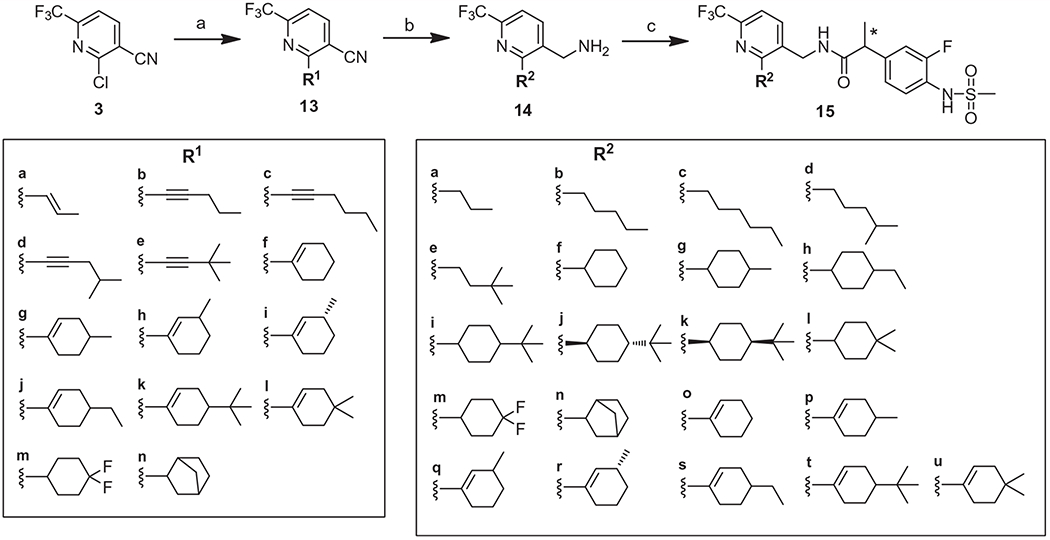
A series of 2-alkyl/alkenyl pyridine C-region derivatives of 2-(3-fluoro-4-methylsulfonylaminophenyl)propanamides were investigated as hTRPV1 antagonists. Multiple compounds showed excellent and stereospecific TRPV1 antagonism with better potency than previous lead 2. Among them, compound 15f demonstrated a strong analgesic profile in a rat neuropathic pain model and blocked capsaicin-induced hypothermia in a dose-dependent manner. Docking analysis of (S)-15f with our hTRPV1 homology model provided insight into its specific binding mode.
研究了一系列2-(3-氟-4-甲基磺酰氨基苯基)丙酰胺的2-烷基/烯基吡啶C区域衍生物作为hTRPV1拮抗剂。多种化合物表现出优异的、立体特异性的TRPV1拮抗作用,效力优于先前的先导化合物2。其中,化合物15f在大鼠神经性疼痛模型中表现出强烈的镇痛作用,并以剂量依赖的方式阻断辣椒素诱导的体温过低。(S)-15f与我们的hTRPV1同源模型的对接分析揭示了其特定的结合模式。