Aguilar-Barragan Alejandra, García-Torres Ana Elisa, Odriozola-Casas Olga, Macedo-Raygoza Gloria, Ogura Tetsuya, Manzo-Sánchez Gilberto, James Andrew C, Islas-Flores Ignacio, Beltrán-García Miguel J
Departamento de Química Universidad Autónoma de Guadalajara GuadalajaraJalisco México.
Instituto de Ingeniería Universidad Autónoma de Baja California Mexicali B.C. México.
Braz J Microbiol. 2014 May 19;45(1):359-64. doi: 10.1590/s1517-83822014000100051. eCollection 2014.
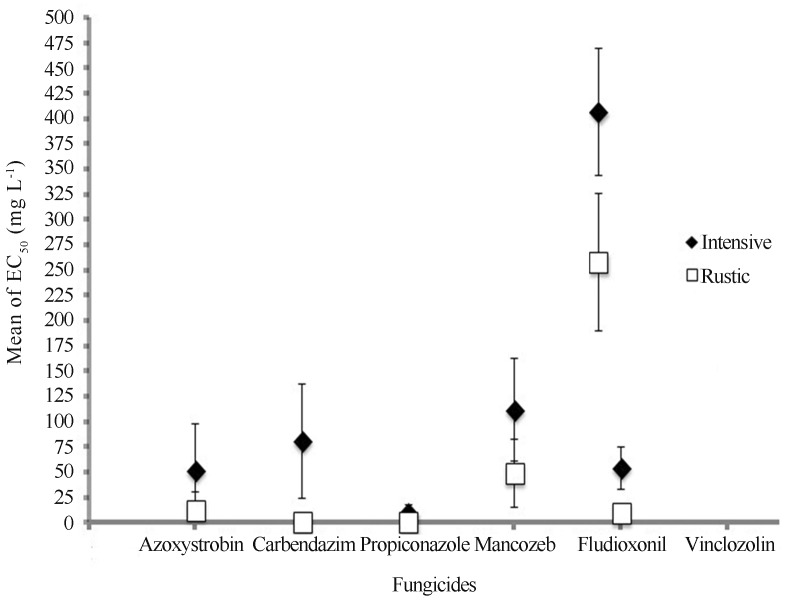
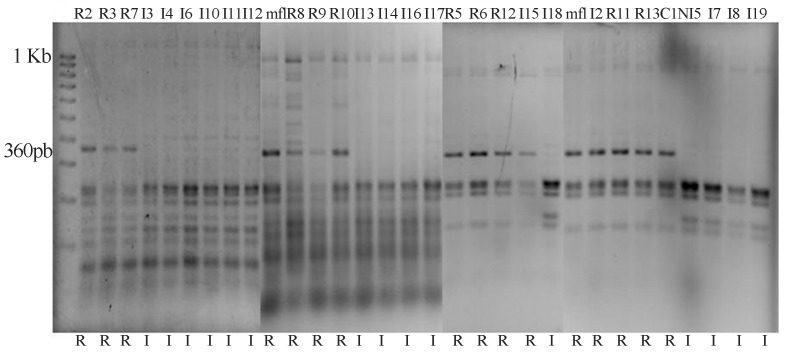
The chemical management of the black leaf streak disease in banana caused by Mycosphaerella fijiensis (Morelet) requires numerous applications of fungicides per year. However this has led to fungicide resistance in the field. The present study evaluated the activities of six fungicides against the mycelial growth by determination of EC50 values of strains collected from fields with different fungicide management programs: Rustic management (RM) without applications and Intensive management (IM) more than 25 fungicide application/year. Results showed a decreased sensitivity to all fungicides in isolates collected from IM. Means of EC50 values in mg L(-1) for RM and IM were: 13.25 ± 18.24 and 51.58 ± 46.14 for azoxystrobin, 81.40 ± 56.50 and 1.8575 ± 2.11 for carbendazim, 1.225 ± 0.945 and 10.01 ± 8.55 for propiconazole, 220 ± 67.66 vs. 368 ± 62.76 for vinclozolin, 9.862 ± 3.24 and 54.5 ± 21.08 for fludioxonil, 49.2125 ± 34.11 and 112.25 ± 51.20 for mancozeb. A molecular analysis for β-tubulin revealed a mutation at codon 198 in these strains having an EC50 greater than 10 mg L(-1) for carbendazim. Our data indicate a consistency between fungicide resistance and intensive chemical management in banana fields, however indicative values for resistance were also found in strains collected from rustic fields, suggesting that proximity among fields may be causing a fungus interchange, where rustic fields are breeding grounds for development of resistant strains. Urgent actions are required in order to avoid fungicide resistance in Mexican populations of M. fijiensis due to fungicide management practices.
由斐济球腔菌(莫雷莱特)引起的香蕉黑条叶斑病的化学防治需要每年大量施用杀菌剂。然而,这已导致田间杀菌剂抗性。本研究通过测定从不同杀菌剂管理方案的田间收集的菌株的EC50值,评估了六种杀菌剂对菌丝生长的活性:未施用杀菌剂的粗放管理(RM)和每年施用超过25次杀菌剂的集约管理(IM)。结果表明,从IM收集的分离株对所有杀菌剂的敏感性均降低。RM和IM的EC50值(mg L(-1))平均值分别为:嘧菌酯为13.25±18.24和51.58±46.14,多菌灵为81.40±56.50和1857.5±211,丙环唑为1.225±0.945和10.01±8.55,乙烯菌核利为220±67.66对368±62.76,咯菌腈为9.862±3.24和54.5±21.08,代森锰锌为49.2125±34.11和112.25±51.20。对β-微管蛋白的分子分析显示,这些对多菌灵的EC50大于10 mg L(-1)的菌株在第198密码子处发生了突变。我们的数据表明,香蕉田中的杀菌剂抗性与集约化学管理之间存在一致性,然而,在从粗放管理田间收集的菌株中也发现了抗性指示值,这表明田间之间的邻近可能导致真菌交换,粗放管理田间是抗性菌株产生的滋生地。由于杀菌剂管理措施,为避免墨西哥斐济球腔菌种群产生杀菌剂抗性,需要采取紧急行动。