Maatouk Mohamed, Bunni John, Schuijtvlot Marjolijn
Weston General Hospital, Weston-super-Mare, UK.
J Surg Case Rep. 2011 Jan 1;2011(1):6. doi: 10.1093/jscr/2011.1.6.
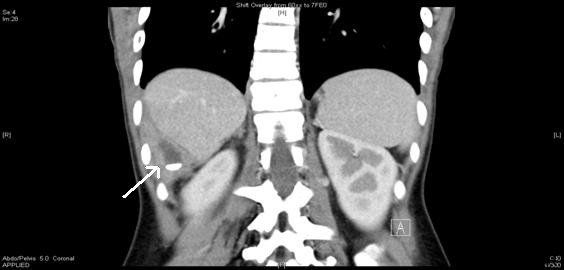
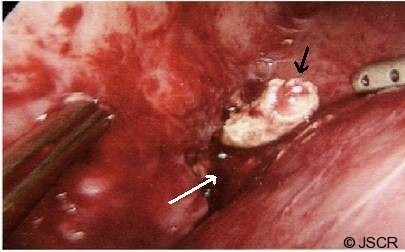
Appendicectomy is one of the commonest emergency operations performed worldwide. In cases of perforated appendicitis, the prevalence of post-operative abscess formation is up to 20 per cent (1). Most cases can be managed with drainage and antibiotics. However, a minority of these will leave a retained appendicolith. We present a case of a 17 year old female patient who presented 1 year after laparoscopic appendicectomy for perforated appendicitis, with right upper quadrant pain and sepsis. Computed tomography (CT) of the abdomen was performed and revealed a retained appendicolith with perihepatic abscess formation in the right upper quadrant. She underwent laparoscopic drainage of this perihepatic abscess and removal of the faecolith. She was discharged home the following day and remains well.
阑尾切除术是全球最常见的急诊手术之一。在穿孔性阑尾炎病例中,术后脓肿形成的发生率高达20%(1)。大多数病例可通过引流和抗生素治疗。然而,其中少数病例会残留阑尾结石。我们报告一例17岁女性患者,她在因穿孔性阑尾炎接受腹腔镜阑尾切除术后1年出现右上腹疼痛和脓毒症。进行了腹部计算机断层扫描(CT),显示右上腹有残留阑尾结石并伴有肝周脓肿形成。她接受了腹腔镜下肝周脓肿引流及阑尾结石清除术。她于次日出院,目前情况良好。