van den Bosch Caroline M A, Hulscher Marlies E J L, Natsch Stephanie, Gyssens Inge C, Prins Jan M, Geerlings Suzanne E
Department of Internal Medicine, division of Infectious Diseases, Center for Infection and Immunity Amsterdam (CINIMA) Academic Medical Center, Meibergdreef 9, 1105, AZ Amsterdam Zuidoost, The Netherlands.
BMC Infect Dis. 2014 Jun 20;14:345. doi: 10.1186/1471-2334-14-345.
Outcomes in patients with sepsis are better if initial empirical antimicrobial use is appropriate. Several studies have shown that adherence to guidelines dictating appropriate antimicrobial use positively influences clinical outcome, shortens length of hospital stay and contributes to the containment of antibiotic resistance.Quality indicators (QIs) can be systematically developed from these guidelines to define and measure appropriate antimicrobial use. We describe the development of a concise set of QIs to assess the appropriateness of antimicrobial use in adult patients with sepsis on a general medical ward or Intensive Care Unit (ICU).
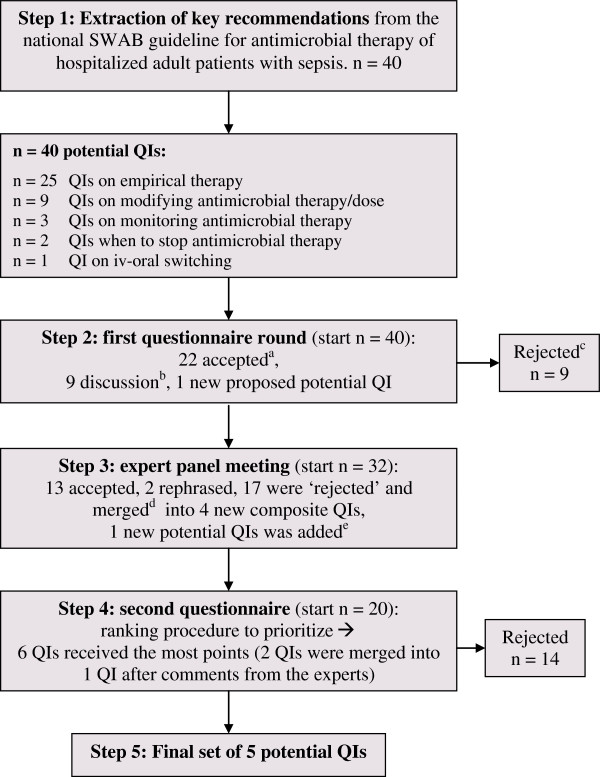
A RAND-modified, five step Delphi procedure was used. A multidisciplinary panel of 14 experts appraised and prioritized 40 key recommendations from within the Dutch national guideline on antimicrobial use for adult hospitalized patients with sepsis (http://www.swab.nl/guidelines). A procedure to select QIs relevant to clinical outcome, antimicrobial resistance and costs was performed using two rounds of questionnaires with a face-to-face consensus meeting between the rounds over a period of three months.
The procedure resulted in the selection of a final set of five QIs, namely: obtain cultures; prescribe empirical antimicrobial therapy according to the national guideline; start intravenous drug therapy; start antimicrobial treatment within one hour; and streamline antimicrobial therapy.
This systematic, stepwise method, which combined evidence and expert opinion, led to a concise and therefore feasible set of QIs for optimal antimicrobial use in hospitalized adult patients with sepsis. The next step will entail subjecting these quality indicators to an applicability test for their clinimetric properties and ultimately, using these QIs in quality-improvement projects. This information is crucial for antimicrobial stewardship teams to help set priorities and to focus improvement.
如果初始经验性抗菌药物使用恰当,脓毒症患者的预后会更好。多项研究表明,遵循规定恰当抗菌药物使用的指南对临床结局有积极影响,可缩短住院时间,并有助于遏制抗生素耐药性。可从这些指南中系统地制定质量指标(QIs),以定义和衡量恰当的抗菌药物使用。我们描述了一套简明的质量指标的制定过程,用于评估普通内科病房或重症监护病房(ICU)中成年脓毒症患者抗菌药物使用的恰当性。
采用经兰德公司修改的五步德尔菲法。一个由14名专家组成的多学科小组对荷兰国家成年住院脓毒症患者抗菌药物使用指南(http://www.swab.nl/guidelines)中的40项关键建议进行了评估和排序。通过两轮问卷调查,并在两轮调查之间举行为期三个月的面对面共识会议,实施了一个选择与临床结局、抗菌药物耐药性和成本相关的质量指标的程序。
该程序最终选出了一组五项质量指标,即:获取培养物;根据国家指南开具经验性抗菌治疗;开始静脉药物治疗;在一小时内开始抗菌治疗;以及简化抗菌治疗。
这种将证据与专家意见相结合的系统、逐步的方法,得出了一套简明且因此可行的质量指标,用于住院成年脓毒症患者的最佳抗菌药物使用。下一步将对这些质量指标进行适用性测试,以评估其临床测量特性,最终将这些质量指标用于质量改进项目。这些信息对抗菌药物管理团队确定优先事项和聚焦改进至关重要。