Cordeiro Erick Maurício G, Corrêa Alberto S, Guedes Raul Narciso C
Departamento de Entomologia, Universidade Federal de Viçosa, Viçosa, Minas Gerais, Brazil.
Departamento de Entomologia, Universidade Federal de Viçosa, Viçosa, Minas Gerais, Brazil; Departamento de Entomologia e Acarologia Agrícola, Escola Superior de Agricultura "Luiz de Queiroz" (ESALQ), Universidade de São Paulo (USP), Piracicaba, São Paulo, Brazil.
PLoS One. 2014 Jun 24;9(6):e100990. doi: 10.1371/journal.pone.0100990. eCollection 2014.
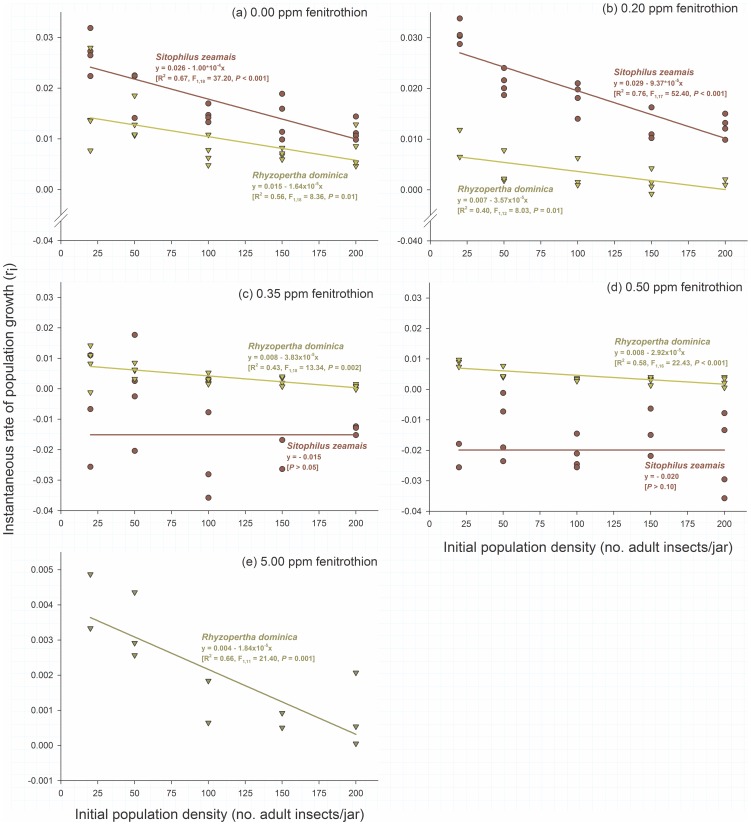
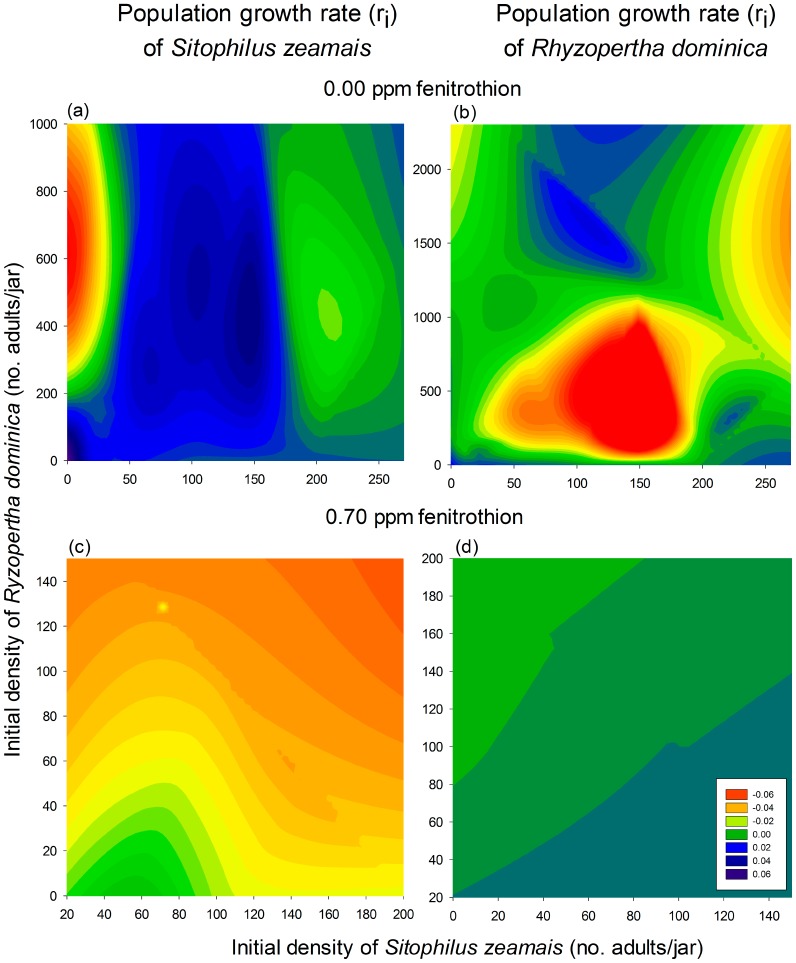
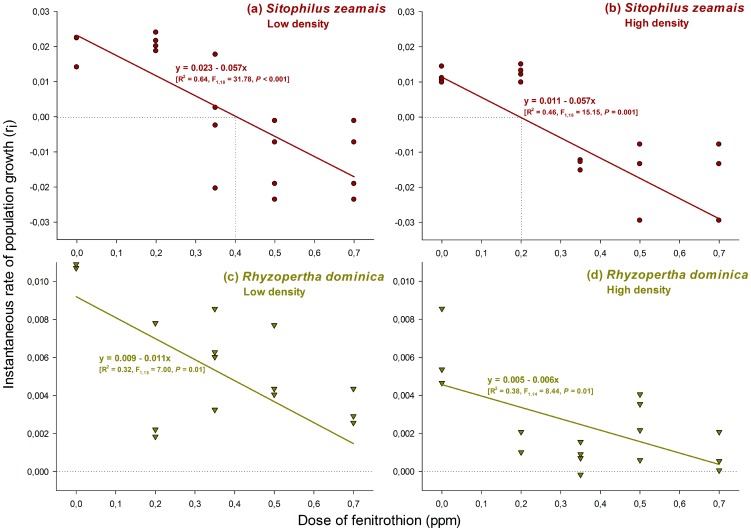
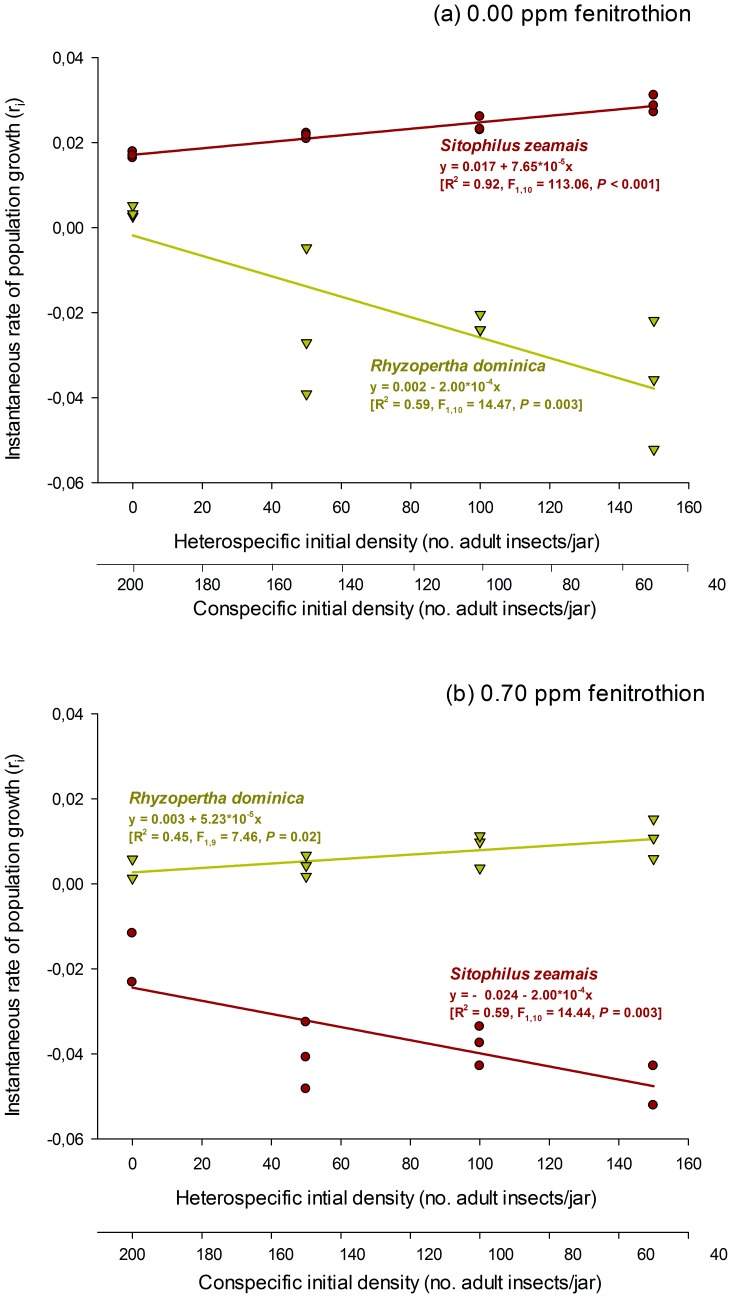
Competition is a driving force regulating communities often considered an intermittent phenomenon, difficult to verify and potentially driven by environmental disturbances. Insecticides are agents of environmental disturbance that can potentially change ecological relationships and competitive outcomes, but this subject has seldom been examined. As the co-existing cereal grain beetle species Sitophilus zeamais Motschulsky and Rhyzopertha dominica F. share a common realized niche, directly competing for the same resources, they were used as models in our study. Intraspecific competition experiments were performed with increasing insect densities and insecticide doses in additive and replacement series using various density combinations of both beetle species maintained on insecticide-free or -sprayed grains. Insecticide-mediated release from competitive stress was not observed in our study of intraspecific competition in grain beetles. The insecticide enhanced the effect of insect density, particularly for the maize weevil S. zeamais, further impairing population growth at high densities. Therefore, insecticide susceptibility increased with intraspecific competition favoring insecticide efficacy. However, the effect of insecticide exposure on competitive interaction extends beyond intraspecific competition, affecting interspecific competition as well. Sitophilus zeamais was the dominant species when in interspecific competition prevailing in natural conditions (without insecticide exposure), but the dominance and species prevalence shifted from S. zeamais to R. dominica under insecticide exposure. Therefore, high conspecific densities favored insecticide efficacy, but the strength of the relationship differs with the species. In addition, the insecticide mediated a shift in species dominance and competition outcome indicating that insecticides are relevant mediators of species interaction, potentially influencing community composition and raising management concerns as potential cause of secondary pest outbreaks.
竞争是调节群落的一种驱动力,通常被认为是一种间歇性现象,难以证实且可能由环境干扰驱动。杀虫剂是环境干扰因素,有可能改变生态关系和竞争结果,但这一主题很少受到研究。由于共存的谷物甲虫物种玉米象Sitophilus zeamais Motschulsky和谷蠹Rhyzopertha dominica F.共享一个共同的实际生态位,直接竞争相同的资源,它们被用作我们研究的模型。在添加系列和替代系列中,使用维持在未喷洒杀虫剂或喷洒杀虫剂谷物上的两种甲虫物种的各种密度组合,随着昆虫密度和杀虫剂剂量的增加进行种内竞争实验。在我们对谷物甲虫种内竞争的研究中,未观察到杀虫剂介导的竞争压力释放。杀虫剂增强了昆虫密度的影响,特别是对玉米象S. zeamais而言,进一步损害了高密度下的种群增长。因此,随着种内竞争有利于杀虫剂效力,杀虫剂敏感性增加。然而,杀虫剂暴露对竞争相互作用的影响超出了种内竞争,也影响种间竞争。在自然条件下(无杀虫剂暴露)种间竞争占主导时,玉米象是优势物种,但在杀虫剂暴露下,优势和物种优势从玉米象转移到谷蠹。因此,高的同种密度有利于杀虫剂效力,但这种关系的强度因物种而异。此外,杀虫剂介导了物种优势和竞争结果的转变,表明杀虫剂是物种相互作用的相关介质,可能影响群落组成,并作为潜在的次要害虫爆发原因引发管理问题。