Iwasaki Mai, Poulsen Thomas M, Oka Kotaro, Hessler Neal A
RIKEN Brain Science Institute Wako-shi, Japan ; Department of Biology, Keio University Yokohama, Japan.
RIKEN Brain Science Institute Wako-shi, Japan.
Front Behav Neurosci. 2014 Jun 11;8:210. doi: 10.3389/fnbeh.2014.00210. eCollection 2014.
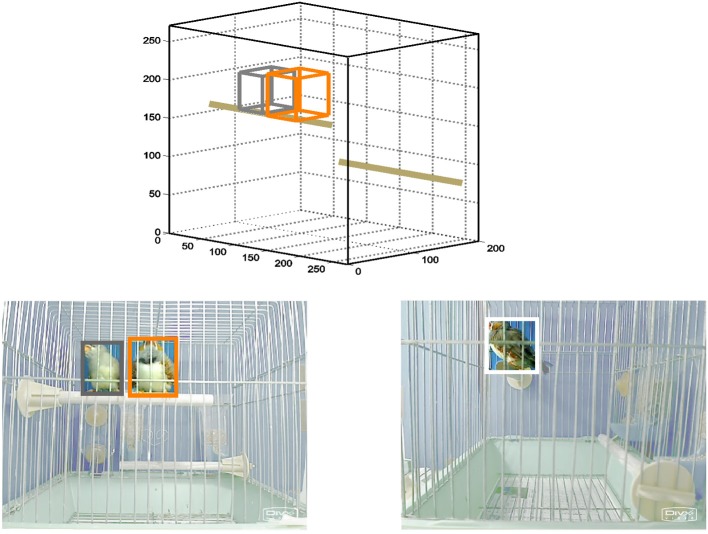
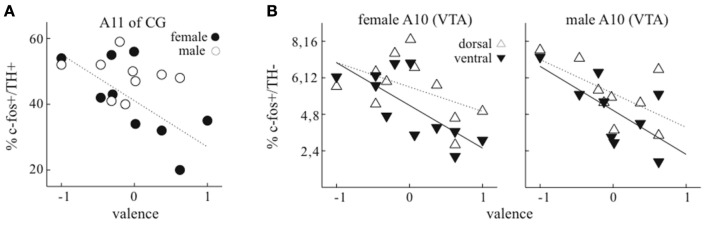
For many species, dyadic interaction during courtship and pair bonding engage intense emotional states that control approach or avoidance behavior. Previous studies have shown that one component of a common social brain network (SBN), dopaminergic areas, are highly engaged during male songbird courtship of females. We tested whether the level of activity in dopaminergic systems of both females and males during courtship is related to their level of affiliation. In order to objectively quantify affiliative behaviors, we developed a system for tracking the position of both birds during free interaction sessions. During a third successive daily interaction session, there was a range of levels of affiliation among bird pairs, as quantified by several position and movement parameters. Because both positive and negative social interactions were present, we chose to characterize affiliation strength by pair valence. As a potential neural system involved in regulating pair valence, the level of activity of the dopaminergic group A11 (within the central gray) was selectively reduced in females of positive valence pairs. Further, activation of non-dopaminergic neurons in VTA was negatively related to valence, with this relationship strongest in ventral VTA of females. Together, these results suggest that inhibition of fear or avoidance networks may be associated with development of close affiliation, and highlight the importance of negative as well as positive emotional states in the process of courtship, and in development of long-lasting social bonds.
对于许多物种而言,求偶和配对过程中的二元互动会引发强烈的情绪状态,从而控制接近或回避行为。先前的研究表明,常见社交脑网络(SBN)的一个组成部分,即多巴胺能区域,在雄性鸣禽向雌性求偶时高度活跃。我们测试了求偶过程中雌性和雄性多巴胺能系统的活动水平是否与它们的亲密程度相关。为了客观地量化亲密行为,我们开发了一个系统,用于在自由互动环节中追踪两只鸟的位置。在连续第三天的日常互动环节中,通过几个位置和运动参数量化可知,鸟对之间存在一系列不同程度的亲密关系。由于同时存在积极和消极的社交互动,我们选择用配对效价来表征亲密程度。作为参与调节配对效价的一个潜在神经系统,正效价配对的雌性中,多巴胺能A11组(在中央灰质内)的活动水平选择性降低。此外,腹侧被盖区(VTA)中非多巴胺能神经元的激活与效价呈负相关,这种关系在雌性腹侧VTA中最为明显。总之,这些结果表明,恐惧或回避网络的抑制可能与亲密关系的发展有关,并突出了求偶过程以及持久社会关系发展过程中消极和积极情绪状态的重要性。