Hane Francis, Leonenko Zoya
Department of Biology, University of Waterloo, 200 University Ave, Waterloo, ON N2L 3G1, Canada.
Biomolecules. 2014 Jan 10;4(1):101-16. doi: 10.3390/biom4010101.
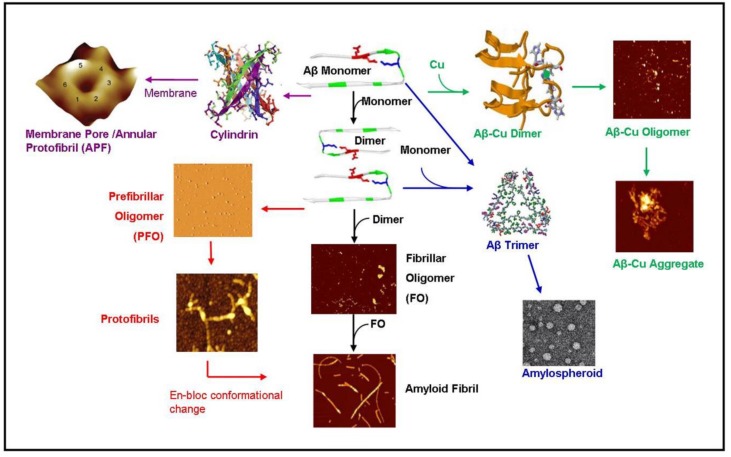
Metal ions, including copper and zinc, have been implicated in the pathogenesis of Alzheimer's disease through a variety of mechanisms including increased amyloid-β affinity and redox effects. Recent reports have demonstrated that the amyloid-β monomer does not necessarily travel through a definitive intermediary en-route to a stable amyloid fibril structure. Rather, amyloid-β misfolding may follow a variety of pathways resulting in a fibrillar end-product or a variety of oligomeric end-products with a diversity of structures and sizes. The presence of metal ions has been demonstrated to alter the kinetic pathway of the amyloid-β peptide which may lead to more toxic oligomeric end-products. In this work, we review the contemporary literature supporting the hypothesis that metal ions alter the reaction pathway of amyloid-β misfolding leading to more neurotoxic species.
包括铜和锌在内的金属离子,已通过多种机制(包括增加淀粉样蛋白-β亲和力和氧化还原作用)被认为与阿尔茨海默病的发病机制有关。最近的报告表明,淀粉样蛋白-β单体在形成稳定的淀粉样纤维结构的过程中不一定会经过确定的中间阶段。相反,淀粉样蛋白-β错误折叠可能遵循多种途径,产生纤维状终产物或具有各种结构和大小的多种寡聚终产物。已证明金属离子的存在会改变淀粉样蛋白-β肽的动力学途径,这可能导致产生毒性更强的寡聚终产物。在这项工作中,我们回顾了当代文献,这些文献支持金属离子改变淀粉样蛋白-β错误折叠反应途径从而导致产生更多神经毒性物质这一假说。