Cečka Filip, Jon Bohumil, Subrt Zdeněk, Ferko Alexander
Department of Surgery, Faculty of Medicine and University Hospital Hradec Králové, Sokolská 581, 500 05 Hradec Králové, Czech Republic.
Department of Surgery, Faculty of Medicine and University Hospital Hradec Králové, Sokolská 581, 500 05 Hradec Králové, Czech Republic ; Department of Field Surgery, Military Health Science Faculty Hradec Králové, Defence University Brno, Třebešská 1575, 500 01 Hradec Králové, Czech Republic.
Biomed Res Int. 2014;2014:482906. doi: 10.1155/2014/482906. Epub 2014 May 29.
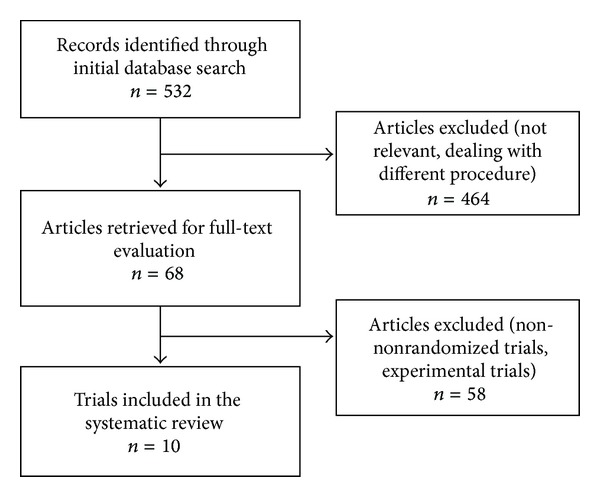
Despite recent improvements in surgical technique, the morbidity of distal pancreatectomy remains high, with pancreatic fistula being the most significant postoperative complication. A systematic review of randomized controlled trials (RCTs) dealing with surgical techniques in distal pancreatectomy was carried out to summarize up-to-date knowledge on this topic. The Cochrane Central Registry of Controlled Trials, Embase, Web of Science, and Pubmed were searched for relevant articles published from 1990 to December 2013. Ten RCTs were identified and included in the systematic review, with a total of 1286 patients being randomized (samples ranging from 41 to 450). The reviewers were in agreement for application of the eligibility criteria for study selection. It was not possible to carry out meta-analysis of these studies because of the heterogeneity of surgical techniques and approaches, such as varying methods of pancreas transection, reinforcement of the stump with seromuscular patch or pancreaticoenteric anastomosis, sealing with fibrin sealants and pancreatic stent placement. Management of the pancreatic remnant after distal pancreatectomy is still a matter of debate. The results of this systematic review are possibly biased by methodological problems in some of the included studies. New well designed and carefully conducted RCTs must be performed to establish the optimal strategy for pancreatic remnant management after distal pancreatectomy.
尽管近期手术技术有所改进,但胰体尾切除术的发病率仍然很高,胰瘘是最主要的术后并发症。我们对有关胰体尾切除术手术技术的随机对照试验(RCT)进行了系统评价,以总结该主题的最新知识。我们检索了Cochrane对照试验中心注册库、Embase、科学网和Pubmed,查找1990年至2013年12月发表的相关文章。共识别出10项RCT并纳入系统评价,共有1286例患者被随机分组(样本量从41例至450例不等)。评审人员在应用研究选择的纳入标准方面达成了一致意见。由于手术技术和方法的异质性,如胰腺横断的不同方法、用浆肌层补片或胰肠吻合加强残端、用纤维蛋白密封剂封闭和放置胰腺支架,因此无法对这些研究进行荟萃分析。胰体尾切除术后胰腺残端的处理仍然存在争议。本系统评价的结果可能因部分纳入研究中的方法学问题而存在偏差。必须开展新的设计良好且实施严谨的RCT,以确立胰体尾切除术后胰腺残端处理的最佳策略。