Zhou Jianfang, Ru Xiaomei, Hearst Norman
Departments of Family and Community Medicine and of Epidemiology and Biostatistics, University of California, 94143 San Francisco, CA, USA.
BMC Public Health. 2014 Jun 28;14:660. doi: 10.1186/1471-2458-14-660.
China has an enormous and growing middle-aged population. Little is known about health-related quality of life (HRQOL) for this group, especially in rural areas. We examined HRQOL and its individual and household predictors among middle-aged people in rural Mid-east China.
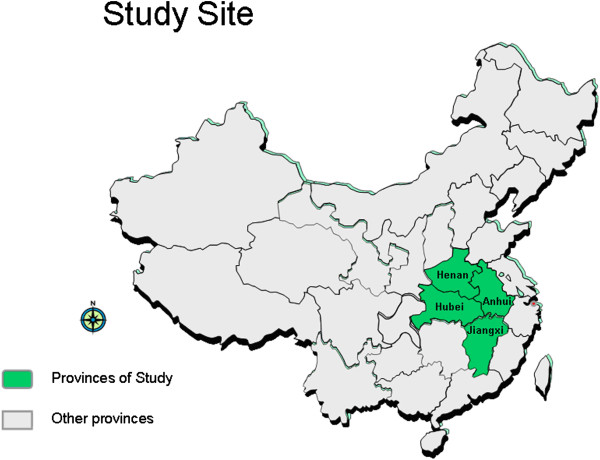
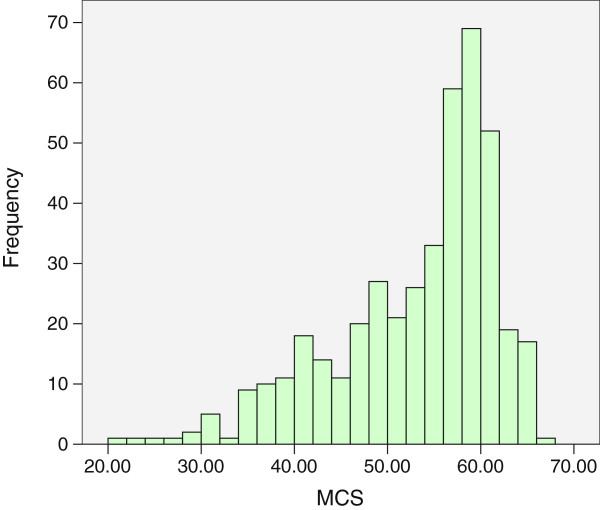
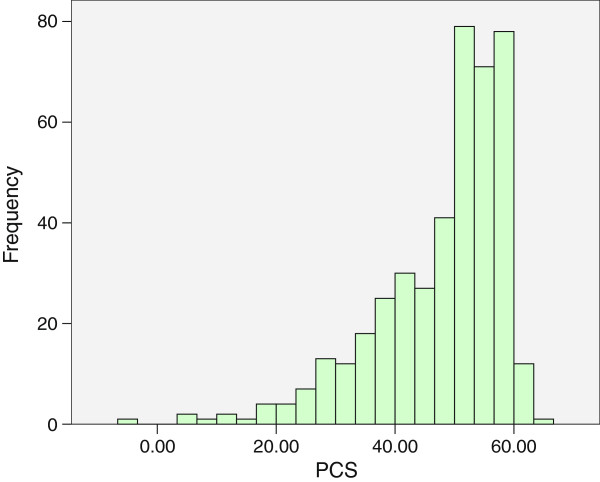
HRQOL questionnaires and information about individual and household characteristics were collected from 428 subjects aged 45 to 65 in 12 villages in Mid-east China. We examined the eight dimensions of the SF-36 instrument, along with the Physical Component Summary (PCS) and Mental Component Summary (MCS) using a reference sample in Hong Kong for standardization. Individual and household predictors of PCS and MCS were examined by one-way ANOVA and binary logistic regression analysis.
Self-reported HRQOL was similar to that seen in middle-aged populations elsewhere. Based on univariate analyses, PCS differed by age, education, occupation, household per capita income, drinking water supply, and frequency of household members caring about each other; MCS differed by education, household per capita income, drinking water supply, and frequency of caring about each other. Individual and household-level factors accounted for 12.5% and 8.2% of the variance in PCS, respectively, and for 3.1% and 10.7% of the variance in MCS.
HRQOL among middle-aged people in rural China appears similar to that observed elsewhere, and varies by income, education, and other factors. Household factors, particularly the extent to which household members care about each other, are significant predictors of physical and mental health. In addition to improving general socioeconomic conditions, efforts to improve HRQOL for middle-aged people in rural China need to focus on the family environment.
中国拥有庞大且不断增长的中年人口。对于这一群体与健康相关的生活质量(HRQOL),人们了解甚少,尤其是在农村地区。我们研究了中国中东部农村中年人群的HRQOL及其个体和家庭预测因素。
在中国中东部12个村庄,对428名年龄在45至65岁之间的受试者收集了HRQOL问卷以及有关个体和家庭特征的信息。我们使用香港的一个参考样本对SF - 36量表的八个维度以及身体成分总结(PCS)和心理成分总结(MCS)进行标准化。通过单因素方差分析和二元逻辑回归分析来研究PCS和MCS的个体和家庭预测因素。
自我报告的HRQOL与其他地方中年人群的情况相似。基于单因素分析,PCS在年龄、教育程度、职业、家庭人均收入、饮用水供应以及家庭成员相互关心的频率方面存在差异;MCS在教育程度、家庭人均收入、饮用水供应以及相互关心的频率方面存在差异。个体和家庭层面的因素分别解释了PCS方差的12.5%和8.2%,以及MCS方差的3.1%和10.7%。
中国农村中年人群的HRQOL似乎与其他地方观察到的情况相似,并因收入、教育程度和其他因素而有所不同。家庭因素,特别是家庭成员相互关心的程度,是身心健康的重要预测因素。除了改善总体社会经济状况外,提高中国农村中年人群HRQOL的努力需要关注家庭环境。