Mabula Joseph B, Kayange Neema M, Manyama Mange, Chandika Alphonce B, Rambau Peter F, Chalya Phillipo L
Department of Surgery, Catholic University of Health and Allied Sciences-Bugando, Mwanza, Tanzania.
BMC Res Notes. 2014 Jun 28;7:410. doi: 10.1186/1756-0500-7-410.
Hirschsprung's disease (HD) is the commonest cause of functional intestinal obstruction in children and poses challenges to pediatricians and pediatric surgeons practicing in resource-limited countries. This study describes the clinical characteristics and outcome of management of this disease in our setting and highlights challenges associated with the care of these patients and proffer solutions for improved outcome.
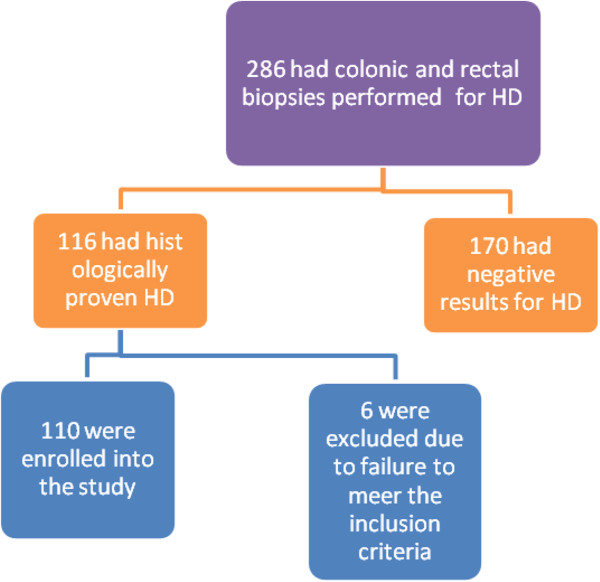
This was a descriptive prospective study of children aged ≤ 10 years who were histologically diagnosed and treated for HD at our centre between July 2008 and June 2013.
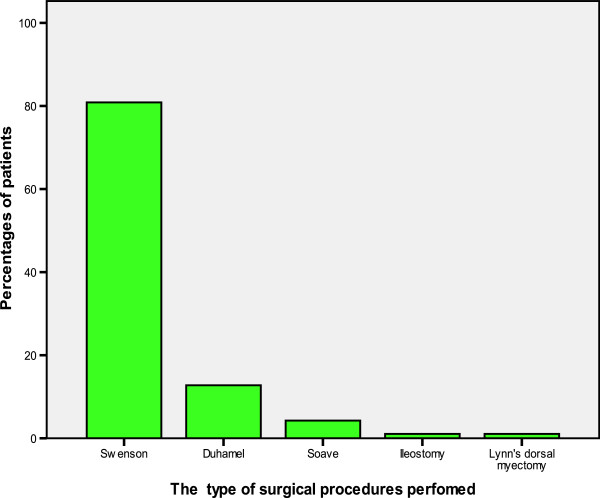
A total of 110 patients (M: F ratio= 3.6:1) with a median age of 24 months were studied. Six (5.5%) patients were in the neonatal period. Sixty-four (58.2%) patients had complete intestinal obstruction whereas 42 (38.2%) and 4 (3.6%) patients had chronic intestinal obstruction and intestinal perforation respectively. No patient had enterocolitis. Constipation (94.5%) was the most common complaints. 109 (99.1%) patients had colostomy prior to the definitive pull-through. The median duration of colostomy before definitive pull-through was 4 months. The majority of patients (67.3%) had short segment of aganglionosis localized to the recto-sigmoid region. The definitive pull-through was performed in 94 (85.5%) patients (Swenson's pull-through 76 (80.9%), Duhamel's pull-through (12.8%) and Soave's pull-through 4 (4.3%) patients). Postoperative complication rate was 47.3%. The median length of hospital stay was 26 days. Patients who developed complications stayed longer in the hospital and this was statistically significant (p <0.001). Mortality rate was 21.8%. The age < 4 weeks, delayed presentation and surgical site infection were the main predictors of mortality (p < 0.001). During the follow-up period, the results of Swenson's and Duhamel's pull through procedures were generally good in 87.8% and 42.9% of patients respectively. The result of Soave's procedures was generally poor in this study.
HD remains the commonest cause of functional intestinal obstruction in children and contributes significantly to high morbidity and mortality in our setting. The majority of patients present late when the disease becomes complicated. Early diagnosis and timely definitive pull through procedure are essential in order to decrease the morbidity and mortality associated with this disease.
先天性巨结肠(HD)是儿童功能性肠梗阻最常见的病因,给资源有限国家的儿科医生和小儿外科医生带来了挑战。本研究描述了该病在我们医院的临床特征及治疗结果,强调了这些患者护理中存在的挑战,并提出改善治疗结果的解决方案。
这是一项对2008年7月至2013年6月间在我们中心接受组织学诊断和治疗的10岁及以下HD患儿的描述性前瞻性研究。
共研究了110例患者(男:女比例为3.6:1),中位年龄为24个月。6例(5.5%)患者处于新生儿期。64例(58.2%)患者出现完全性肠梗阻,而42例(38.2%)和4例(3.6%)患者分别出现慢性肠梗阻和肠穿孔。无患者发生小肠结肠炎。便秘(94.5%)是最常见的主诉。109例(99.1%)患者在最终拖出手术前进行了结肠造口术。最终拖出手术前结肠造口术的中位持续时间为4个月。大多数患者(67.3%)的无神经节细胞症短节段局限于直肠乙状结肠区域。94例(85.5%)患者进行了最终拖出手术(Swenson拖出术76例(80.9%),Duhamel拖出术12.8%,Soave拖出术4例(4.3%))。术后并发症发生率为47.3%。中位住院时间为26天。发生并发症的患者住院时间更长,这具有统计学意义(p<0.001)。死亡率为21.8%。年龄<4周、就诊延迟和手术部位感染是死亡的主要预测因素(p<0.001)。在随访期间,Swenson拖出术和Duhamel拖出术的结果在87.8%和42.9%的患者中总体良好。在本研究中,Soave手术的结果总体较差。
HD仍然是儿童功能性肠梗阻最常见的病因,在我们的环境中对高发病率和死亡率有显著影响。大多数患者在疾病变得复杂时就诊较晚。早期诊断和及时的最终拖出手术对于降低与该病相关的发病率和死亡率至关重要。