Cao Chunxiang, Zhang Xunlei, Kuang Meng, Gu Dongying, He Mingliang, Chen Jinfei, Tang Cuiju
Department of Oncology, Nanjing First Hospital, Nanjing Medical University, Nanjing, China.
Cancer Sci. 2014 Aug;105(8):1008-14. doi: 10.1111/cas.12465.
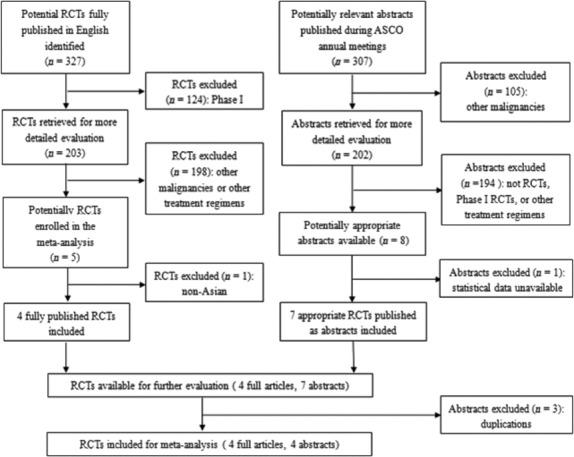
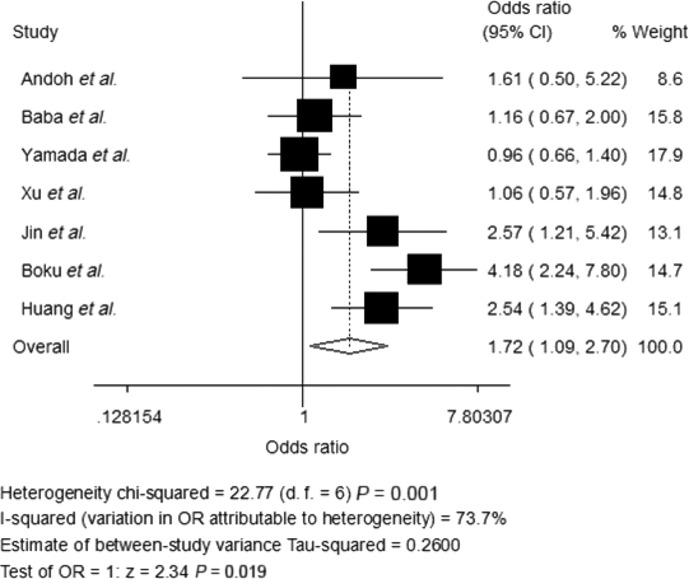
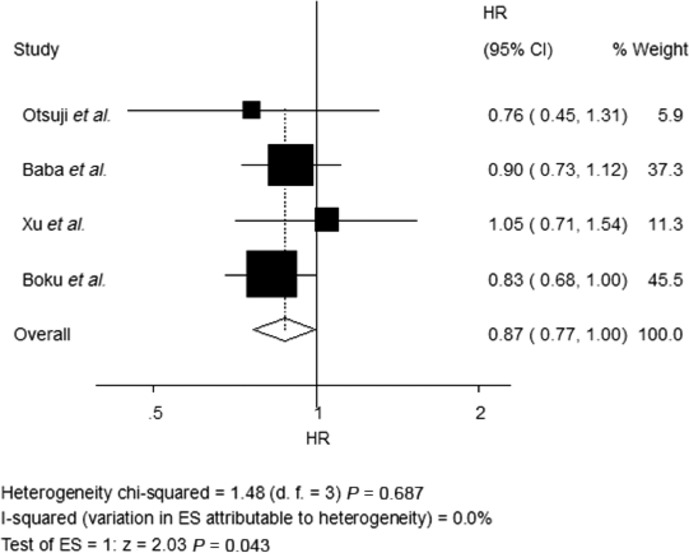
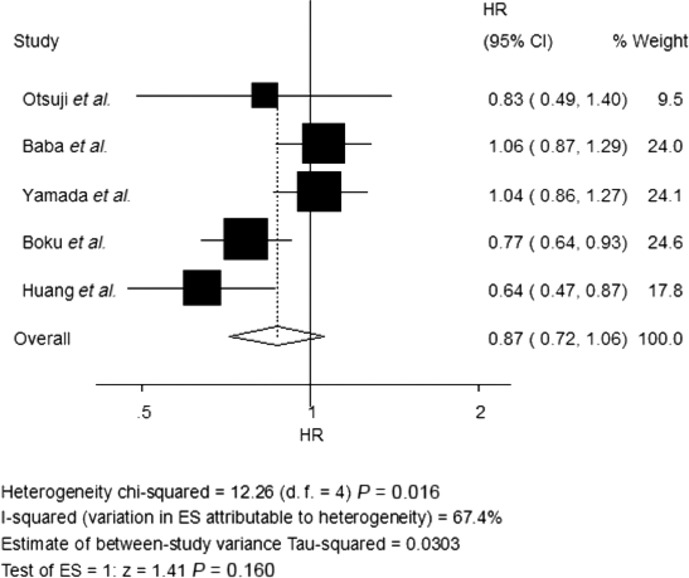
Whether S-1 could replace 5-Fluorouracil (5-Fu) or not in the treatment of advanced gastrointestinal (GI) cancer (including advanced gastric cancer [AGS] and metastatic colorectal cancer [mCRC]) in Asian patients has been controversial. This meta-analysis was performed to compare the activity, efficacy and toxicity of S-1-based versus 5-Fu-based chemotherapy in those Asian patients. Randomized controlled trials (RCTs) were identified by electronic search of Pubmed. Relevant abstracts were manually searched to identify relevant trials. A total of 2182 patients from eight RCTs were included, and our results demonstrated that S-1-based chemotherapy significantly improved overall survival (OS) (hazard ratio [HR], 0.87; 95% confidence interval [CI], 0.77-1.00) and overall response rate (ORR) (odds ratio [OR], 1.72; 95% CI, 1.09-2.70), but no significant progression-free survival (PFS) benefit was found between arms (HR, 0.87; 95% CI, 0.72-1.06). Subgroup analyses revealed that S-1-based chemotherapy significantly improved OS and ORR in subgroups of patients with non-platinum containing regimens (P = 0.041; P = 0.034) and patients with no prior chemotherapy history (P = 0.025; P = 0.016). Statistically significant improvements of PFS and ORR in the S-1-based chemotherapy were observed in the subgroup of patients with AGC (P < 0.001; P = 0.005). S-1-based chemotherapy was characterized by significantly higher incidences of diarrhea, fatigue and thrombocytopenia, and a lower incidence of nausea. This analysis provided strong evidence for survival benefits of S-1, and S-1-based chemotherapy could be considered to replace 5-Fu-based therapy for the treatment of advanced GI cancer in Asian patients.
在亚洲患者中,S-1在晚期胃肠道(GI)癌(包括晚期胃癌[AGS]和转移性结直肠癌[mCRC])治疗中是否能取代5-氟尿嘧啶(5-Fu)一直存在争议。本荟萃分析旨在比较亚洲患者中基于S-1的化疗与基于5-Fu的化疗的活性、疗效和毒性。通过对PubMed进行电子检索来识别随机对照试验(RCT)。手动检索相关摘要以识别相关试验。纳入了来自八项RCT的2182例患者,我们的结果表明,基于S-1的化疗显著改善了总生存期(OS)(风险比[HR],0.87;95%置信区间[CI],0.77 - 1.00)和总缓解率(ORR)(优势比[OR],1.72;95%CI,1.09 - 2.70),但两组之间无显著的无进展生存期(PFS)获益(HR,0.87;95%CI,0.72 - 1.06)。亚组分析显示,基于S-1的化疗在不含铂方案的患者亚组(P = 0.041;P = 0.034)和无既往化疗史的患者亚组(P = 0.025;P = 0.016)中显著改善了OS和ORR。在AGS患者亚组中,基于S-1的化疗观察到PFS和ORR有统计学显著改善(P < 0.001;P = 0.005)。基于S-1的化疗的特征是腹泻、疲劳和血小板减少的发生率显著更高,而恶心的发生率更低。该分析为S-1的生存获益提供了有力证据,基于S-1的化疗可被考虑取代基于5-Fu的疗法用于亚洲患者晚期GI癌的治疗。