Acupuncture and Meridian Science Research Center, College of Korean Medicine, Kyung Hee University, Seoul 130-701, Korea.
The Graduate School of Basic Science of Korean Medicine, College of Korean Medicine, Kyung Hee University, Seoul 130-701, Korea.
Korean J Physiol Pharmacol. 2014 Jun;18(3):191-200. doi: 10.4196/kjpp.2014.18.3.191. Epub 2014 Jun 12.
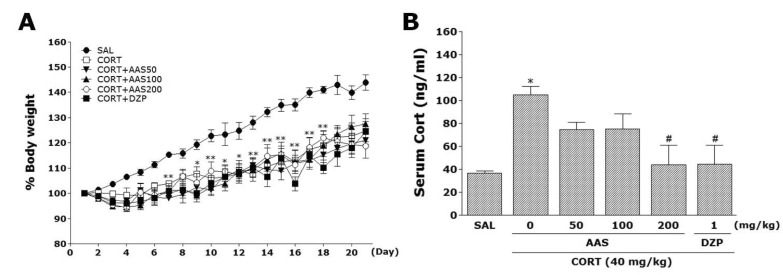
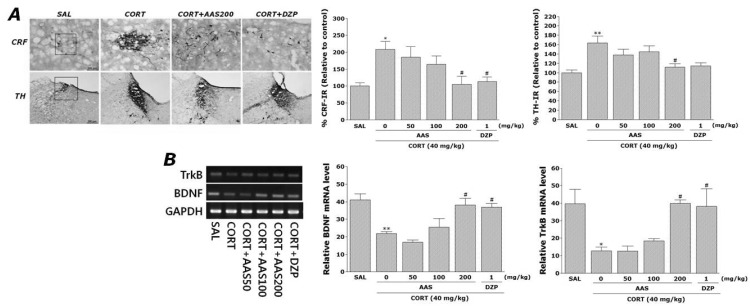
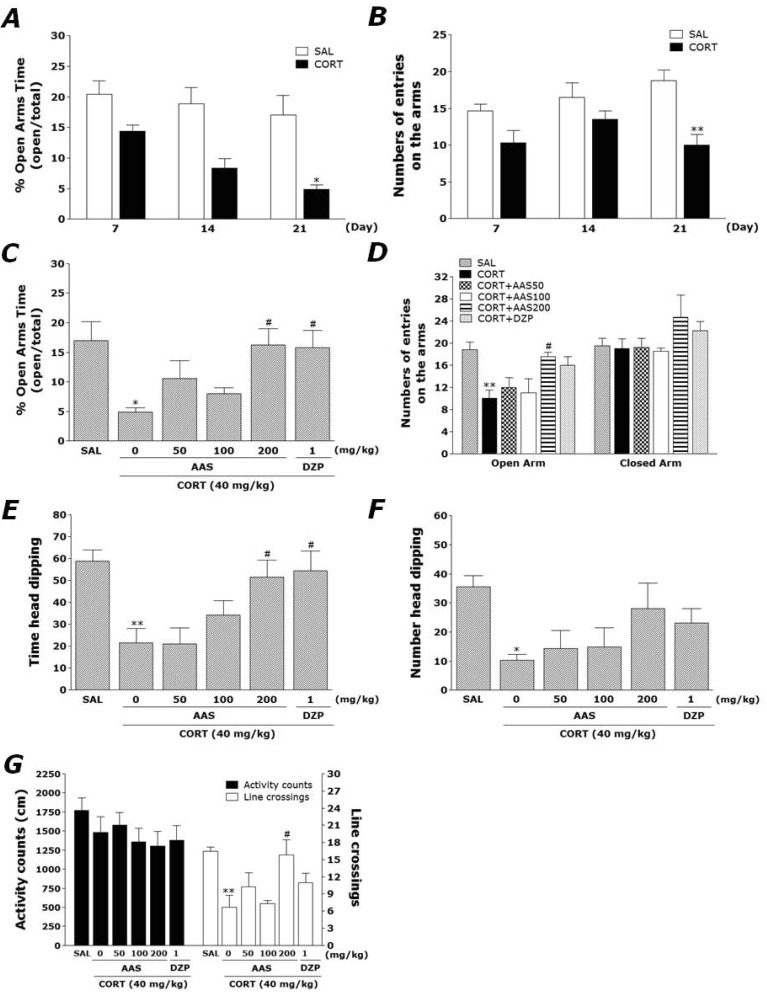
We investigated the anxiolytic-like activity of α-asarone (AAS) from Acorus gramineus in an experimental rat model of anxiety induced by repeated administration of the exogenous stress hormone corticosterone (CORT). The putative anxiolytic effect of AAS was studied in behavioral tests of anxiety, such as the elevated plus maze (EPM) test and the hole-board test (HBT) in rats. For 21 consecutive days, male rats received 50, 100, or 200 mg/kg AAS (i.p.) 30 min prior to a daily injection of CORT. Dysregulation of the HPA axis in response to the repeated CORT injections was confirmed by measuring serum levels of CORT and the expression of corticotrophin-releasing factor (CRF) in the hypothalamus. Daily AAS (200 mg/kg) administration increased open-arm exploration significantly in the EPM test, and it increased the duration of head dipping activity in the HBT. It also blocked the increase in tyrosine hydroxylase (TH) expression in the locus coeruleus (LC) and decreased mRNA expression of brain-derived neurotrophic factor (BDNF) and its receptor, TrkB, in the hippocampus. These results indicated that the administration of AAS prior to high-dose exogenous CORT significantly improved anxiety-like behaviors, which are associated with modification of the central noradrenergic system and with BDNF function in rats. The current finding may improve understanding of the neurobiological mechanisms responsible for changes in emotions induced by repeated administration of high doses of CORT or by elevated levels of hormones associated with chronic stress. Thus, AAS did exhibit an anxiolytic-like effects in animal models of anxiety.
我们研究了菖蒲烯(AAS)从菖蒲在实验大鼠模型中的抗焦虑样活性焦虑由重复给予外源性应激激素皮质酮(CORT)引起。AAS 的假定抗焦虑作用在焦虑的行为测试中进行了研究,如高架十字迷宫(EPM)测试和大鼠的洞板测试(HBT)。在连续 21 天内,雄性大鼠在每日接受 CORT 注射前 30 分钟接受 50、100 或 200 mg/kg AAS(ip)。通过测量血清皮质酮(CORT)水平和下丘脑促肾上腺皮质释放因子(CRF)的表达,证实了 HPA 轴对重复 CORT 注射的失调。每日 AAS(200 mg/kg)给药显著增加了 EPM 测试中开放臂的探索,增加了头浸活动在 HBT 中的持续时间。它还阻断了蓝斑核(LC)中酪氨酸羟化酶(TH)表达的增加,并降低了海马中脑源性神经营养因子(BDNF)及其受体 TrkB 的 mRNA 表达。这些结果表明,在高剂量外源性 CORT 给药前给予 AAS 显著改善了焦虑样行为,这与中枢去甲肾上腺素能系统的修饰以及大鼠脑中 BDNF 功能有关。目前的发现可能有助于理解反复给予大剂量 CORT 或与慢性应激相关的激素水平升高引起的情绪变化的神经生物学机制。因此,AAS 在焦虑动物模型中表现出抗焦虑样作用。