Beyer Frederike, Münte Thomas F, Wiechert Juliana, Heldmann Marcus, Krämer Ulrike M
Dept. of Neurology, University of Lübeck, Lübeck, Germany.
PLoS One. 2014 Jun 30;9(6):e101105. doi: 10.1371/journal.pone.0101105. eCollection 2014.
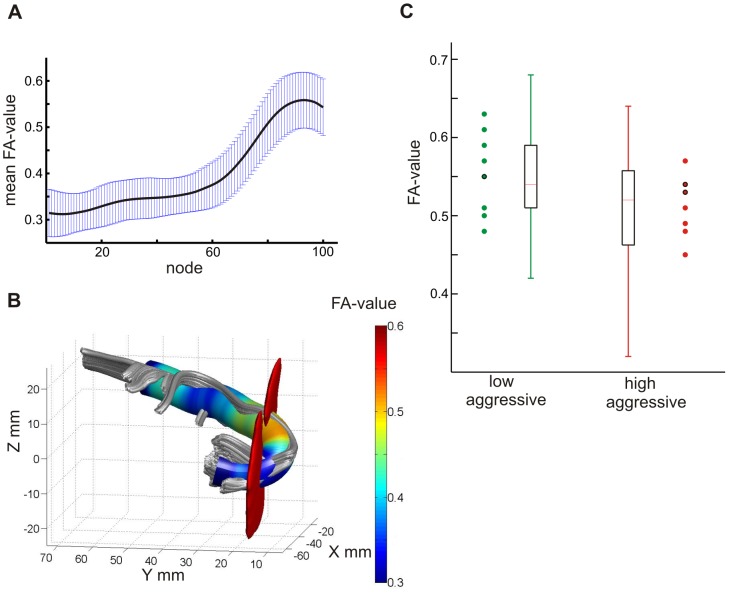
Studies in both pathological and healthy samples have suggested altered functional connectivity between orbitofrontal cortex (OFC) and amygdala as a possible cause of anger and aggression. In patient populations presenting with pathological aggression, there is also evidence for changes in structural connectivity between OFC and amygdala. In healthy samples, however, the relationship between white matter integrity and aggression has not been studied to date. Here, we investigated the relationship between trait aggressiveness and structural OFC-amygdala connectivity in a large sample (n = 93) of healthy young men. Using diffusion tensor imaging, we measured the distribution of fractional anisotropy and mean diffusivity along the uncinate fascicle bilaterally. We found no differences in either measure between participants high and low in physical aggressiveness, or between those high and low in trait anger. Our results therefore argue against a direct relationship between structural OFC-amygdala connectivity and normal-range trait aggressiveness.
对病理样本和健康样本的研究表明,眶额皮质(OFC)与杏仁核之间功能连接的改变可能是愤怒和攻击行为的一个原因。在表现出病理性攻击行为的患者群体中,也有证据表明OFC与杏仁核之间的结构连接发生了变化。然而,在健康样本中,迄今为止尚未研究白质完整性与攻击行为之间的关系。在此,我们在一个由健康年轻男性组成的大样本(n = 93)中,研究了特质攻击性与OFC-杏仁核结构连接之间的关系。使用扩散张量成像,我们双侧测量了沿钩束的各向异性分数和平均扩散率的分布。我们发现,在身体攻击性高和低的参与者之间,或在特质愤怒高和低的参与者之间,这两种测量结果均无差异。因此,我们的结果表明,OFC-杏仁核结构连接与正常范围内的特质攻击性之间不存在直接关系。