Ross J S, Wang K, Elkadi O R, Tarasen A, Foulke L, Sheehan C E, Otto G A, Palmer G, Yelensky R, Lipson D, Chmielecki J, Ali S M, Elvin J, Morosini D, Miller V A, Stephens P J
J Clin Pathol. 2014 Sep;67(9):772-6. doi: 10.1136/jclinpath-2014-202447.
Small cell lung cancer (SCLC) carries a poor prognosis, and the systemic therapies currently used as treatments are only modestly effective, as demonstrated by a low 5-year survival at only ∼5%. In this retrospective collected from March 2013 to study, we performed comprehensive genomic profiling of 98 small cell undifferentiated lung cancer (SCLC) samples to identify potential targets of therapy not currently searched for in routine clinical practice.
DNA from 98 SCLC was sequenced to high, uniform coverage (Illumina HiSeq 2500) and analysed for all classes of genomic alterations.
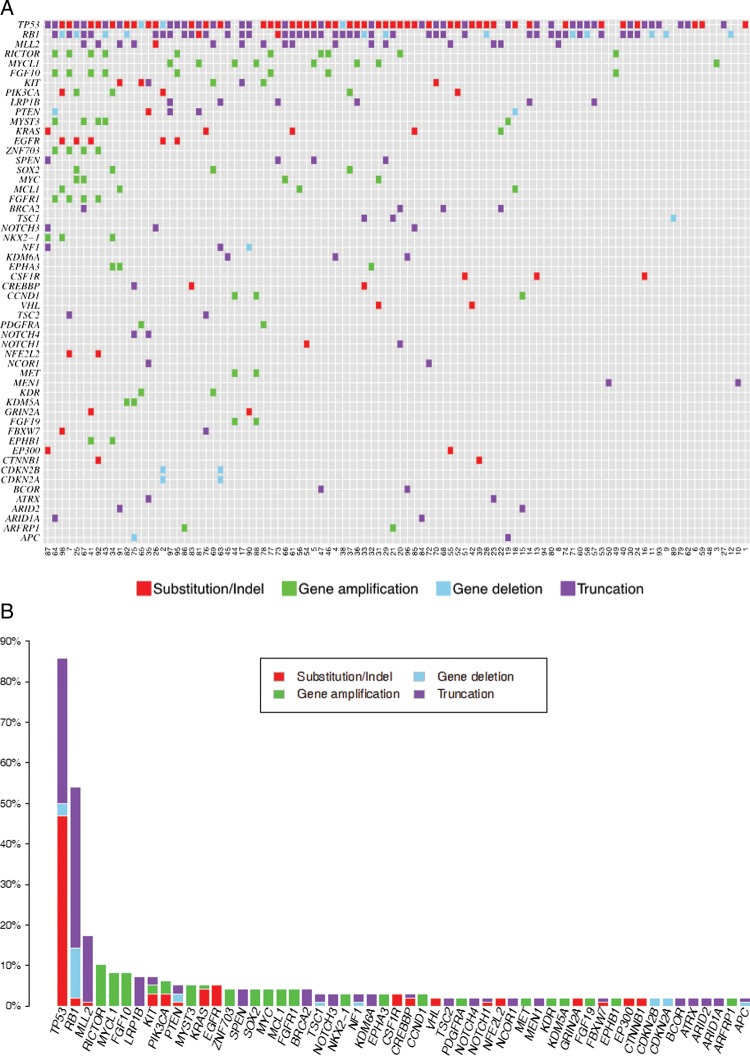
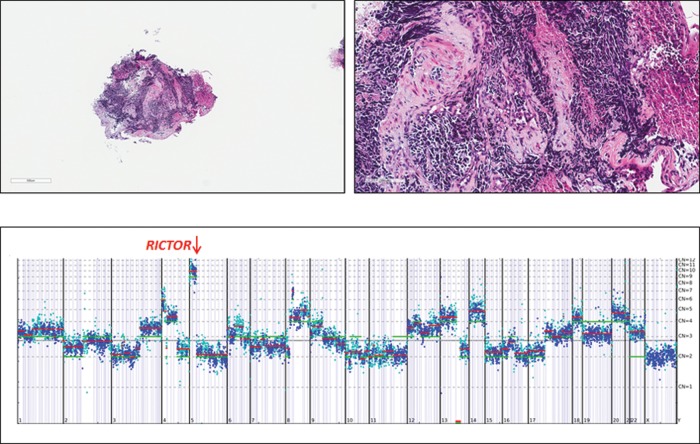
A total of 386 alterations were identified for an average of 3.9 alterations per tumour (range 1–10). Fifty-two (53%) of cases harboured at least 1 actionable alteration with the potential to personalise therapy including base substitutions, amplifications or homozygous deletions in RICTOR (10%), KIT (7%), PIK3CA (6%), EGFR (5%), PTEN (5%), KRAS (5%), MCL1 (4%), FGFR1 (4%), BRCA2, (4%), TSC1 (3%), NF1 (3%), EPHA3 (3%) and CCND1. The most common non-actionable genomic alterations were alterations in TP53 (86% of SCLC cases), RB1 (54%) and MLL2 (17%).
Greater than 50% of the SCLC cases harboured at least one actionable alteration. Given the limited treatment options and poor prognosis of patients with SCLC, comprehensive genomic profiling has the potential to identify new treatment paradigms and meet an unmet clinical need for this disease.
小细胞肺癌(SCLC)预后较差,目前使用的全身治疗效果有限,5年生存率仅约5%,这表明了其疗效不佳。在这项从2013年3月收集样本的回顾性研究中,我们对98例小细胞未分化肺癌(SCLC)样本进行了全面的基因组分析,以确定常规临床实践中尚未探索的潜在治疗靶点。
对98例SCLC的DNA进行测序,以获得高且均匀的覆盖度(Illumina HiSeq 2500),并分析所有类型的基因组改变。
共鉴定出386处改变,平均每个肿瘤有3.9处改变(范围为1 - 10)。52例(53%)病例存在至少1处可用于指导个体化治疗的可操作改变,包括RICTOR(10%)、KIT(7%)、PIK3CA(6%)、EGFR(5%)、PTEN(5%)、KRAS(5%)、MCL1(4%)、FGFR1(4%)、BRCA2(4%)、TSC1(3%)、NF1(3%)、EPHA3(3%)和CCND1中的碱基置换、扩增或纯合缺失。最常见的不可操作基因组改变是TP53(86%的SCLC病例)、RB1(54%)和MLL2(17%)的改变。
超过50%的SCLC病例存在至少一处可操作改变。鉴于SCLC患者的治疗选择有限且预后较差,全面的基因组分析有潜力确定新的治疗模式,满足该疾病尚未满足的临床需求。