Wang Lin, Shi Zhu-Mei, Jiang Cheng-Fei, Liu Xue, Chen Qiu-Dan, Qian Xu, Li Dong-Mei, Ge Xin, Wang Xie-Feng, Liu Ling-Zhi, You Yong-Ping, Liu Ning, Jiang Bing-Hua
State Key Lab of Reproductive Medicine, Department of Pathology, Nanjing Medical University, Nanjing, China. These authors contributed equally to this work.
State Key Lab of Reproductive Medicine, Department of Pathology, Nanjing Medical University, Nanjing, China. Department of Neurosurgery, The First Affiliated Hospital of Nanjing Medical University, Nanjing, China. These authors contributed equally to this work.
Oncotarget. 2014 Jul 30;5(14):5416-27. doi: 10.18632/oncotarget.2116.
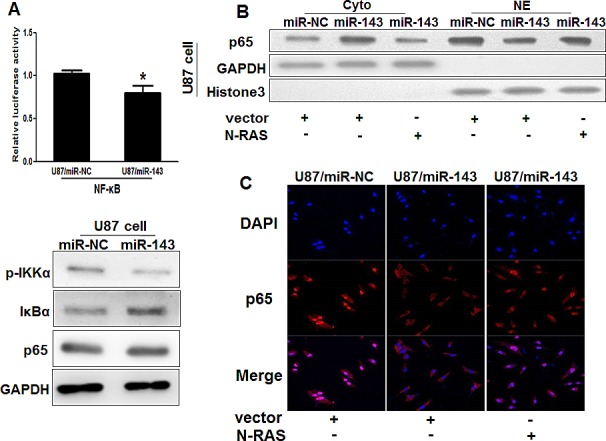
Therapeutic applications of microRNAs (miRNAs) in RAS-driven glioma were valuable, but their specific roles and functions have yet to be fully elucidated. Here, we firstly report that miR-143 directly targets the neuroblastoma RAS viral oncogene homolog (N-RAS) and functions as a tumor-suppressor in glioma. Overexpression of miR-143 decreased the expression of N-RAS, inhibited PI3K/AKT, MAPK/ERK signaling, and attenuated the accumulation of p65 in nucleus of glioma cells. In human clinical specimens, miR-143 was downregulated where an adverse with N-RAS expression was observed. Furthermore, overexpression of miR-143 decreased glioma cell migration, invasion, tube formation and slowed tumor growth and angiogenesis in a manner associated with N-RAS downregulation in vitro and in vivo. Finally, miR-143 also sensitizes glioma cells to temozolomide (TMZ),the first-line drug for glioma treatment. Taken together, for the first time, our results demonstrate that miR-143 plays a significant role in inactivating the RAS signaling pathway through the inhibition of N-RAS, which may provide a novel therapeutic strategy for treatment of glioma and other RAS-driven cancers.
微小RNA(miRNA)在RAS驱动的神经胶质瘤中的治疗应用具有重要价值,但其具体作用和功能尚未完全阐明。在此,我们首次报道miR-143直接靶向神经母细胞瘤RAS病毒癌基因同源物(N-RAS),并在神经胶质瘤中发挥肿瘤抑制作用。miR-143的过表达降低了N-RAS的表达,抑制了PI3K/AKT、MAPK/ERK信号通路,并减弱了胶质瘤细胞核中p65的积累。在人类临床标本中,miR-143表达下调,同时观察到与N-RAS表达呈负相关。此外,miR-143的过表达在体外和体内以与N-RAS下调相关的方式降低了胶质瘤细胞的迁移、侵袭、血管生成,并减缓了肿瘤生长和血管生成。最后,miR-143还使胶质瘤细胞对替莫唑胺(TMZ)(胶质瘤治疗的一线药物)敏感。综上所述,我们的结果首次证明miR-143通过抑制N-RAS在失活RAS信号通路中发挥重要作用,这可能为治疗神经胶质瘤和其他RAS驱动的癌症提供一种新的治疗策略。