
根治性前列腺切除术后尿道直肠瘘的治疗——两种手术技术
Treatment of urethrorectal fistulas caused by radical prostatectomy - two surgical techniques.
作者信息
Polom Wojciech, Krajka Kazimierz, Fudalewski Tomasz, Matuszewski Marcin
机构信息
Department of Urology, Medical University of Gdańsk, Gdańsk, Poland.
Karol Marcinkowski University of Medical Sciences, Św. Marii Magdaleny, Poznań, Poland.
出版信息
Cent European J Urol. 2014;67(1):93-7. doi: 10.5173/ceju.2014.01.art21. Epub 2014 Apr 17.
INTRODUCTION
The repair of complex urethrorectal fistulas, which can be the result of treating prostate cancer with radical prostatectomy, is a big problem in urology and its final result is not always satisfactory. There are no universally accepted methods for repairing such fistulas. In our work we present a retrospective analysis of patients treated for urethrorectal fistulas after previous radical prostatectomy. The methods used were the initial excision and suture of the fistula, or a gracilis muscle flap interposition.
MATERIAL AND METHODS
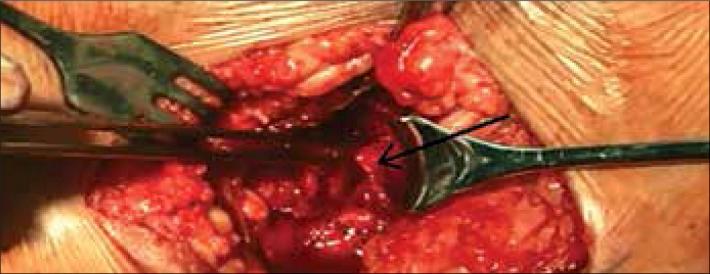
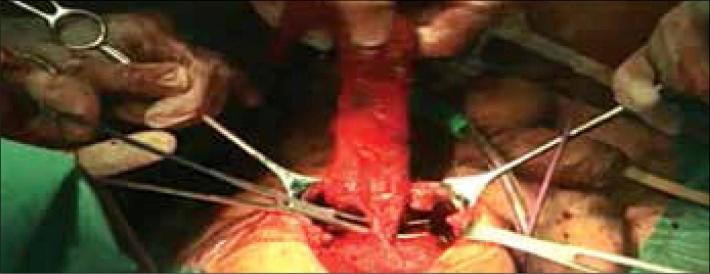
In the years 2000-2012, four patients were treated because of urethrorectal fistulas after radical prostatectomy. In two patients, open radical prostatectomy had been performed. Two other patients had been operated laparoscopically. Two patients had a primary fistula repair. They were operated using anterior perineal access. Two others were treated with the use of a gracilis muscle flap.
RESULTS
During the follow up, there was no recurrence of fistulas. Medium follow up for the first two patients was 120 and 156 months, and follow up of two other patients was 16 and 23 months. Until now, there were no final postoperative complications.
CONCLUSIONS
Repair of the fistulas requires an individual approach to each case. Excision and suturing of the fistula gives a very good final result, especially when the primary reconstruction is performed. Repair of urethrorectal fistula using a gracilis muscle flap appears to be an excellent option in cases of complex recurrent fistulas. It is also associated with low morbidity in patients and a high success rate.
引言
复杂尿道直肠瘘的修复是泌尿外科的一大难题,它可能是根治性前列腺切除治疗前列腺癌的结果,其最终效果并不总是令人满意。目前尚无普遍接受的修复此类瘘管的方法。在我们的研究中,我们对既往根治性前列腺切除术后尿道直肠瘘患者进行了回顾性分析。所采用的方法为瘘管的初次切除缝合或股薄肌瓣置入。
材料与方法
2000年至2012年间,4例患者因根治性前列腺切除术后尿道直肠瘘接受治疗。其中2例患者接受了开放性根治性前列腺切除术。另外2例患者接受了腹腔镜手术。2例患者进行了一期瘘管修复。他们采用经会阴前路手术。另外2例患者采用股薄肌瓣治疗。
结果
随访期间,瘘管无复发。前2例患者的平均随访时间为120个月和156个月,另外2例患者的随访时间为16个月和23个月。目前尚无术后最终并发症。
结论
瘘管修复需要针对每个病例采取个体化方法。瘘管的切除缝合可取得非常好的最终效果,尤其是进行一期重建时。对于复杂复发性瘘管,采用股薄肌瓣修复尿道直肠瘘似乎是一个极佳的选择。它还具有患者发病率低、成功率高的特点。




 Zotero 插件