Feigenberg Tomer, Clarke Blaise, Virtanen Carl, Plotkin Anna, Letarte Michelle, Rosen Barry, Bernardini Marcus Q, Kollara Alexandra, Brown Theodore J, Murphy K Joan
Division of Gynaecologic Oncology, Department of Obstetrics and Gynaecology, University of Toronto, Toronto, ON, Canada M5G 2M9 ; Department of Obstetrics and Gynaecology, Trillium Health Partners, 2200 Eglinton Avenue West, Mississauga, ON, Canada L5M 2N1.
Department of Laboratory Medicine and Pathology, University of Toronto, Toronto, ON, Canada M5G 2M9 ; Department of Laboratory Medicine and Pathology, University Health Network, Toronto, ON, Canada M5T 2M9.
Biomed Res Int. 2014;2014:367103. doi: 10.1155/2014/367103. Epub 2014 May 25.
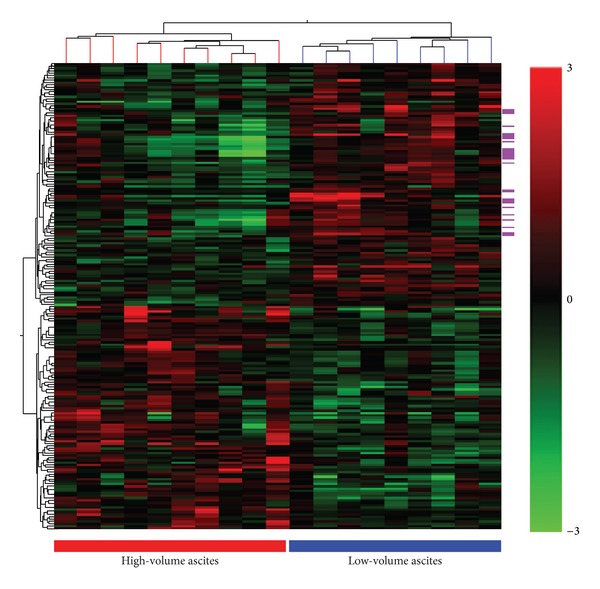
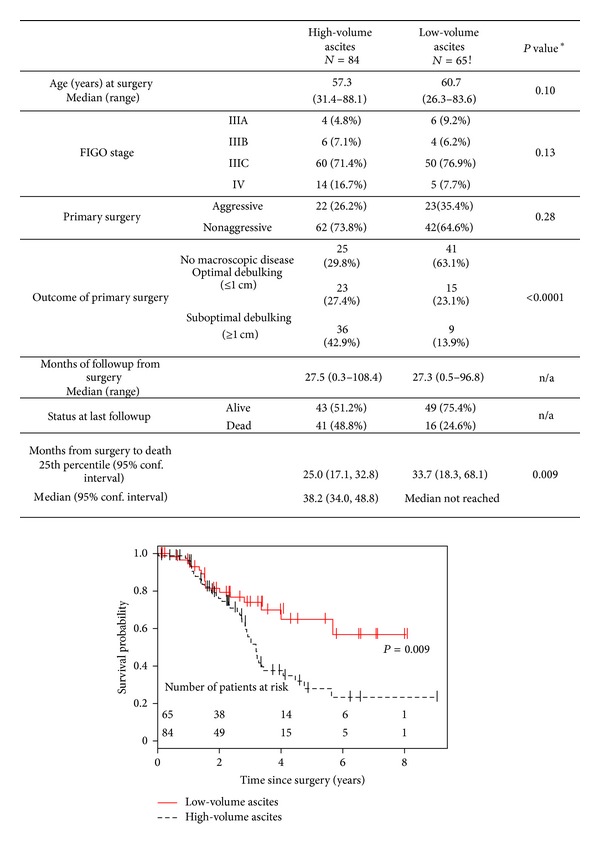
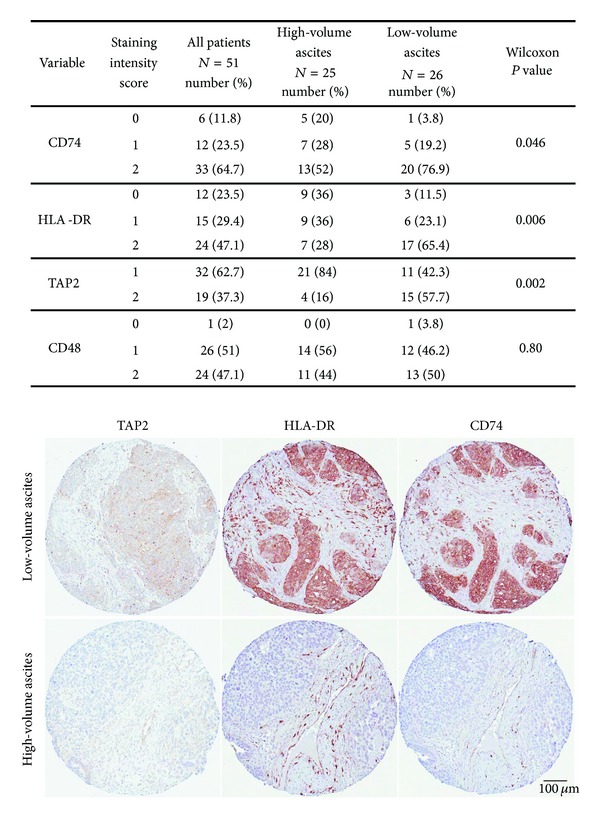
Epithelial ovarian cancer consists of multiple histotypes differing in etiology and clinical course. The most prevalent histotype is high-grade serous ovarian cancer (HGSOC), which often presents at an advanced stage frequently accompanied with high-volume ascites. While some studies suggest that ascites is associated with poor clinical outcome, most reports have not differentiated between histological subtypes or tumor grade. We compared genome-wide gene expression profiles from a discovery cohort of ten patients diagnosed with stages III-IV HGSOC with high-volume ascites and nine patients with low-volume ascites. An upregulation of immune response genes was detected in tumors from patients presenting with low-volume ascites relative to those with high-volume ascites. Immunohistochemical studies performed on tissue microarrays confirmed higher expression of proteins encoded by immune response genes and increased tumorinfiltrating cells in tumors associated with low-volume ascites. Comparison of 149 advanced-stage HGSOC cases with differential ascites volume at time of primary surgery indicated low-volume ascites correlated with better surgical outcome and longer overall survival. These findings suggest that advanced stage HGSOC presenting with low-volume ascites reflects a unique subgroup of HGSOC, which is associated with upregulation of immune related genes, more abundant tumor infiltrating cells and better clinical outcomes.
上皮性卵巢癌由多种组织学类型组成,其病因和临床过程各不相同。最常见的组织学类型是高级别浆液性卵巢癌(HGSOC),这种癌症通常在晚期出现,常伴有大量腹水。虽然一些研究表明腹水与不良临床结局相关,但大多数报告并未区分组织学亚型或肿瘤分级。我们比较了一个发现队列中10例诊断为III-IV期伴有大量腹水的HGSOC患者和9例伴有少量腹水患者的全基因组基因表达谱。相对于大量腹水患者,少量腹水患者肿瘤中检测到免疫反应基因上调。在组织微阵列上进行的免疫组化研究证实,免疫反应基因编码的蛋白质在与少量腹水相关的肿瘤中表达更高,且肿瘤浸润细胞增多。对149例初次手术时腹水体积不同的晚期HGSOC病例进行比较,结果表明少量腹水与更好的手术结局和更长的总生存期相关。这些发现表明,伴有少量腹水的晚期HGSOC反映了HGSOC的一个独特亚组,与免疫相关基因上调、肿瘤浸润细胞更丰富及更好的临床结局相关。